
Our Short List of 3
All 4 Picks at a Glance
| Product | Specs | Action |
|---|---|---|
 Canon imageCLASS LBP122dw — the compact print-only pick | Check price on Amazon | |
 Canon imageCLASS MF465dw — the all-in-one for document bursts | Check price on Amazon | |
 HP Color LaserJet Pro 3201dw — color documents, print only | Check price on Amazon | |
 Brother MFC-L3780CDW — the color all-in-one that can wait | Check price on Amazon |
Key takeaways
- Four laser and LED printers for infrequent use, each picked because the maker documents dry toner technology with no liquid ink to dry out between jobs.
As an Amazon Associate, we earn from qualifying purchases made through links on this page.
Some homes print in bursts. A boarding pass in March, a tax form in April, a school project in October, then nothing for weeks. That pattern is gentle on paper and electricity, but it is the hardest pattern there is on a cartridge inkjet printer. Liquid ink waits inside nozzles finer than a hair, the water in it slowly evaporates, and the first job after a quiet month can come out streaked or blank until cleaning cycles push fresh ink through. Inkjet makers document those cleaning cycles in their own manuals, and each cycle spends ink you bought for printing.
This guide takes a stricter route, and the rule is stated here so you can judge the picks against it. Every model below is a laser or LED printer, verified on the maker’s own specification sheet. Laser and LED machines print with toner, a dry powder that is fused to the page by heat. There is no liquid stage while the machine sits idle, no nozzle to clog, and no cleaning cycle burning supplies between jobs. Cartridge inkjets were excluded entirely. Refillable tank inkjets were considered and also left out: the ink in a tank machine is still liquid, it still parks in a fixed print head, and the makers of tank printers document head cleaning utilities rather than any mechanism that preserves the head during long idle stretches. If your printing is light but regular, a tank model can still make sense; if your printer sleeps for a month at a time, the documented technology that tolerates that sleep is toner.
One scope note before the picks. These are document printers. The two color models handle charts, schoolwork and simple graphics on plain paper, and none of the four is a photo printer for glossy paper. What they are built for is the occasional, unglamorous, must-work-today job: the form, the label, the contract, the homework page.
What to look for in a printer for infrequent use
Print technology comes first
The single decision that decides whether a printer tolerates idle time is how it puts marks on paper. Toner is a fine dry powder sealed inside a cartridge. It does not evaporate, it does not thicken, and it only becomes liquid for a fraction of a second inside the fuser while a page is printing. Liquid ink systems, cartridge and tank alike, keep fluid in the print head at all times, which is why their manuals carry nozzle check and head cleaning procedures. LED printers, including the Brother model below, belong to the same toner family: an LED array replaces the laser beam, but the consumable is still dry toner powder.
Match toner yield to a light volume
Yield figures on a maker’s specification sheet tell you how far one cartridge goes, and for a light user the arithmetic is generous. At twenty pages a month, a cartridge rated at 1,200 pages covers about five years of printing, and a 3,000-page cartridge covers more than a decade. That flips the usual buying logic. High yield matters less here than it does in a busy office, and the cartridge in the box may carry a light household for years. Check the yield of both the regular and the high yield cartridge for any model you shortlist, and remember that color machines carry four cartridges, each aging on its own schedule of use rather than on a calendar.
Wake behavior and the first page
A printer that sleeps for weeks should wake, print one page, and go back to sleep without ceremony. Look for a documented first-page-out time in the seconds range, automatic sleep or deep sleep modes on the spec sheet, and low sleep power draw, since a machine that sits plugged in all year spends nearly all of that year asleep. Duplex printing, the automatic two-sided kind, is worth having even at low volume, because the jobs light users do print tend to be long documents: leases, manuals, tax records.
Functions you will actually use twice a year
Print-only models are smaller, simpler and have fewer parts waiting to go wrong. An all-in-one adds a scanner and copier, which for an infrequent printer usually means digitizing a document now and then rather than daily scanning. If that is your pattern, a feeder that scans both sides of a stack in one pass saves real time on the two or three days a year you need it. If you never scan, skip the all-in-one and take the smaller footprint.
Paper handling for a machine that waits
Paper sitting in an open tray for a month collects dust and absorbs room moisture, and damp paper is the most common cause of jams in a machine that prints rarely. A closed cassette tray shelters the stack better than an open rear feed. Whatever you choose, keep the spare ream in its wrapper until you load it, and fan and reload the stack if the machine has been sitting through a humid season.
Connections that survive router changes
Dual-band Wi-Fi is worth having because a printer reconnected once and forgotten should stay forgotten. Ethernet is the most set-and-forget option of all where a cable can reach. AirPrint and Mopria support, both documented on every model below, let phones print without a maker account or a companion app account standing in the way.
The picks
Canon imageCLASS LBP122dw — the compact print-only pick
The LBP122dw is the smallest commitment on this page: a monochrome laser that only prints, in a body sized for a corner of a desk. Canon documents print speeds of up to 30 pages per minute, automatic two-sided printing, a 150-sheet paper tray, and Wi-Fi, Ethernet and USB connections, with AirPrint and Mopria for phone printing. It runs on Canon’s Toner 071 cartridge, rated by Canon at roughly 1,200 pages, with a 071 H high yield option at roughly 2,500 pages. At the pace of a light household, the regular cartridge alone is measured in years, and the sealed toner inside it is dry powder for every one of those years.
This is the pick for one person printing documents: letters, forms, returns labels, the odd boarding pass. The five-line LCD panel is basic but enough for a machine you interact with monthly.
Limitations follow from the spec sheet. There is no scanner or copier at all, output is black and white only, and the 150-sheet tray is the smallest here, which matters if your rare jobs are long ones. Canon’s cartridge platform for this model is a combined toner and drum unit, convenient to swap, but it means the drum is replaced with every cartridge whether it needs it or not.
Canon imageCLASS MF465dw — the all-in-one for document bursts
The MF465dw is the same dry-toner logic scaled up for a home office that prints in heavy bursts separated by quiet weeks. Canon documents up to 42 pages per minute, a 250-sheet cassette plus a 100-sheet multipurpose tray, and an optional extra cassette for households that load a full ream at once. The 50-sheet document feeder scans both sides of a stack in a single pass, at speeds Canon rates up to 100 images per minute in black and white, which turns the twice-a-year archive-the-paperwork session into a short job. Print, scan, copy and fax are all built in, driven from a five-inch color touchscreen, with Wi-Fi, Ethernet and USB connections.
Its toner platform is the strongest fit for infrequent use in this guide. Canon’s Toner 070 is rated at roughly 3,000 pages and the 070 H at roughly 10,200 pages. Fit the high yield cartridge and a light user may replace toner twice in the machine’s working life, with the powder sealed and dry in between.
Limitations are size and focus. This is an office-shaped machine that takes real desk space, it prints in black and white only, and you are paying for fax hardware and workgroup features a small household may never touch. If your bursts are a few pages rather than a few hundred, the smaller Canon above covers the same ground.
HP Color LaserJet Pro 3201dw — color documents, print only
When the occasional job genuinely needs color — a chart for a meeting, a school project, a flyer for a local group — the 3201dw adds color without giving up the toner advantage. HP documents color and monochrome speeds of up to 26 pages per minute on letter paper, automatic two-sided printing, a 250-sheet tray, and Wi-Fi, Ethernet and USB connections in one of the smaller color laser bodies HP makes. It uses HP 218A toner cartridges, with 218X high yield versions, and HP’s data sheet rates the cartridges in the box at roughly 600 pages in black and 500 pages in each color, a fair match for light color volume.
This is the pick for a household that prints rarely but prints in color when it counts, and does its scanning with a phone camera instead of a flatbed.
Limitations are clear on the spec sheet. It is print-only, so there is no scanner or copier. Four cartridges mean four eventual replacements, and color toner sets cost more than a single black cartridge when the day finally comes. HP also documents that this printer uses dynamic security measures and is intended to work with cartridges carrying HP chips, so bargain refill cartridges of unknown origin may be refused by the machine; plan on genuine HP toner or reputable remanufactured cartridges built for this platform.
Brother MFC-L3780CDW — the color all-in-one that can wait
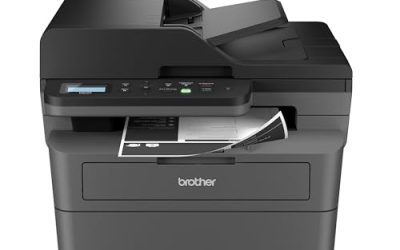
The MFC-L3780CDW is Brother’s digital color all-in-one, built on LED technology with toner cartridges from Brother’s TN-229 family. Brother documents print speeds of up to 31 pages per minute in both color and black and white, two-sided printing, and single-pass two-sided scanning and copying through a 50-sheet document feeder. Paper handling is the most flexible here: a 250-sheet tray plus a 30-sheet multipurpose tray for envelopes and heavier sheets, with an optional second tray. Connections run to dual-band Wi-Fi, Gigabit Ethernet and USB, the touchscreen is a 3.5-inch color panel, and NFC card authentication is built in for offices that want it.
For the infrequent user, the draw is having everything in one machine that does not punish you for ignoring it: color printing, proper scanning, copying, all fed by four sealed toner cartridges that sit dormant without drying. Brother lists standard and high yield TN-229 cartridges, so a light household can run the standard set for a long stretch before any replacement is due.
Limitations are footprint and appetite. It is the largest machine in this guide, and four toner cartridges plus a drum unit and belt unit on the parts list make its long-term consumable picture more involved than the monochrome Canons. Its color is tuned for documents and graphics on plain paper, not for photo output.
Comparison table
| Model | Technology | Output | Functions | Top speed | Paper input | Toner platform |
|---|---|---|---|---|---|---|
| Canon imageCLASS LBP122dw | Laser | Monochrome | 30 ppm | 150 sheets | Canon Toner 071 / 071 H | |
| Canon imageCLASS MF465dw | Laser | Monochrome | Print, scan, copy, fax | 42 ppm | 250 + 100 sheets | Canon Toner 070 / 070 H |
| HP Color LaserJet Pro 3201dw | Laser | Color | 26 ppm | 250 sheets | HP 218A / 218X | |
| Brother MFC-L3780CDW | LED | Color | Print, scan, copy, fax | 31 ppm | 250 + 30 sheets | Brother TN-229 family |
Frequently asked questions
Does toner really stay good while a printer sits unused?
Toner leaves the factory as a dry powder and stays that way inside a sealed cartridge; there is no water in it to evaporate and no liquid to thicken. The powder only melts for a moment inside the fuser during printing. Printer manuals describe one idle-related chore: if a first print after a long rest looks faint, remove the cartridge and rock it gently side to side to redistribute powder that has settled, then put it back. That is the whole maintenance ritual, and it spends nothing.
Why is there no inkjet or tank printer in this guide?
Because the hard condition was maker-documented idle tolerance, and liquid ink is the thing that fails during idle time. Tank printers cut the cost of ink dramatically and suit light but steady printing well. Their ink, though, still waits as a liquid in a fixed print head, and their makers document cleaning and flushing procedures for exactly the clogging pattern this guide is trying to avoid. No tank maker publishes a head preservation mechanism for month-long idle stretches, so no tank model met the condition.
How long can a laser printer sit between jobs?
The makers of these four models publish no maximum idle time, and the toner itself is not the limiting factor. The practical limits are the paper and the room: paper that absorbs moisture can feed badly, and dust settles on any machine left open. Keep the tray loaded with dry paper, keep spare paper wrapped, and close covers and trays. Given that, a gap of months between jobs is unremarkable for a toner machine.
Can these printers handle the odd photo?
They print color documents, charts and simple graphics on plain and matte paper, and the two color models do that job well. Glossy photo paper made for inkjets is outside their documented media path, and a laser fuser runs hot enough that the wrong coated stock is a genuine problem rather than a quality quibble. For a handful of photos a year, these machines are the wrong tool; for color documents, they are the right one.
Should a light user choose monochrome or color?
Count the cartridges. A monochrome machine carries one cartridge that a light user might replace every few years. A color machine carries four, and the color ones age by use just as the black one does. If your printing is forms, letters and documents, monochrome is the simpler ownership story. Choose color only when color pages are a real, recurring part of your light volume, as they are for school projects and charts.
Conclusion
Infrequent use punishes liquid ink and forgives dry toner, so this guide is built entirely on laser and LED machines whose makers document toner technology on the spec sheet. Take the Canon LBP122dw for the smallest desk and the simplest job list. Take the Canon MF465dw when the quiet weeks end in document bursts and scanning sessions. Take the HP 3201dw for color documents without a scanner, and the Brother MFC-L3780CDW when one machine must do color, scanning and copying while asking nothing of you in between. Any of the four will sit through a silent month and print the next page like the last one.
More from Amazon
Programs that pair well with the guide above. Offers and eligibility are set by Amazon and may change.
Free shipping on eligible items, Prime Video and more. Eligible new members can start with a free trial.
Start a Prime free trialAd-free music streaming. Eligible new subscribers can start with a free trial.
Try Music Unlimited freeA Prime membership for ages 18-24 with a trial period. Eligibility is set by Amazon.
See Prime for Young AdultsAudiobooks and podcasts to listen to on the go. Eligible new members can start with a free trial.
Try Audible freeAs an Amazon Associate we earn from qualifying purchases.
Write Your Review
No reviews yet. Be the first to share your experience!