
Our Short List of 3

- Product link: Pentax 17 on Amazon
- Format: 35mm half-frame, 17x24mm frames, up to 72 shots per 36-exposure roll
- Lens: HD PENTAX 25mm f/3.5, about 37mm in full-frame terms
- Focus: zone focus, six distance zones from 0.25m to infinity

- Product link: Ilford Sprite 35-II on Amazon
- Format: 35mm full-frame, 24x36mm
- Lens: 31mm f/9, single element
- Focus: focus free, 1m to infinity

- Product link: Kodak M35 on Amazon
- Format: 35mm full-frame, 24x36mm
- Lens: 31mm fixed-focus
- Focus: focus free, from about 1m
All 5 Picks at a Glance
| Product | Specs | Action |
|---|---|---|
| 1. Pentax 17 |
| Check price on Amazon |
| 2. Ilford Sprite 35-II |
| Check price on Amazon |
| 3. Kodak M35 |
| Check price on Amazon |
 4. Kodak Ultra F9 |
| Check price on Amazon |
 5. RETO Ultra Wide and Slim |
| Check price on Amazon |
Key takeaways
- Compare five reusable 35mm film cameras made for beginners, from the zone-focus Pentax 17 to fixed-focus models with built-in flash and simple loading.
As an Amazon Associate, we earn from qualifying purchases made through links on this page.
A first film camera should make the early rolls easy to finish. The routine is new enough on its own: load a cassette, wind between frames, rewind at the end, and hand the roll to a lab. A beginner does not need a camera that adds focusing puzzles or exposure homework on top of that routine, and none of the five cameras below asks for either. Every pick is a reusable 35mm camera in current production, built around standard 135 roll film that any lab can process and scan.
The scope here is narrow on purpose. These are roll-film cameras only. Instant cameras print onto their own film packs, and single-use cameras are thrown away after one roll, so both sit outside a 35mm list. Older used classics can be lovely machines, but light seals, meters and shutters vary from one copy to the next, and a beginner has no easy way to judge condition. Each camera below is sold new with current maker documentation behind it, which keeps the learning curve pointed at photography rather than repairs.
Four of the five are fixed-focus point-and-shoot models: aim, press, wind on. The fifth, the Pentax 17, adds zone focusing and automatic exposure for a learner who wants room to grow. Two frame sizes appear in the list. Full-frame models expose the whole 24x36mm frame, while the half-frame Pentax exposes a 17x24mm frame and doubles the number of shots on every roll.
Our top picks
What to look for in a first 35mm camera
Frame size. A full-frame 35mm camera records one 24x36mm image per shot, so a 36-exposure roll holds 36 photos. A half-frame camera splits that space in two and records vertical 17x24mm frames, so the same roll holds up to 72 photos. Half-frame stretches a film budget further and suits vertical sharing, but each negative is smaller, so grain shows sooner in large prints.
Focusing. Most beginner cameras are focus free: the lens is set so subjects from about one metre away to the horizon stay acceptably sharp in decent light. Nothing needs adjusting, and nothing can be set wrong. Zone focusing, found on the Pentax 17, asks the shooter to pick one of several distance bands before each shot. It takes a little practice and rewards it with sharper close-ups and better results in dim light.
Flash. Film handles dim rooms less gracefully than a phone, and indoor snapshots are where beginners shoot most. A built-in flash covers parties, cafes and evening gatherings. Four picks here have one. The RETO Ultra Wide and Slim has no flash at all and is honestly a daylight camera, which is fine as long as that limit is understood before the first indoor roll.
Batteries. Three picks run their flash on a single AAA cell, the Pentax 17 uses one CR2 cell for its meter and flash, and the RETO needs no battery of any kind. A camera that takes a common cell is simpler to keep ready, because a flat battery only ever blocks the flash and meter, never the winding.
Film choice. Every camera here accepts any standard 135 cassette, colour negative or black-and-white. An ISO 400 colour negative roll is the forgiving first choice: it copes with shade, bright sun and flash, and labs handle it everywhere. The fixed-exposure models are happiest with film in the ISO 200 to 400 range, while the Pentax 17 reads a manual ISO dial from 50 to 3200 and meters for whatever is loaded.
Loading and winding. All five use manual film advance, either a thumbwheel or a lever, and a manual rewind at the end of the roll. A clear frame counter matters more than it sounds, because it is the only way to know how much of the roll remains.
1. Pentax 17
- Product link: Pentax 17 on Amazon
- Format: 35mm half-frame, 17x24mm frames, up to 72 shots per 36-exposure roll
- Lens: HD PENTAX 25mm f/3.5, about 37mm in full-frame terms
- Focus: zone focus, six distance zones from 0.25m to infinity
The Pentax 17 is the one camera in this list that teaches while it shoots. Built by Ricoh Imaging and released in 2024, it is a half-frame camera with a proper exposure system: program automatic metering does the everyday work, a mode dial adds a full-auto setting, a wide-open aperture setting for dim scenes and a slow-shutter setting, and an exposure compensation dial lets the shooter brighten or darken a frame by up to two stops. Focusing is manual but simple, with six zone markings running from a 0.25 metre close-up zone out to infinity, chosen on the lens ring before each shot.
Who it suits. Beginners who expect to shoot film for more than a few rolls and want a camera that grows with them. The doubled frame count keeps the cost per photo low while skills build, the vertical frames suit phone-shaped sharing, and zone focusing is a gentle introduction to judging distance.
Limits to know. The half-frame negative is half the size, so big enlargements show grain sooner than full-frame shots. Zone focusing punishes a forgotten setting: leave the ring on the close-up zone and a landscape goes soft. The CR2 cell is less common in household drawers than an AAA, and this is the most complex camera here by a wide margin.
2. Ilford Sprite 35-II
- Product link: Ilford Sprite 35-II on Amazon
- Format: 35mm full-frame, 24x36mm
- Lens: 31mm f/9, single element
- Focus: focus free, 1m to infinity
The Sprite 35-II comes from Ilford, a name long tied to black-and-white film, and it follows the simplest pattern in this list. The lens is a single-element 31mm f/9 fixed-focus unit behind a fixed 1/120 second shutter, so exposure needs no thought at all: load film, wind the lever, press the button. A built-in flash with a recycle time of about 15 seconds handles indoor frames, and Ilford publishes guidance for film speeds from ISO 200 to 800, which covers the colour and monochrome rolls a beginner is likely to buy.
Who it suits. First-time shooters who want the plainest possible routine and a camera light enough to live in a jacket pocket. It is also a natural match for someone curious about black-and-white film, since the maker publishes its own monochrome loading guidance.
Limits to know. A single-element lens is soft toward the edges of the frame, and the fixed exposure has no answer for dim rooms beyond the flash, which reaches only a few metres. Ilford describes the Sprite 35-II plainly as an entry-level plastic camera that is not designed to be repaired, so it should be bought as a light, simple tool rather than a lifetime instrument.
3. Kodak M35
- Product link: Kodak M35 on Amazon
- Format: 35mm full-frame, 24x36mm
- Lens: 31mm fixed-focus
- Focus: focus free, from about 1m
The M35 is Kodak’s reusable answer to the disposable camera: the same load-and-shoot shape, but the back opens and a fresh roll goes in when the old one finishes. The 31mm fixed-focus lens, optical viewfinder and built-in flash need no settings, and the winding thumbwheel and frame counter are the only moving parts a beginner touches. It is sold in a wide range of colours and runs its flash on one AAA cell.
Who it suits. Casual snapshot shooters: parties, holidays, festivals and everyday carry where the camera must never slow anyone down. Anyone moving up from single-use cameras gets a familiar shape with none of the waste.
Limits to know. Exposure is fixed and tuned for daylight plus flash range, so dim scenes without flash come back dark and grainy. There are no film speed settings to lean on, which makes ISO 400 film the sensible default load. The plastic lens gives a soft, lo-fi rendering that fans enjoy and pixel-counters will not.
4. Kodak Ultra F9
- Product link: Kodak Ultra F9 on Amazon
- Format: 35mm full-frame, 24x36mm
- Lens: 31mm f/9
- Focus: focus free, 1m to infinity
The Ultra F9 is Kodak’s second reusable design, a slightly larger body with retro styling and the same beginner brief. Its 31mm f/9 lens is focus free from one metre, the flash is built in, and one AAA cell powers it. At about 170g it has a little more substance in the hand than the M35, and the maker rates it for ISO 200 and 400 film, which matches the rolls most beginners buy first.
Who it suits. Beginners who like the M35 idea but want a body that fills the hand a bit more and a retro look they will enjoy carrying. The guidance is identical, so the choice between the two Kodaks is mostly about feel and colour.
Limits to know. The exposure ceiling is the same fixed one as the M35: bright daylight and flash-lit rooms are home ground, and everything dimmer is a gamble. Focus is fixed, so subjects closer than about a metre soften. Nothing on the camera adjusts, which is the point, and also the limit.
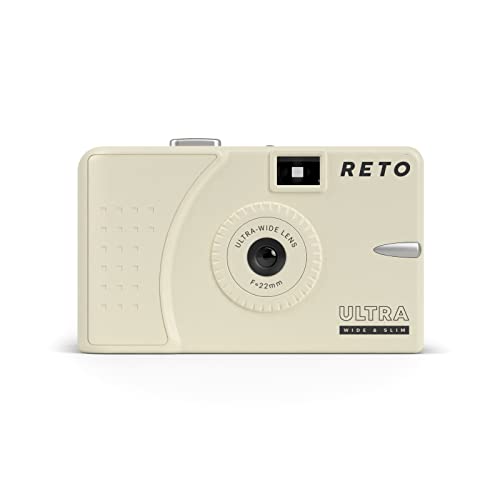
5. RETO Ultra Wide and Slim
- Product link: RETO Ultra Wide and Slim on Amazon
- Format: 35mm full-frame, 24x36mm
- Lens: 22mm f/11, two-element acrylic
- Focus: focus free, 1m to infinity
The RETO Ultra Wide and Slim does one thing none of the others attempt: a 22mm ultra-wide lens that swallows whole streets, squares and coastlines in a single frame. It is fully mechanical, with a 1/125 second shutter, no flash, no meter and no battery, in a body weighing 68.8g and measuring 100x59x28mm. The two-element acrylic lens is focus free from one metre, and the whole camera is thinner than most phones.
Who it suits. Daylight travellers and street shooters who want the widest possible view from a camera that disappears into a pocket and never needs a battery. Landscapes, architecture and crowded markets are its natural subjects.
Limits to know. The daylight label is literal. With an f/11 lens, a fixed shutter and no flash, indoor and evening frames come back underexposed unless very fast film is loaded, and even then the margin is thin. The ultra-wide view also bends straight lines near the edges, which flatters buildings and distorts faces placed at the frame corners.
Comparison table
| Camera | Format | Lens | Focus | Flash | Battery | Weight |
|---|---|---|---|---|---|---|
| Pentax 17 | Half-frame 17x24mm | 25mm f/3.5 | Zone focus, 6 zones | Built-in | 1x CR2 | about 290g |
| Ilford Sprite 35-II | Full-frame 24x36mm | 31mm f/9 | Focus free | Built-in | 1x AAA | 122g |
| Kodak M35 | Full-frame 24x36mm | 31mm fixed-focus | Focus free | Built-in | 1x AAA | not listed by maker |
| Kodak Ultra F9 | Full-frame 24x36mm | 31mm f/9 | Focus free | Built-in | 1x AAA | about 170g |
| RETO Ultra Wide and Slim | Full-frame 24x36mm | 22mm f/11 | Focus free | None | None | 68.8g |
FAQ
How many photos fit on one roll of 35mm film?
Full-frame cameras in this list record 24 or 36 photos per roll, matching the cassette. The half-frame Pentax 17 records two vertical frames in the same space, so a 36-exposure roll holds up to 72 photos.
Which film should a beginner load first?
An ISO 400 colour negative roll is the safest first load. It tolerates bright sun, shade and flash in one roll, every lab processes it, and the fixed-exposure cameras here are tuned around that speed range.
Do these cameras need batteries?
Four of the five use a small cell: a single AAA powers the flash in the Ilford and both Kodaks, and a CR2 runs the meter and flash in the Pentax 17. The RETO Ultra Wide and Slim is fully mechanical and needs no battery at all. A flat battery never stops the film winding; it only disables the flash and, on the Pentax, the metering.
Can these cameras shoot black-and-white film?
Yes. Every pick accepts any standard 135 cassette, and black-and-white rolls from makers such as Ilford load and wind exactly like colour film. Processing goes through the same labs, and many beginners find monochrome more forgiving while they learn exposure habits.
Where do finished rolls get developed?
Local photo labs and mail-in labs both handle 35mm rolls and typically return negatives with digital scans. A beginner only needs to rewind the roll fully into its cassette before opening the camera back, then hand the cassette over.
Conclusion
For most beginners, the choice splits by ambition. The Ilford Sprite 35-II, Kodak M35 and Kodak Ultra F9 give the simplest possible path from box to finished roll: fixed focus, fixed exposure, a flash for indoor frames and one AAA cell. The RETO Ultra Wide and Slim trades the flash away for the widest lens and the lightest body, and earns its place on bright trips. The Pentax 17 stands apart as the camera for a beginner who wants to keep learning, with zone focusing, automatic exposure, compensation control and twice the frames on every roll. Any of the five loads the same film and teaches the same core habit, which is slowing down and choosing each frame on purpose.
More from Amazon
Programs that pair well with the guide above. Offers and eligibility are set by Amazon and may change.
Free shipping on eligible items, Prime Video and more. Eligible new members can start with a free trial.
Start a Prime free trialAd-free music streaming. Eligible new subscribers can start with a free trial.
Try Music Unlimited freeA Prime membership for ages 18-24 with a trial period. Eligibility is set by Amazon.
See Prime for Young AdultsAudiobooks and podcasts to listen to on the go. Eligible new members can start with a free trial.
Try Audible freeAs an Amazon Associate we earn from qualifying purchases.

Write Your Review
No reviews yet. Be the first to share your experience!