

Key takeaways
- DLSS 4 with Multi Frame Generation: can insert up to three generated frames between each rendered frame on RTX 50 cards, which is why Nvidia’s launch charts showed such large frame-rate multiples.
- Neural rendering and updated media engines: Blackwell added support for 4:2:2 video formats and improved encoding hardware aimed at creators.
The GeForce RTX 5090 went on sale on January 30, 2025, after Nvidia unveiled it at CES on January 6, 2025. It launched alongside the RTX 5080 as the flagship of the Blackwell-based RTX 50 series, with 32GB of GDDR7 memory, 21,760 CUDA cores and a 575W power rating. Almost two years on, the date matters less than the question that follows it: can you still actually get one in late 2026?
Our top picks



As an Amazon Associate we earn from qualifying purchases at no extra cost to you.
RTX 5090 Release Timeline at a Glance
The launch played out in three distinct steps: announcement, independent reviews, and retail availability. Knowing which date belongs to which step clears up most of the confusion in forum threads, where people quote “release date” for all three.
| Milestone | Date | What happened |
|---|---|---|
| Announcement | January 6, 2025 | Nvidia revealed the RTX 50 series in its CES keynote, including the RTX 5090, 5080, 5070 Ti and 5070 |
| Review embargo lifted | January 23, 2025 | Independent reviews of the Founders Edition and partner cards went public |
| RTX 5090 and 5080 on sale | January 30, 2025 | Founders Edition and board-partner models went live at retailers worldwide |
| RTX 5070 Ti and 5070 | February and March 2025 | The next tier down followed within weeks |
| RTX 5060 Ti and 5060 | April and May 2025 | The mainstream cards completed the desktop stack |
The January 30 date applies to the RTX 5090 in most regions. A China-specific variant, the RTX 5090 D, was built to meet that market’s export rules and is a separate product with its own configuration, so do not confuse its listings with the standard card.
How the Launch Compares With Earlier Flagships
Nvidia keeps a rough two-year rhythm for its top GeForce card. The RTX 3090 arrived in September 2020, the RTX 4090 in October 2022, and the RTX 5090 in January 2025. That makes the Blackwell flagship about 27 months after its predecessor, a little later than the previous gap of roughly 25 months. The delay is worth knowing if you are trying to guess when a successor might appear, because the pattern suggests the next flagship generation is unlikely before 2027 at the earliest. Industry reports in 2026 have pointed to later still, though Nvidia has not published a date for any RTX 60 series product.
| Spec | RTX 3090 | RTX 4090 | RTX 5090 |
|---|---|---|---|
| Launch | Sept 2020 | Oct 2022 | Jan 30, 2025 |
| Architecture | Ampere | Ada Lovelace | Blackwell |
| CUDA cores | 10,496 | 16,384 | 21,760 |
| Memory | 24GB GDDR6X | 24GB GDDR6X | 32GB GDDR7 |
| Memory bus | 384-bit | 384-bit | 512-bit |
| Bandwidth | 936 GB/s | 1,008 GB/s | 1,792 GB/s |
| Rated board power | 350W | 450W | 575W |
Per the manufacturer’s spec sheets, the RTX 5090 has about a third more CUDA cores than the RTX 4090, a third more memory, and roughly 78 percent more memory bandwidth. The power rating rises by about 28 percent, from 450W to 575W. Those numbers explain why the card is faster in demanding workloads, and also why it places heavier demands on the power supply and case.
What Launched on January 30, 2025
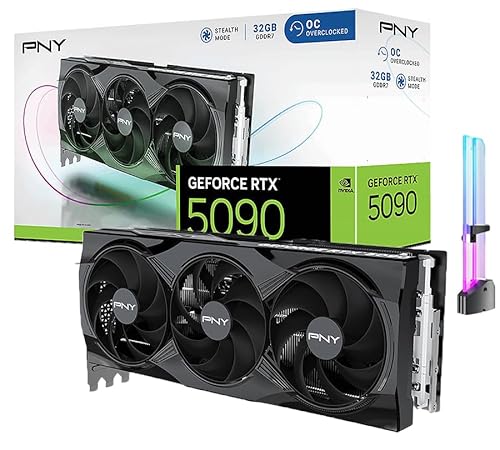
The RTX 5090 is built on the GB202 chip, manufactured on a TSMC 4NP process, with fifth-generation Tensor cores and fourth-generation RT cores. It connects over PCIe 5.0 x16 and draws power through the 12V-2×6 connector, the revised version of the 12VHPWR plug. The Founders Edition is a two-slot design roughly 304 mm long, which surprised many people after the very large RTX 4090 coolers. Partner cards from ASUS, MSI, Gigabyte, Zotac, PNY and others are generally thicker, often occupying three or more slots.
Two software features defined the launch just as much as the hardware:
- DLSS 4 with Multi Frame Generation: can insert up to three generated frames between each rendered frame on RTX 50 cards, which is why Nvidia’s launch charts showed such large frame-rate multiples.
- Neural rendering and updated media engines: Blackwell added support for 4:2:2 video formats and improved encoding hardware aimed at creators.
Nvidia also recommended a 1,000W power supply for the card, a figure worth taking seriously because transient spikes on a 575W part can trip lower-rated units.
Was the RTX 5090 Ever Easy to Buy?
Not really. Stock sold out within minutes at most retailers on launch day, and the pattern repeated in the following months. Several factors stacked up: very limited early allocation, strong demand from gamers and AI hobbyists, and the card’s usefulness for local language-model work thanks to its 32GB of memory.
By October 2026 the situation had tightened further. Nvidia said on October 16 that reports of the RTX 5090 being discontinued were not true and that it would continue to ship, while acknowledging that supply chain capacity is constrained. Reports also noted that the Founders Edition no longer appears readily in Nvidia’s own store listings, and that some large retailers have marked several partner models as not carried. Memory is the commonly cited cause: demand from AI data centres has absorbed a large share of global memory output, and GDDR7 modules are no exception. These supply details come from press reports and company statements, and they can change quickly, so check current retailer pages before making plans.
How to Check Whether a Listing Is Genuine
Scarcity attracts scams, and the RTX 5090 is one of the most targeted products in PC hardware. A few checks catch most problems:
- Confirm the seller. Stick with established retailers or the manufacturer’s own store. A new seller account offering stock that major shops lack is a warning sign.
- Compare against the official spec. A real RTX 5090 has 32GB of GDDR7 and a 512-bit bus. Any listing quoting 24GB or a different memory type is something else.
- Look for fake “bundle” tricks. Photos of boxes with no card inside, or listings that sell only the packaging, have appeared repeatedly on resale marketplaces.
- Use protected payment methods. Avoid bank transfers and gift cards, since neither offers buyer recourse.
- Verify on arrival. Check the serial number, then run GPU-Z or a similar utility to confirm the memory size, bus width and driver-reported model before the return window closes.
Should You Wait, Buy, or Pick Something Else?
The answer depends on what you actually need from the card. The decision matrix below maps common situations to a sensible next step.
| Your situation | Best move | Reason |
|---|---|---|
| 4K gaming at 120Hz or more with ray tracing | RTX 5090 if you can find one at a fair price, otherwise RTX 5080 | The 5090 has the most headroom, but the 5080 handles 4K with DLSS well |
| Local AI models above 24GB of VRAM | RTX 5090 or a workstation card | 32GB is the main draw; nothing else in the GeForce range matches it |
| 1440p high refresh gaming | RTX 5070 Ti or RTX 5080 | The extra cores of a 5090 sit idle at this resolution |
| Already own an RTX 4090 | Wait | The uplift is real but rarely worth the upheaval of a new power setup |
| Small case or 750W power supply | Skip the 5090 | Cooling and power requirements make fitting it difficult |
If you own an RTX 4090, the upgrade case is weak outside memory-hungry professional work. Published reviews found the RTX 5090 typically ahead of the 4090 by roughly a third in native 4K rasterized games, with larger gains in ray tracing and in DLSS 4 workloads. A third is meaningful, but it is a smaller step than the leap from the RTX 3090 to the RTX 4090.
Preparing Your PC for an RTX 5090
If you do secure a card, a few preparations avoid unpleasant surprises:
- Power supply: choose a quality unit rated at 1,000W or higher with a native 12V-2×6 cable. Using adapters increases the risk of a poor connection.
- Cable seating: push the connector in fully until it clicks, and avoid sharp bends within a few centimetres of the plug. Several melted-connector reports on the previous generation came down to incomplete seating.
- Case clearance: measure card length, thickness and the space needed for the power cable. Partner models vary widely, and some exceed 350 mm.
- Motherboard slot: PCIe 5.0 x16 is supported, but the card also works in PCIe 4.0 and 3.0 slots with some performance loss in the most bandwidth-sensitive situations.
- CPU pairing: pair it with a fast modern processor. At 1440p especially, an older CPU can limit what the card delivers.
Launch-Window Problems Worth Knowing About
The first months of RTX 5090 ownership were not entirely smooth, and several of the problems explain advice you still see repeated today.
- Driver maturity: early Blackwell drivers produced black screens, flickering and crashes for some owners, particularly with multi-monitor setups and certain high-refresh displays. Nvidia shipped a rapid series of driver updates through the spring of 2025, and most of those issues faded. Running a current driver is still the first fix to try for any instability.
- Missing render units: Nvidia confirmed in February 2025 that a small share of RTX 5090 and 5090 D boards shipped with one fewer ROP unit than specified, which cost a few percent of performance. The company said affected buyers could arrange a replacement. If your card benchmarks noticeably below similar models, GPU-Z will show the ROP count so you can compare it with the official figure of 176.
- PCIe link behaviour: some owners saw the card fall back to a lower PCIe speed or fail to post on particular motherboards. A BIOS update or forcing the slot to PCIe 4.0 usually settled it.
- Power connector anxiety: because the card draws up to 575W through a single 12V-2×6 plug, the safety margin is thinner than on lower-power cards. Several enthusiast sites documented hot connectors on the previous generation, and the same caution carries over. Partner brands have since added features such as per-pin monitoring and indicator lights on some models.
Founders Edition Versus Partner Cards
When people ask about the release date, they often really want to know which version they can buy and when. The RTX 5090 comes in two broad families.
| Type | Typical size | Strengths | Trade-offs |
|---|---|---|---|
| Founders Edition | 2 slots, about 304 mm long | Compact, fits more cases, reference clocks and power | Sold in limited quantities; hotter memory under sustained load in some cases |
| Partner entry models | 3 to 3.5 slots, 320 to 340 mm | Quieter coolers, easier to find than the reference card | Large and heavy; may need a support bracket |
| Partner overclocked models | 3.5 to 4 slots, 340 to 360 mm or more | Higher boost clocks, upgraded power delivery, extra features | Often limited by the same 575W class power target, so real gains are small |
The Founders Edition’s two-slot cooler was a design achievement, using a dual-fan flow-through layout with liquid-metal thermal compound on the GPU. The compact size is a real advantage in small cases. Partner designs tend to be quieter at the same temperature because they have more fin area to work with. If you plan to run the card for long AI or rendering jobs, extra cooling headroom matters more than a few extra megahertz.
What the Card Offered at Launch
Reviewers at launch generally described the RTX 5090 as the first consumer card that could play most modern games at 4K with high settings comfortably, and a viable option for high-refresh 4K displays. Its advantages were largest in three areas:
- Native 4K rasterization: around 30 percent faster than the RTX 4090 in averaged results, according to published reviews.
- Ray and path tracing: the improved RT cores and higher throughput widen the gap in the heaviest titles, though the very heaviest settings still lean on upscaling.
- AI and creative workloads: 32GB of memory and bandwidth of 1,792 GB/s let it load larger models and projects without spilling over to system memory.
At 1080p and 1440p the card is frequently limited by the processor, so the improvement shrinks. That is why buyers with mid-range monitors usually see better value from a lower-tier model.
A Simple Worked Example: Power Budget
A frequent mistake is sizing the power supply to the graphics card alone. Here is a worked budget for a high-end gaming build:
- RTX 5090 at its 575W rating
- High-end desktop processor under gaming load: around 120W
- Motherboard, memory, drives, fans and USB devices: around 80W
- Total sustained draw: about 775W
Short power spikes can exceed those averages, so a 1,000W unit leaves roughly 25 percent headroom, which is the buffer Nvidia’s recommendation aims for. A workstation using a high-core-count CPU or heavy overclocking should step up to 1,200W. Running a 750W unit at close to full load invites shutdowns and shortens the supply’s life.
How to Track Restocks Without Wasting Weeks
Because availability changes by region and by week, a repeatable routine beats refreshing pages at random. Start by listing the three or four retailers in your country that are known to receive partner-card shipments, then follow their stock alerts through email or app notifications. Community restock trackers and enthusiast forums often spot deliveries hours before they sell out, which matters when a batch holds only a handful of cards.
Set a firm ceiling on what you are willing to pay before you begin. Without one, the pressure of a sold-out product makes inflated resale listings look reasonable. If a card stays far above the level you set for several weeks, that is useful information: it may be wiser to buy an RTX 5080 now and revisit the flagship when supply improves. Another practical route is a prebuilt desktop, since system builders sometimes receive allocation that individual buyers cannot get. Check that the rest of the machine, especially the power supply and cooling, is a good match for a 575W graphics card before accepting it.
What the Release Date Means for the Rest of the Lineup
The RTX 5090 was the first card in a stack that stretched over about four months. Buyers who could not find a flagship in January 2025 had a steady stream of alternatives: the RTX 5080 on the same day, the RTX 5070 Ti and 5070 shortly afterwards, and the RTX 5060 Ti and 5060 by late spring. Nvidia also later introduced further models in the family, so the line now offers a card at nearly every tier. For many gamers the sweet spot sits below the flagship, because the performance gap between tiers is smaller than the gap in power draw and physical size. The flagship remains the answer for people who need the memory capacity or the very top frame rates at 4K, and for everyone else it is a halo product that sets the pace for the rest of the range.
Frequently Asked Questions
When was the RTX 5090 released?
The RTX 5090 went on sale on January 30, 2025, following its announcement at CES on January 6, 2025. Independent reviews were published a week before sales began. It launched on the same day as the RTX 5080.
Is the RTX 5090 discontinued?
No. Nvidia stated in October 2026 that the card has not been discontinued and will continue to ship when supply allows. The company did acknowledge that supply is constrained, which is why stock is hard to find at many retailers.
Why is the RTX 5090 so hard to buy?
Limited production allocation, strong demand and rising memory costs all play a part. The card’s 32GB of GDDR7 also makes it attractive for AI work, which widens the pool of buyers beyond gamers.
Is the RTX 5090 worth upgrading to from an RTX 4090?
For most people it is not. The gain in native 4K gaming is around a third in published reviews, and the card needs more power and cooling. It makes more sense if you need the extra 8GB of memory or want the best multi-frame-generation performance.
Will the RTX 5090 work on an older PCIe slot?
Yes. The card is backward compatible with PCIe 4.0 and 3.0 slots. In most games the loss is small, though some owners have reported stability quirks on certain boards, so updating the motherboard BIOS is a sensible first step.
When will the next Nvidia flagship arrive?
Nvidia has not announced a successor. Based on the gaps between the RTX 3090, 4090 and 5090, a new flagship would not be expected before 2027, and press reports in 2026 suggest it may slip further.




Write Your Review
No reviews yet. Be the first to share your experience!