
Our Short List of 3

- Best for: Households whose stations are all UHF and broadcast from several directions, wanting one fixed outdoor antenna without a rotator.

- Best for: Budget-conscious households with towers in one direction, planning to add a splitter for two to four televisions.
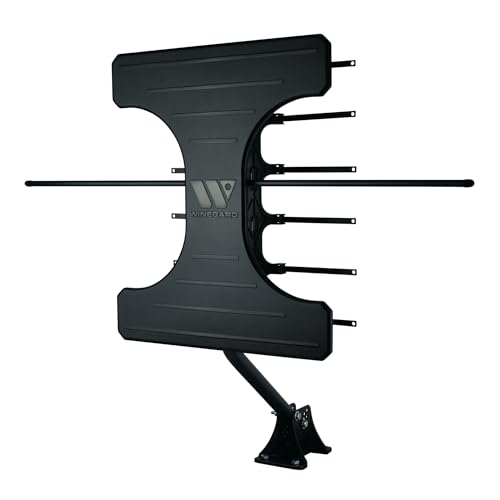
- Best for: Homes with weak signals, long cable runs, or three or more televisions sharing one antenna.
All 5 Picks at a Glance
| Product | Specs | Action |
|---|---|---|
| 1. Antennas Direct ClearStream 4 — Best Multi-Directional Pick for Scattered Towers |
| Check price on Amazon |
| 2. GE Outdoor HD Digital TV Antenna 29884 — Best Budget Outdoor Pick for Whole-Home Use |
| Check price on Amazon |
| 3. Winegard Elite 7550 — Best Amplified Pick for Weak Signals |
| Check price on Amazon |
 4. GE Outdoor Yagi Antenna 33685 — Best Yagi Pick with Explicit Multi-TV Support |
| Check price on Amazon |
 5. RCA Compact Outdoor Yagi ANT751E — Best Compact Pick for Tight Mounting Spots |
| Check price on Amazon |
Key takeaways
- Find the best outdoor HDTV antenna for multiple TVs: weatherproof rooftop picks with amplifiers and splitters to feed every screen in your home reliably.
One rooftop antenna can feed every television in a house. Instead of buying a separate indoor antenna for each room, a single outdoor HDTV antenna mounted high on a roof, eave, or mast captures the broadcast signal once and shares it through coaxial cable to the living room, bedrooms, and anywhere else a television lives.
This guide covers outdoor models only. Every antenna below is built to live outside in rain, wind, snow, and summer heat, and every one suits a multi-television setup when paired with the right splitter or distribution amplifier. Indoor flat-panel antennas are not included, because they solve a different problem: a single room close to the broadcast towers, with no cable runs to plan.
Disclosure: As an Amazon Associate, we earn from qualifying purchases.
How to Choose an Outdoor HDTV Antenna for Multiple TVs
Start with your towers, not the box
The mileage number on an antenna box is a best-case figure, not a promise for your address. What matters is where your local broadcast towers sit, how far away they are, and what stands between you and them: hills, tall buildings, dense trees, and roofing materials. Before buying, look up your address on a free signal locator such as the FCC DTV reception map. It lists local channels, tower distance and compass bearing, and whether each station uses UHF or VHF. Towers clustered in one direction favor a directional antenna aimed at that bearing, while towers scattered in several directions favor a multi-directional design.
UHF versus VHF matters more than 4K labels
Antennas do not receive 4K or 1080p as such; they receive radio-frequency signals, and picture resolution depends on what the broadcaster transmits. Most digital television in the United States broadcasts on UHF, but many stations still use high-VHF, and a few use low-VHF. An antenna that only covers UHF will miss a high-VHF station, no matter how strong the signal is at your roof. Check the band for each station you care about, and choose an antenna with VHF elements if any must-have channel is high-VHF.
Splitting the signal costs signal
Every split costs signal. A two-way splitter typically sends about half the signal to each television, and a four-way splitter costs more still. Long cable runs and connectors add further loss, so a signal that looked strong at the antenna can arrive marginal at the farthest bedroom. Start with as much signal as possible by mounting the antenna high and aiming it carefully, then compensate with amplification in the right place: a mast-mounted preamplifier boosts the signal before a long cable run, while a distribution amplifier at the split point overcomes splitter loss. An amplifier cannot create a signal the antenna never captured, and near very strong stations it can overload a tuner.
Plan the wiring, mounting, and grounding
Treat the installation as a small distribution network: one cable from the antenna down to a central point, then branches to each television. Many homes can reuse existing RG6 coaxial wiring left over from a cable or satellite installation, provided the connectors are sound and old satellite multiswitches are removed. Use RG6 rather than older RG59, keep runs short, use compression connectors, and seal outdoor connections against moisture. Each television needs its own channel scan afterward, since tuners differ in sensitivity.
Mount the antenna as high as practical with a clear line toward the towers, and avoid metal siding or metal roofing that can block the signal. Look for galvanized steel or aluminum elements, UV-resistant housings, and rust-resistant hardware. Ground the mast and the coaxial cable according to local electrical codes, using a grounding block where the cable enters the house. Grounding protects the equipment and the home during storms and should not be skipped on a rooftop installation.
Top Picks: Best Outdoor HDTV Antennas for Multiple TVs
1. Antennas Direct ClearStream 4 — Best Multi-Directional Pick for Scattered Towers
- Best for: Households whose stations are all UHF and broadcast from several directions, wanting one fixed outdoor antenna without a rotator.
Households whose stations are all UHF and broadcast from several directions, wanting one fixed outdoor antenna without a rotator.
The Antennas Direct ClearStream 4 suits homes whose broadcast towers are not all in one direction. Its four-loop multi-directional design receives signals from a wide arc, which fits suburban and rural addresses where stations cluster in two or three different bearings. It ships with a 20-inch mast, reflectors, a pivoting base, and mounting hardware, so rooftop or eave installation is straightforward. Key specifications include a manufacturer range of 70-plus miles, UHF coverage from 470 to 608 MHz, UHF peak gain of 12.25 dBi, and 50-ohm impedance.
One honest limitation: this model is UHF-only, so confirm that your must-have stations broadcast on UHF first. If any important local channel is high-VHF, choose one of the VHF-capable models below. For multi-television use, pair it with a quality splitter and RG6 cable, adding a distribution amplifier when feeding four or more sets or running long cable runs.
Pros: Multi-directional reception for scattered towers; strong UHF peak gain of 12.25 dBi; 20-inch mast and pivoting base included; lighter and easier to mount than a long Yagi.
Cons: UHF-only, so it misses high-VHF stations; no amplifier included; multi-directional designs collect more interference than a tightly aimed Yagi.
2. GE Outdoor HD Digital TV Antenna 29884 — Best Budget Outdoor Pick for Whole-Home Use
- Best for: Budget-conscious households with towers in one direction, planning to add a splitter for two to four televisions.
Budget-conscious households with towers in one direction, planning to add a splitter for two to four televisions.
The GE 29884, also sold under the UltraPro brand as the Pro Outdoor and Attic Mount Antenna, is the long-running budget favorite among outdoor antennas. It is a Yagi-style antenna with signal-enhancing reflectors and a compact frame for its class, and a J-mount is included for attic or outdoor installation. Its popularity shows in a large body of owner feedback, with more than ten thousand ratings on its Amazon listing.
Key specifications include a manufacturer range of up to 70 miles, VHF and UHF reception, support for 4K Ultra HD and Full HD 1080p broadcasts, a weather-resistant build, and dimensions of approximately 29 inches by 20.5 inches. The model number is 29884-PK1. The listing describes the antenna as whole-home ready, with support for distributing the signal to multiple televisions through a splitter and coaxial cables. Its directional design concentrates reception in one direction, which is an advantage when all local towers sit in the same general bearing.
Pros: Strong value for a 70-mile outdoor Yagi; directional gain where the towers are; covers VHF and UHF; J-mount included; explicitly designed for whole-home use with splitters.
Cons: Directional, so it needs careful aiming; no amplifier included; coaxial cable is not included.
3. Winegard Elite 7550 — Best Amplified Pick for Weak Signals
- Best for: Homes with weak signals, long cable runs, or three or more televisions sharing one antenna.
Homes with weak signals, long cable runs, or three or more televisions sharing one antenna.
The Winegard Elite 7550 is the premium amplified option in this roundup, and the one to consider when the signal at your roof is present but weak, or when the cable path to several televisions is long. It is a compact directional outdoor antenna with an embedded amplifier built into the antenna body, using Winegard Clear Circuit technology with an ultra-low noise figure of 1 dB. A low noise figure matters because an amplifier that adds its own noise can bury a weak station.
Key specifications include a manufacturer range of up to 70 miles, reception of both high-VHF and UHF signals, an embedded Boost amplifier with TwinAmp technology that amplifies VHF and UHF separately, an inline 5-volt power inverter with an LED indicator, a 3-foot USB power cable with a 110-volt adapter, mounting supplies including a pipe, foot, and hardware, 75-ohm impedance, and a weight of only 16 ounces. For multi-television use, the built-in amplification compensates for splitter and cable losses at the source, before they occur, which suits homes feeding three or four televisions or a set at the end of a long run.
Pros: Embedded amplifier with a 1 dB noise figure; TwinAmp amplifies VHF and UHF separately; covers high-VHF and UHF to 70 miles; weighs only 16 ounces; amplification offsets splitter and cable loss.
Cons: Directional, so it must be aimed; the amplifier needs power; the plastic mounting bracket feels less substantial than the antenna, according to independent coverage; premium positioning against passive Yagis.
4. GE Outdoor Yagi Antenna 33685 — Best Yagi Pick with Explicit Multi-TV Support
- Best for: Homes with towers clustered in one direction wanting a no-electronics outdoor Yagi built to feed several televisions.
Homes with towers clustered in one direction wanting a no-electronics outdoor Yagi built to feed several televisions.
The GE 33685 is a larger Yagi-style outdoor antenna, and the most explicit multi-television model in this roundup: its Amazon item description states multiple-television support directly. It is a long-range, weather-resistant Yagi with a J-mount included for attic or outdoor installation, built around the classic directional layout of a driven element, directors, and a reflector. That layout concentrates reception in one direction, which is what you want when the towers are clustered together.
Key specifications include a Yagi-style design, VHF and UHF reception, support for 4K and Full HD 1080p broadcasts, a weather-resistant build, and a J-mount included. The model number is 33685. Because it is passive, there is no amplifier to power and nothing to overload if a strong local station sits nearby. Add a good splitter, and, for a long run to the farthest television or a four-way split, a distribution amplifier at the split point.
Pros: Classic directional Yagi gain toward the towers; covers VHF and UHF; multiple-television support stated directly; J-mount included; passive design with nothing electronic to fail outdoors.
Cons: Directional, so aiming matters; larger footprint needs a solid mount; no amplifier included; cable and splitter are bought separately.
5. RCA Compact Outdoor Yagi ANT751E — Best Compact Pick for Tight Mounting Spots
- Best for: Homes with limited mounting space or a low roofline, where a compact Yagi is easier to install high than a full-size antenna.
Homes with limited mounting space or a low roofline, where a compact Yagi is easier to install high than a full-size antenna.
The RCA ANT751E is the compact option in this roundup, for mounting locations that are tight, rooflines that are low, or spots where a full-size Yagi would be unwieldy. It is a compact outdoor Yagi with a cross-phase multi-element design combining UHF and VHF dipoles with a signal reflector to boost gain, designed in the United States. Despite its small size, it is rated for long-range reception and has been a staple of rooftop and attic installations for years.
Key specifications include a manufacturer range of up to 70 miles, UHF and VHF reception, support for Full HD 1080p broadcasts, snap-lock elements with tool-free fold-out assembly, a heavy-duty locking mast clamp, a 75-ohm matching transformer, and construction built to withstand tough outdoor conditions. It measures approximately 36 inches deep, 4.6 inches wide, and 6.7 inches high, and weighs around 2 pounds. Coaxial cable is sold separately. Its small size and light weight make it easy to mount high on a mast or eave, and height is often worth more than raw antenna size.
Pros: Compact and light for easy high mounting; covers UHF and VHF; rated up to 70 miles; snap-lock elements and locking mast clamp simplify installation; durable outdoor construction.
Cons: Directional, so it needs aiming; no amplifier included; coaxial cable sold separately; less raw gain than a full-size Yagi for the weakest fringe signals.
Comparison Table
| Antenna | Type | Bands | Stated Range | Amplifier | Mounting Hardware | Multi-TV Approach |
|---|---|---|---|---|---|---|
| Antennas Direct ClearStream 4 | Multi-directional loop | UHF only | 70-plus miles | None included | 20-inch mast, reflectors, pivoting base | Wide-arc reception feeding a splitter |
| GE Outdoor 29884 | Directional Yagi | VHF, UHF | Up to 70 miles | None included | J-mount included | Whole-home ready with splitter and coax |
| Winegard Elite 7550 | Directional, amplified | High-VHF, UHF | Up to 70 miles | Embedded Boost amp, 1 dB noise figure | Pipe, foot, hardware included | Built-in amp offsets splitter and cable loss |
| GE Outdoor Yagi 33685 | Directional Yagi | VHF, UHF | Long range | None included | J-mount included | Multiple-TV support stated in product description |
| RCA Compact Yagi ANT751E | Compact directional Yagi | VHF, UHF | Up to 70 miles | None included | Locking mast clamp included | Single antenna feeding a splitter to several rooms |
Frequently Asked Questions
Can one outdoor antenna really feed multiple TVs?
Yes. One outdoor antenna feeds multiple televisions through a splitter and coaxial cable, and many homes reuse existing coaxial wiring left over from a cable or satellite installation. Each split reduces the signal reaching each television, so mount the antenna high, aim it carefully, and add a distribution amplifier when feeding four or more sets or running long cables. Each television then runs its own channel scan and builds its own channel list from the shared signal.
Do I need an amplifier for multiple TVs?
Not always. With towers close and strong and only two televisions over short cable runs, a passive antenna and a plain two-way splitter are often enough. An amplifier earns its place when the signal is weak at the antenna, the cable runs are long, or the signal is split three or four ways. A mast-mounted preamplifier boosts the signal before a long run down, while a distribution amplifier at the split point compensates for splitter loss. Near very strong stations, an amplifier can overload a tuner, so add one only when the signal needs it.
What is the difference between a directional and a multi-directional outdoor antenna?
A directional antenna concentrates reception in one narrow direction, giving higher gain and better rejection of interference, but it must be aimed at the towers. A multi-directional antenna receives from a wider arc, suiting stations spread across several bearings, but it offers less gain in any single direction. Check a tower map first: clustered towers favor a directional Yagi, while scattered towers favor a multi-directional design such as the ClearStream 4.
Should I mount the antenna on the roof or in the attic?
Outdoors and high is better whenever practical. Roofing materials, foil-backed insulation, metal ductwork, and nearby structures weaken the signal before it reaches an attic antenna, and that loss matters more when the signal must then survive a splitter and long cable runs. An attic installation avoids roof penetrations and is easier to reach, so it is a reasonable compromise when outdoor mounting is not possible, but a rooftop mount at the same height normally delivers a stronger signal to every television.
Why does one TV get channels that another TV misses?
Each television has its own tuner, and tuners differ in sensitivity, so a borderline signal can be strong enough for one set and too weak for another. Cable length matters too: the set at the end of the longest run, or on the weakest splitter output, receives the least signal. If one room shows pixelation while another is fine, check the connectors on that run, try a different splitter output, or add a distribution amplifier at the split point, then run a fresh channel scan on the affected television.
Conclusion
The best outdoor HDTV antenna for multiple TVs is the one that matches your towers, your bands, and your wiring. Start with a tower map, confirm whether your must-have stations are UHF or high-VHF, then choose between a directional Yagi and a multi-directional design. The ClearStream 4 fits scattered UHF towers, the GE 29884 is the best value for a single-direction setup, the Winegard Elite 7550 fits weak signals and long cable runs, the GE 33685 is the straightforward large Yagi with explicit multi-television support, and the RCA ANT751E fits tight mounting spots.
Whichever model you choose, the installation matters as much as the antenna. Mount it high and outdoors, aim it with a tower map rather than guesswork, use RG6 cable and quality compression connectors, ground the mast and the cable, and add a distribution amplifier only when the split to several televisions needs the help. Get those steps right, and a single rooftop antenna will feed every television in the house with free over-the-air channels for years.
More from Amazon
Programs that pair well with the guide above. Offers and eligibility are set by Amazon and may change.
Free shipping on eligible items, Prime Video and more. Eligible new members can start with a free trial.
Start a Prime free trialAd-free music streaming. Eligible new subscribers can start with a free trial.
Try Music Unlimited freeA Prime membership for ages 18-24 with a trial period. Eligibility is set by Amazon.
See Prime for Young AdultsAudiobooks and podcasts to listen to on the go. Eligible new members can start with a free trial.
Try Audible freeAs an Amazon Associate we earn from qualifying purchases.










Write Your Review
No reviews yet. Be the first to share your experience!