
Our Short List of 3


All 4 Picks at a Glance
| Product | Specs | Action |
|---|---|---|
| 2. Lenovo Yoga 9i 2-in-1 Aura Edition (14, Gen 10) — the brightest OLED here | Check price on Amazon | |
| 3. Samsung Galaxy Book5 Pro 360 (16) — the convertible with anti-glare AMOLED | Check price on Amazon | |
 4. Apple MacBook Air 15 (M4) — the silent, fanless pick | Check price on Amazon | |
 5. LG gram Pro 17 — the largest screen, still light to carry | Check price on Amazon |
Key takeaways
- Five laptops picked for film nights using maker-published specs only: OLED and IPS panels, nits, wide color coverage, HDR formats and speaker layouts compared.
As an Amazon Associate, we earn from qualifying purchases made through links on this page.
A laptop bought mainly for films is judged by a different yardstick than a work machine. Processing speed matters far less than the panel carrying the picture, the speakers carrying dialogue, and the battery that has to outlast the plot. A dark scene in a thriller exposes weak contrast in seconds, and a quiet conversation exposes thin speakers just as fast. This roundup names five laptops whose makers publish genuinely strong display and audio specifications, and it judges every model on those published numbers: panel type, resolution, brightness in nits, color coverage, HDR format support, and speaker layout.
The five picks split into two camps. Four use OLED panels, which light each pixel on its own and produce true blacks in a dark room. One uses a very large IPS panel, which trades those perfect blacks for screen size, a matte finish, and freedom from burn-in worries during long static scenes such as paused menus. Screen sizes run from 14 inches to 17 inches, covering a solo viewer at a desk, two people on a sofa, and a traveller in a window seat. Every figure below comes from the maker’s published specification for that model, and each limitation follows from those same specifications.
Our top picks
What to look for
Panel type decides the dark scenes. An OLED panel switches individual pixels off completely, so letterbox bars and night scenes render as real black and contrast stays high at any brightness. An IPS panel uses a backlight that stays on, so blacks look dark grey in a dim room, though a good IPS panel holds color and brightness well when two people watch from an angle. Neither choice is wrong; the room you watch in should decide.
Resolution and size work together. A 14-inch screen at 2880 by 1800 looks very sharp at sofa distance, while a 17-inch screen fills more of your view and makes subtitles easier to read from further back. Nearly every laptop panel uses a 16:10 shape, which is taller than the 16:9 shape of most films, so expect black bars above and below the picture on every model here. That is normal, and on an OLED those bars are truly black.
Brightness is quoted in nits. A higher nit figure helps in a bright living room or near a window. Makers quote two numbers on HDR models: a typical figure for everyday content and a higher peak figure that applies to small bright areas in HDR scenes. Compare typical with typical and peak with peak, because mixing the two misleads.
Color coverage is quoted against DCI-P3. Films are mastered in the DCI-P3 color space, so a panel covering 100 percent of DCI-P3 can show the colors the film crew intended. Coverage above 100 percent, quoted by Samsung as color volume, means the panel can go beyond that space. Coverage well below 100 percent makes film colors look muted.
HDR support needs the panel and the app to agree. A screen can only show Dolby Vision or HDR10 when the maker lists that format for the panel and the playback app on that machine supports it. A bright panel without a listed HDR format still shows standard dynamic range films well; it simply cannot reproduce the extra highlight detail in HDR masters.
Speakers are described by count and placement. More speaker units, larger woofers, and forward or upward placement generally mean clearer dialogue than small downward-firing units muffled by a bed or sofa. Dolby Atmos support adds processing that widens the soundstage. A headphone jack and current Bluetooth remain useful fallbacks for late-night viewing.
Battery figures are maker claims under gentle conditions. Makers measure video playback at modest brightness with light workloads. Treat the published figure as a ceiling, expect less with the screen bright and Wi-Fi busy, and value a large battery in watt-hours when comparing machines for travel.
Ports shape the home setup. An HDMI port sends the picture to a television without adapters, and USB-C ports with video output do the same job with the right cable. A hinge that folds into a tent shape helps on a kitchen counter or a tray table.
The five picks
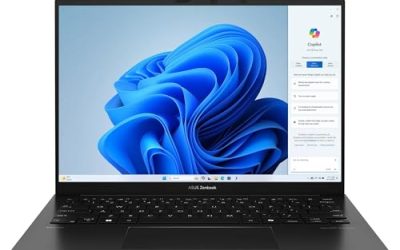
1. ASUS Zenbook S 16 (UM5606) — the big OLED with six speakers
Amazon listing: ASUS Zenbook S 16 on Amazon (ASIN B0DJH4XLBS)
ASUS fits this 16-inch laptop with a Lumina OLED touch panel at 2880 by 1800 resolution and a 120Hz refresh rate. ASUS quotes 400 nits of typical brightness, a 550-nit peak for HDR content, and 100 percent coverage of DCI-P3, with Dolby Vision support and Pantone Validated color. Sound gets unusual attention for such a thin machine: six speakers tuned by Harman Kardon with Dolby Atmos and a Smart Amp, the largest speaker count in this roundup. The listed configuration pairs a Ryzen AI 9 365 processor with 24GB of memory and a 1TB SSD, and the battery is a 78Wh unit inside a chassis ASUS lists at 1.5 kg.
This is the pick for a household screen that lives on a coffee table or a desk and serves two viewers at once. The 16-inch OLED gives dark scenes real depth, the six-speaker layout gives dialogue a better chance against room noise than most thin laptops manage, and the touch layer makes pausing and scrubbing simple.
The limitations follow from the panel choice. The glossy OLED finish reflects lamps and windows, so a bright room works against it. OLED owners should also vary content over time, since any OLED can retain a faint image of fixed elements left on screen for very long periods. The 120Hz panel does not change film playback itself, because films are shot at far lower frame rates; its smoothness shows in scrolling and general use.
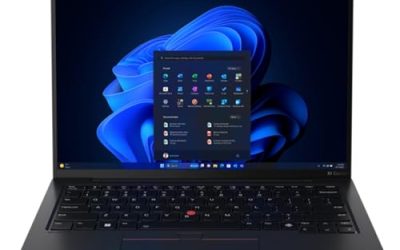
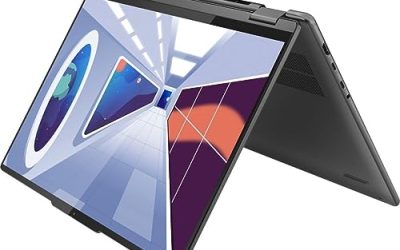
2. Lenovo Yoga 9i 2-in-1 Aura Edition (14, Gen 10) — the brightest OLED here
Amazon listing: Lenovo Yoga 9i 2-in-1 Aura Edition on Amazon (ASIN B0FTCGYXTM)
Lenovo quotes the strongest HDR numbers in this group for the 14-inch Yoga 9i. Its 2880 by 1800 OLED touch panel runs at 120Hz with a variable refresh range, covers 100 percent of DCI-P3, supports Dolby Vision, and reaches a 1,100-nit HDR peak, with a DisplayHDR True Black 1000 certification from VESA. Audio comes from a rotating soundbar built into the hinge, with four speakers tuned with Bowers and Wilkins and Dolby Atmos support, so the speakers face the viewer in laptop, tent, and tablet positions alike. The listed configuration carries an Intel Core Ultra 7 258V processor, 32GB of memory, and a 1TB SSD.
Choose this one if you watch in varied places and positions. The hinge folds fully, so the machine works as a laptop on a desk, a tent on a tray table, or a tablet held in two hands, and the soundbar keeps dialogue aimed at you in every position. The high HDR peak also gives bright scenes more punch than the other OLED picks when the content is mastered for it.
The trade-offs are size and finish. Fourteen inches is the smallest screen in this roundup, so it suits one viewer, or two people sitting close, rather than a sofa across a room. The panel is glossy, which mirrors light sources behind you. Lenovo also sells this model with a higher-resolution 4K OLED panel in some configurations, so confirm the listing describes the 2.8K panel before ordering, because brightness and refresh figures differ between the two panels.
3. Samsung Galaxy Book5 Pro 360 (16) — the convertible with anti-glare AMOLED
Amazon listing: Samsung Galaxy Book5 Pro 360 on Amazon (ASIN B0DVCDC2NN)
Samsung uses a 16-inch Dynamic AMOLED 2X touch panel at 2880 by 1800 with an adaptive refresh range up to 120Hz. Samsung quotes 120 percent color volume against DCI-P3, a 500-nit HDR peak, and a Vision Booster anti-reflective coating that keeps the picture readable in bright rooms, which is rare on glossy OLED-class panels. Four speakers, built from a pair of woofers and a pair of tweeters, handle sound with Dolby Atmos support. Samsung quotes up to 25 hours of video playback from the battery under its own test conditions. The listed configuration pairs an Intel Core Ultra 7 256V processor with 16GB of memory and a 512GB SSD, and an S Pen is included in the box.
This is the pick for bright rooms and shared spaces. The anti-reflective treatment tackles the main weakness of the other OLED picks, the 360-degree hinge allows tent and tablet positions for counters and tray tables, and the long quoted video playback figure suits long-haul travel. Dialogue clarity benefits from the dedicated tweeters in the four-speaker layout.
The limitations are modest but real. The HDR peak of 500 nits is the lowest among the OLED picks here, so HDR highlights have less force than on the Lenovo. The 512GB drive in this configuration fills quickly if you keep many downloaded films, and the anti-reflective coating softens reflections rather than removing them, so a window directly behind the viewer still shows on screen.
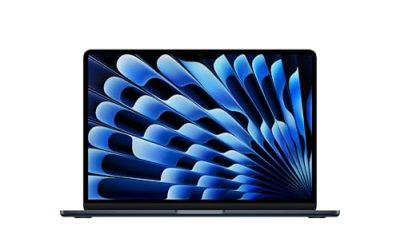
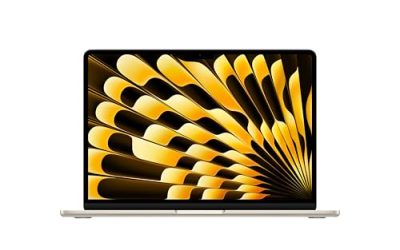
4. Apple MacBook Air 15 (M4) — the silent, fanless pick
Amazon listing: Apple MacBook Air 15 on Amazon (ASIN B0DZDBDCFH)
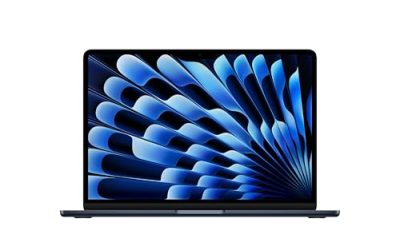
Apple’s 15.3-inch Liquid Retina panel uses IPS technology at 2880 by 1864 resolution with 500 nits of brightness, P3 wide color, and support for one billion colors. There is no fan anywhere in the machine, so it runs in complete silence during quiet scenes, a trait none of the other picks can promise. The six-speaker sound system uses force-cancelling woofers, and Apple lists Spatial Audio with Dolby Atmos playback through the built-in speakers. Apple quotes up to 18 hours of video streaming on a charge. The listed configuration has the M4 chip with 16GB of unified memory and a 256GB SSD in the Midnight finish.
Pick this one if fan noise ruins films for you, or if the laptop will live on a bed or lap where vents get blocked. Silence plus a large, bright, color-rich screen makes it the most relaxed long-session machine here, and the wide color support keeps film tones accurate even without an OLED panel.
Its limits are plain in the spec sheet. The panel has no HDR format support and a 60Hz refresh rate, so HDR films play in standard dynamic range and dark scenes show the grey-leaning blacks of an IPS backlight rather than true black. The glossy finish reflects room light. The 256GB SSD in this configuration is the smallest here, which matters if you download films for flights, and memory and storage are fixed at purchase with no later upgrade path.
5. LG gram Pro 17 — the largest screen, still light to carry
Amazon listing: LG gram Pro 17 on Amazon (ASIN B0FC33XPSP)
LG takes the opposite route from the OLED picks: a 17-inch IPS panel at 2560 by 1600, the biggest screen in this roundup, with 99 percent coverage of DCI-P3 and a variable refresh range up to 144Hz. Stereo speakers with Dolby Atmos handle sound, and the battery is a large 90Wh unit. Despite the screen size, LG lists the weight at about 1.48 kg, lighter than many 14-inch machines, because the gram line is built around low weight. The listed configuration pairs an Intel Core Ultra 7 255H processor and an NVIDIA GeForce RTX 5050 graphics chip with 32GB of memory and a 2TB SSD.
Choose this one if screen size matters more than black depth: a shared screen in a small flat, a viewer who sits further back, or anyone who reads subtitles at a distance. The matte-style IPS finish and the big battery also suit bright rooms and long days away from a socket, and the large SSD holds a deep library of downloaded films.
The compromises are the familiar IPS ones, plus one extra. Blacks in a dark room will look grey beside any OLED pick, and LG lists no HDR format support for this panel, so HDR films play in standard dynamic range. The discrete graphics chip is hardware film playback never uses; it adds a fan that can run during other work, and it explains part of the cost of a machine whose screen is the real attraction here.
Comparison table
| Laptop | Screen | Panel | Typical / peak nits | Color coverage | Sound |
|---|---|---|---|---|---|
| ASUS Zenbook S 16 (UM5606) | 16 in, 2880 by 1800, 120Hz | OLED touch | 400 / 550 | 100 percent DCI-P3 | Six speakers, Harman Kardon, Dolby Atmos |
| Lenovo Yoga 9i 2-in-1 (Gen 10) | 14 in, 2880 by 1800, 120Hz | OLED touch | 500 / 1,100 | 100 percent DCI-P3 | Rotating soundbar, four speakers, Bowers and Wilkins, Dolby Atmos |
| Samsung Galaxy Book5 Pro 360 | 16 in, 2880 by 1800, 120Hz | Dynamic AMOLED 2X touch | 400 / 500 | 120 percent DCI-P3 color volume | Four speakers, Dolby Atmos |
| Apple MacBook Air 15 (M4) | 15.3 in, 2880 by 1864, 60Hz | IPS (Liquid Retina) | 500 / 500 | P3 wide color | Six speakers, force-cancelling woofers, Dolby Atmos |
| LG gram Pro 17 | 17 in, 2560 by 1600, up to 144Hz | IPS | 400 / 400 | 99 percent DCI-P3 | Stereo speakers, Dolby Atmos |
Frequently asked questions
Is OLED or IPS better for watching films?
In a dark or dim room, OLED wins on contrast, because each pixel makes its own light and black areas of the picture are genuinely black. In a bright room, a good IPS panel with an anti-glare finish can be easier to watch, and it carries no burn-in concern during long paused scenes. The room decides more than the badge does.
Do you need a 4K screen for films on a laptop?
No. At laptop sizes and normal viewing distances, a sharp panel around 2880 by 1800 shows film detail very well, and most playback apps scale content to the panel cleanly. Panel type, brightness, and color coverage change the picture more than the jump from 3K to 4K at these sizes.
Can these laptops send a film to a television?
Yes. The Windows models here carry HDMI or USB-C video output, and the MacBook Air sends video over its USB-C ports with a suitable cable or adapter. The television then handles picture and sound, and the laptop acts as the playback source, which is a simple way to get a bigger screen for a group.
Does a high refresh rate improve movies?
Films are shot at 24 frames per second, far below the 120Hz panels in this roundup, so a high refresh rate does not add detail to the film itself. It makes scrolling, menus, and general use feel smoother, and some playback apps use the extra headroom for smoother frame pacing, but it should not drive a film-focused purchase.
Are built-in speakers enough, or should you use headphones?
For dialogue at close range in a quiet room, the multi-speaker layouts in the ASUS, Lenovo, and Apple picks are built for exactly that. Headphones still give the fullest low end and the best late-night volume without disturbing anyone, and every model here supports wired or Bluetooth headphones, with spatial audio features on several of them.
Conclusion
Match the pick to the room and the seat. For a shared screen with the strongest all-round picture and sound specifications, the ASUS Zenbook S 16 pairs a large OLED with six speakers. For one viewer who moves around, the Lenovo Yoga 9i folds into any position and brings the brightest HDR panel here. The Samsung Galaxy Book5 Pro 360 suits bright rooms thanks to its anti-reflective AMOLED screen. The MacBook Air 15 is the quiet-room choice, silent by design with a big, accurate IPS screen. The LG gram Pro 17 trades black depth for the largest, lightest big screen of the five. Whichever you choose, judge it the way the makers publish it: panel, nits, color coverage, HDR formats, and speakers, in that order.
More from Amazon
Programs that pair well with the guide above. Offers and eligibility are set by Amazon and may change.
Free shipping on eligible items, Prime Video and more. Eligible new members can start with a free trial.
Start a Prime free trialAd-free music streaming. Eligible new subscribers can start with a free trial.
Try Music Unlimited freeA Prime membership for ages 18-24 with a trial period. Eligibility is set by Amazon.
See Prime for Young AdultsAudiobooks and podcasts to listen to on the go. Eligible new members can start with a free trial.
Try Audible freeAs an Amazon Associate we earn from qualifying purchases.
Write Your Review
No reviews yet. Be the first to share your experience!