

Key takeaways
- Pros: Excellent cooling per unit of money, quiet at moderate loads, easy mounting, black and white versions available.
- Cons: The fan can get audible at full speed under heavy load, large dual-tower footprint, tall memory modules may need the front fan raised.
- Who it suits: Nearly every gaming build with a Ryzen 5, Ryzen 7 or X3D chip.
The Thermalright Peerless Assassin 120 SE is the best AM5 CPU cooler for most builds, because it handles chips up to the Ryzen 7 9800X3D class at a low price. Step up to the Thermalright Phantom Spirit 120 SE or Noctua NH-D15 G2 for hotter Ryzen 9 processors, and pick a low-profile Noctua NH-L9a-AM5 only when the case forces it.
AM5 changed the cooling picture in two ways. The socket (LGA1718) moved the pins to the motherboard, and Ryzen 7000 and 9000 chips run hotter and boost more aggressively than their AM4 predecessors, so a basic stock-style heatsink is no longer enough on higher-end parts. This guide ranks seven air coolers that support AM5, explains which cooler class matches which processor, and covers the clearance checks that cause most return headaches. Specifications come from manufacturer and retailer spec sheets; where they disagree, the difference is noted. Prices appear as tiers because retail figures change often.
Our top picks


As an Amazon Associate we earn from qualifying purchases at no extra cost to you.
Quick comparison of the AM5 air cooler picks
| Cooler | Best for | Height | Heat pipes | Fans | Price tier |
|---|---|---|---|---|---|
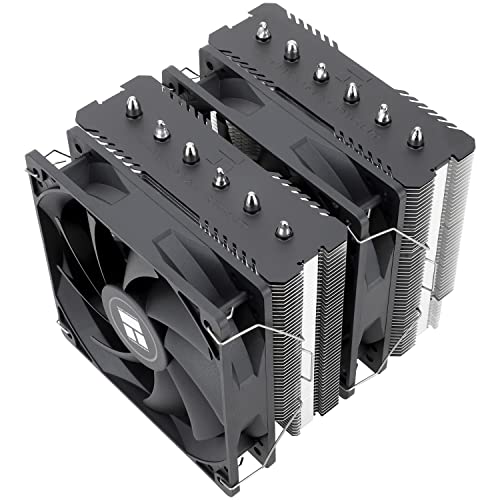
| Thermalright Peerless Assassin 120 SE | Best value overall | 155 mm | 6 | 2x 120 mm (1550 RPM) | Budget |
| Thermalright Phantom Spirit 120 SE | Best high-performance value | 154 mm | 7 | 2x 120 mm (1500 RPM) | Budget to mid-range |
| Noctua NH-D15 G2 | Best premium air cooling | 168 mm | 8 | 2x 140 mm | Premium |
| DeepCool AK620 | Best proven mainstream tower | 160 mm | 6 | 2x 120 mm | Mid-range |
| Scythe Fuma 3 | Best for tall memory | 154 mm | 6 | 2x 120 mm (one slim) | Mid-range |
| Noctua NH-U12A | Best single-tower, quiet | 158 mm | 7 | 2x 120 mm NF-A12x25 | Upper mid-range |
| Noctua NH-L9a-AM5 | Best low-profile | 37 mm | Low-profile design | 1x 92 mm | Mid-range |
The Peerless Assassin figures (6 heat pipes, 125 x 110 x 155 mm, 730 g, a 1550 RPM fan at about 25.6 dBA) come from Thermalright’s listing. The Phantom Spirit measures 154 mm and weighs 765 g. Retailer TDP ratings vary: AVADirect lists 265 W for the Peerless Assassin and 280 W for the Phantom Spirit, while other stores list 250 to 265 W for the latter. Treat TDP numbers as marketing guidance rather than exact limits.
How much cooler do AM5 chips need?
AMD’s current AM5 range spans a wide power spread. The Ryzen 7 9700X is a 65 W part (about 88 W at the socket). The Ryzen 7 9800X3D has a 120 W TDP and roughly 162 W of socket power. The Ryzen 9 9950X is a 170 W TDP chip rated up to about 230 W maximum, and AMD recommends a liquid cooler for it. Based on those numbers, a practical mapping looks like this:
| Processor class | TDP | Cooler class that fits |
|---|---|---|
| Ryzen 5 and Ryzen 7 non-X3D (65 W) | 65 W | Any mid-range single or dual tower; the Peerless Assassin is more than enough |
| Ryzen 7 X3D (7800X3D, 9800X3D) | 120 W | Quality dual tower such as the Peerless Assassin, Phantom Spirit or AK620 |
| Ryzen 9 (170 W) | 170 W | Top dual tower (NH-D15 G2, Phantom Spirit) or a 240 to 360 mm AIO |
| Small-form-factor build with 65 W chip | 65 W | Low-profile cooler like the NH-L9a-AM5, accepting lower sustained clocks |
Ryzen 7000 and 9000 processors are designed to boost until they reach a temperature limit, so a stronger cooler does not just lower temperatures; it often lets the chip hold higher clocks for longer. That makes cooler quality matter for performance, not only for noise.
Best value overall: Thermalright Peerless Assassin 120 SE
The Peerless Assassin 120 SE is the cooler that most recommendation lists settle on. It uses two towers, six 6 mm heat pipes, a nickel-plated copper base and two 120 mm TL-C12C fans spinning at up to 1550 RPM, with a flow of about 66 CFM per fan and 25.6 dBA noise. At 155 mm tall and 730 g, it fits most mid-tower cases, and Tom’s Hardware’s coverage calls its air-cooling performance exceptional for the price.
It handles 65 W and 120 W AM5 chips without difficulty and copes with higher loads at the cost of fan noise. AM5 mounting hardware is included in the box.
- Pros: Excellent cooling per unit of money, quiet at moderate loads, easy mounting, black and white versions available.
- Cons: The fan can get audible at full speed under heavy load, large dual-tower footprint, tall memory modules may need the front fan raised.
- Who it suits: Nearly every gaming build with a Ryzen 5, Ryzen 7 or X3D chip.
Best high-performance value: Thermalright Phantom Spirit 120 SE
The Phantom Spirit is the more advanced Thermalright tower, with seven 6 mm heat pipes and a tighter fin stack. It measures 154 mm tall, weighs 765 g and uses a TL-C12B V2 fan rated at 1500 RPM, 25.6 dBA and 66.17 CFM. Reviewers comparing it with the NH-D15 on a Ryzen 9 7950X found it within about 3 degrees Celsius of the Noctua while costing far less. A memory-clearance note from Tom’s Hardware says RAM around 42 mm tall fits normally, while taller modules may require raising the front fan.
- Pros: Near-flagship cooling at a mid-range price, seven heat pipes, supports high-wattage chips.
- Cons: Heavier than the Peerless Assassin, RAM clearance can be tight, Thermalright documentation is less polished than Noctua’s.
- Who it suits: Ryzen 9 and overclocking builds that want to avoid the cost of an AIO.
Best premium air cooling: Noctua NH-D15 G2
The NH-D15 G2 is the second generation of Noctua’s best-known cooler. Noctua’s specification page lists eight heat pipes (up from six in the original), two 140 mm fans, a height of 168 mm, and a weight of 1525 g with fans. It stands about 150 mm wide and 152 mm deep. An offset design lets it clear the top PCIe slot on most boards.
Memory clearance depends on fan configuration: RAM up to 59 mm tall fits when one fan is fitted, but only up to 32 mm when both fans are installed. Noctua sells the G2 in several base-convexity variants, so confirm the version recommended for your processor on Noctua’s compatibility page. It is the quietest high-end air cooler of the group and has a strong warranty and long support period.
- Pros: Top-tier cooling and noise, eight heat pipes, excellent mounting, long service life.
- Cons: Premium price, 168 mm height needs a wide case, heavy, memory clearance limits.
- Who it suits: Ryzen 9 builds and quiet-PC enthusiasts who want the best air solution.
Best proven mainstream tower: DeepCool AK620
The AK620 has been a mainstream favorite for years. DeepCool’s dimensions are 129 x 138 x 160 mm, and the unit weighs 1456 g with six 6 mm heat pipes and two 120 mm fans. RAM clearance is 43 mm with both fans fitted, rising to 59 mm with a single fan. The 160 mm figure is the overall height, and the heatsink alone is 157 mm.
It supports AM5 using updated mounting hardware, and the design remains a safe choice for 65 W and 120 W chips. Its dual-fan configuration is simple, quiet at moderate speeds and well documented.
- Pros: Well-known design, strong cooling for the price, good documentation, easy to find.
- Cons: Slightly taller than Thermalright rivals, outperformed by newer designs at the top end.
- Who it suits: Builders who want a safe, widely reviewed choice for mid-range Ryzen chips.
Best for tall memory: Scythe Fuma 3
The Fuma 3 uses an asymmetric dual-tower design and a slim second fan, so it does not overhang the memory slots. Scythe’s specifications list 138 mm wide, 128 mm deep, 154 mm tall and 1,095 g, with six plated copper heat pipes and two 120 mm Kaze Flex II fans, one of them slim. The slim fan avoids RAM interference, which makes the Fuma 3 attractive for builds using tall heat-spreader memory or RGB kits.
- Pros: Compact, light for a dual-tower, excellent RAM clearance.
- Cons: Not as strong as the Phantom Spirit at high loads, price sits above the Thermalright coolers.
- Who it suits: Builds with tall memory modules or cases with limited clearance.
Best single tower: Noctua NH-U12A
The NH-U12A is the pick when you want strong cooling in a single tower. Noctua lists a total height of 158 mm, seven nickel-plated copper heat pipes and two 120 mm NF-A12x25 fans. It is short enough to fit most modern mid and high-end cases and is known for very low noise at moderate loads. It is a good match for 65 W and 120 W chips, but it is not the best fit for a 170 W Ryzen 9 where a dual-tower or AIO has more reserve.
- Pros: Quiet, compact for its performance, robust build and warranty.
- Cons: Expensive for its size, trails larger dual towers at the highest loads.
- Who it suits: Quiet mid-range builds in mid-tower cases.
Best low-profile: Noctua NH-L9a-AM5
For small-form-factor cases, the NH-L9a-AM5 is a dedicated AM5 low-profile cooler. It stands just 37 mm tall (a 23 mm heatsink plus a 14 mm fan) and weighs 465 g with the fan. Noctua does not publish a TDP, using an NSPR 61 rating instead. Retailer guidance lists chips up to about 95 W, other reviewers suggest around 65 W for steady use, and Noctua has noted internal runs up to 130 W on higher-end Ryzen chips, although that is not a rated limit. It provides full RAM and PCIe compatibility on mini-ITX boards.
- Pros: Tiny, quiet, full memory compatibility, ideal for SFF builds.
- Cons: Cannot cool hot chips at full boost, expensive for its capacity, pair only with 65 W parts.
- Who it suits: Slim cases and home-theater PCs using a Ryzen 5 or Ryzen 7 non-X processor.
Air versus AIO on AM5
Air coolers remain the better value for most AM5 builds. They have no pump to fail, no coolant to evaporate over many years and no leak risk, and their only moving parts are the fans. A well-chosen dual tower like the Phantom Spirit or NH-D15 G2 matches many 240 mm liquid coolers in sustained temperatures while staying simpler to maintain.
A closed-loop liquid cooler earns its place in three situations. The first is a hot Ryzen 9 where AMD itself recommends a 240 to 280 mm radiator. The second is a case that cannot fit a tall tower or that has poor clearance over the memory slots. The third is a build where a cleaner look around the socket matters. Otherwise the money is better spent on a faster graphics card or extra case fans.
Noise also differs. A pump adds a constant low hum, while air-cooler fans change pitch with load. Pairing either type with a sensible fan curve matters more than the type itself.
Compatibility checks before you buy
- Measure case clearance. Compare the cooler height with the case’s maximum CPU cooler height. Many mid-towers allow 160 to 188 mm, but compact cases may stop at 150 mm or less.
- Check memory height. The NH-D15 G2 limits RAM to 32 mm with both fans, and the Phantom Spirit works best with modules around 42 mm or lower unless the fan is raised.
- Check the top PCIe slot. Some towers block the first slot on boards where it sits close to the socket.
- Confirm AM5 mounting. AM5 kept the AM4 mounting hole spacing, so many AM4 coolers fit, but confirm with the cooler maker’s AM5 compatibility list because retention brackets and backplates vary.
- Look at the weight. A 1.5 kg cooler like the NH-D15 G2 needs a case you will not ship across the country with the cooler installed.
Worked example: matching a cooler to a build
Take a Ryzen 7 9800X3D at 120 W TDP in a mid-tower case with 165 mm of cooler clearance and 40 mm tall memory. The Peerless Assassin 120 SE (155 mm) and Phantom Spirit 120 SE (154 mm) both fit, and so does the Fuma 3 (154 mm). The AK620 at 160 mm also fits. The NH-D15 G2 at 168 mm does not. Among the fitting options, the Phantom Spirit gives the most thermal headroom, while the Peerless Assassin gives the best value. If budget matters, the Peerless Assassin is the sensible pick; if the chip will be pushed, choose the Phantom Spirit.
Now change the processor to a Ryzen 9 9950X at 170 W. Air coolers still work, but the case needs 170 mm or more of clearance for the NH-D15 G2, and a 240 or 280 mm AIO becomes an equally valid answer. This is why checking height first saves the most trouble.
Installation tips and ownership realities
- Apply a pea-sized dot of thermal paste at the centre of the heat spreader. The Ryzen 7000 and 9000 spreaders are large, so excess paste is rarely an issue but too little can leave edges uncovered.
- Tighten mounting screws in a cross pattern, a little at a time, to keep the pressure even.
- Point the fans so air flows from front to back, in line with case airflow, with the exhaust fan on the same axis.
- Set a fan curve in the BIOS. A gentle ramp avoids sudden noise from short load spikes.
- Re-seat the cooler and replace paste every few years. Thermal compound dries out slowly, and dust builds up in the fin stack, so blow it out with compressed air every six months.
- Expect the fans, not the heatsink, to wear out first. Standard 120 and 140 mm sizes make replacements simple.
Common mistakes to avoid
- Choosing a cooler by TDP number alone; retailer ratings differ and do not reflect real noise levels.
- Ignoring memory clearance on dual-tower coolers.
- Forgetting the difference between the Ryzen 9 and Ryzen 7 heat load and under-buying cooling for a 170 W chip.
- Installing the front fan on the wrong side, which blows air against the case airflow direction.
- Buying a low-profile cooler for a high-boost chip and then blaming the processor for throttling.
Frequently Asked Questions
Do I need an AIO for AM5?
Not for most chips. A good dual-tower air cooler handles Ryzen 5, Ryzen 7 and X3D processors well. AMD recommends liquid cooling for the 170 W Ryzen 9 9950X, though a top dual-tower air cooler can also cope with reduced noise limits.
Will my AM4 cooler fit on AM5?
Often yes, since AM5 retains the AM4 mounting hole spacing. The retention bracket or backplate may differ, so check the cooler maker’s compatibility list before reusing it.
Is the Peerless Assassin 120 SE good enough for a Ryzen 7 9800X3D?
Yes. The 9800X3D is a 120 W TDP chip, and the Peerless Assassin handles loads of that level while staying reasonably quiet, though the Phantom Spirit gives extra headroom.
Which cooler is quietest?
The Noctua NH-D15 G2 and NH-U12A are known for low noise at a given temperature. The Thermalright coolers are quiet at moderate load but louder at full speed.
How tall a cooler fits my case?
Check the case’s listed CPU cooler clearance and subtract a few millimetres for the side panel. Most mid-tower cases allow 160 to 188 mm, while compact cases may be limited to 150 mm.
Does a stronger cooler improve gaming performance?
It can, indirectly. Ryzen chips boost until they hit a temperature or power limit, so better cooling lets them hold higher clocks for longer, particularly in demanding games and all-core workloads.




Write Your Review
No reviews yet. Be the first to share your experience!