

Key takeaways
- Pro: strong upper-mid presence that cuts through a mix at gig volume.
- Pro: tight bass and fast response for high-gain palm muting.
- Pro: the most commonly sold replacement speaker, so cabinets and used speakers are easy to find.
- Con: can sound hard or honky with a bright amp or single-coil guitar.
- Con: needs break-in time of several hours before it settles.
The Celestion Vintage 30 is the safest upgrade for most tube amps, especially for rock and metal, while the G12M Greenback suits classic crunch and the Neo Creamback suits players who carry their rig a lot. If you play through a modeler, profiler or pedal-based digital rig, you do not need a guitar speaker at all: a full-range flat-response (FRFR) cabinet such as the Fender Tone Master FR-12 or a guitar-aware powered cab such as the Line 6 Powercab 112 Plus is the right tool. The advice below is based on manufacturer spec sheets and published reviews, and it is organised so you can pick by amp type, genre and weight.
Our top picks
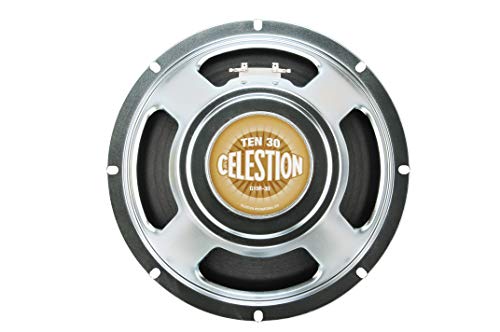


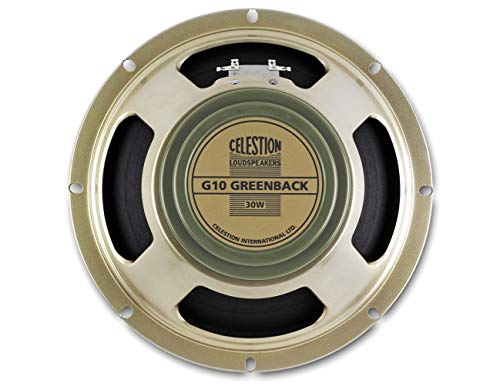
As an Amazon Associate we earn from qualifying purchases at no extra cost to you.
Guitar speaker comparison
| Model | Size | Power rating (per spec) | Sensitivity (approx.) | Voicing | Price tier |
|---|---|---|---|---|---|
| Celestion Vintage 30 | 12-inch | 60 W | about 100 dB | Aggressive upper mids, tight low end | Mid |
| Celestion G12M Greenback | 12-inch | 25 W | about 97 dB | Warm, fuzzy British crunch | Mid |
| Celestion G12M-65 Creamback | 12-inch | 65 W | about 97 dB | Smooth, rounded highs | Mid |
| Celestion Neo Creamback | 12-inch neodymium | about 60 W class | about 97 dB | Creamback voice, much lighter | Mid to premium |
| Celestion G12K-100 | 12-inch | 100 W | about 98 dB | Big, clean low end, high headroom | Mid |
| Eminence Texas Heat | 12-inch | 150 W | about 99 dB | Open American, high headroom | Mid |
| Jensen C12N | 12-inch | 50 W | about 100 dB | Clean sparkle, American blackface voicing | Entry to mid |
| Line 6 Powercab 112 Plus (FRFR/modeling) | Powered cabinet | 250 W class | Powered, DSP speaker modes | Switchable FRFR and speaker models | Premium |
Sensitivity numbers are the manufacturer’s rating at 1 watt and 1 metre. Three decibels more sensitivity sounds roughly twice as loud for the same amp power, which matters more than most players expect.
How a guitar speaker shapes your tone
A guitar speaker is the last filter in the signal path. Unlike a hi-fi speaker, it is designed to roll off above roughly 5 kHz, so it removes the harsh fizz of a distorted signal, and it adds its own midrange peak. The cone material, magnet, voice coil and cone-edge stiffness decide how quickly it breaks up and how it compresses. Swapping a single 12-inch speaker often changes the amp’s character more than swapping a pedal.
Because most of these speakers are 8 ohm or 16 ohm, match the impedance to the amp output or its selector. Mismatching a tube amp can stress the output transformer and shorten tube life. A single 16 ohm speaker on an 8 ohm tap is a common mistake that sounds fine briefly and then causes problems.
Best overall: Celestion Vintage 30
Spec line: 12-inch, 60 W, around 100 dB sensitivity, 8 or 16 ohm, ceramic magnet, 75 to 5 kHz usable response per Celestion’s chart.
Best for: rock, hard rock and metal tube amps in the 15 to 100 watt range. Skip if: you want a smooth, vintage 1960s British sound.
- Pro: strong upper-mid presence that cuts through a mix at gig volume.
- Pro: tight bass and fast response for high-gain palm muting.
- Pro: the most commonly sold replacement speaker, so cabinets and used speakers are easy to find.
- Con: can sound hard or honky with a bright amp or single-coil guitar.
- Con: needs break-in time of several hours before it settles.
Best for classic British crunch: Celestion G12M Greenback
Spec line: 12-inch, 25 W, about 97 dB, 8 or 16 ohm, ceramic magnet, strongly damped low end with a rounded top.
Best for: low-wattage tube amps and classic rock, blues and indie tones. Skip if: you need high power handling or play very loud with a big amp.
- Pro: a warm, woolly breakup that many players treat as the template for 1960s and 1970s rock.
- Pro: works well in 4×12 cabs at gig volume when four speakers share the load.
- Pro: smooths harsh fuzz and overdrive pedals.
- Con: the 25 W rating limits a 50 W amp used in a single-speaker combo.
- Con: loose low end when pushed hard.
Best all-rounder for vintage tone: Celestion G12M-65 Creamback
Spec line: 12-inch, 65 W, about 97 dB, 8 or 16 ohm, ceramic magnet, 65 W rating that lets it handle more power than the Greenback.
Best for: rock, blues and classic crunch players who also play at higher volume. Skip if: you want the sharper Vintage 30 attitude.
- Pro: smoother treble than the Vintage 30 and more power handling than the Greenback.
- Pro: some roundups name it the top choice for vintage-style rock and blues rigs.
- Pro: works with clean, crunch and moderate high-gain tones.
- Con: less aggressive in the upper mids for heavy modern metal.
- Con: a little darker than some players like.
Best lightweight option: Celestion Neo Creamback
Spec line: 12-inch neodymium-magnet version of the Creamback, 8 or 16 ohm, designed to weigh around half of a ceramic-magnet speaker.
Best for: gigging players with 2×12 or 4×12 cabinets, or anyone with a bad back. Skip if: you do not move your rig often.
- Pro: weight savings add up, especially in a 4×12 cabinet.
- Pro: close to the sound of the standard Creamback, according to published reviews.
- Pro: good power handling for its size.
- Con: higher cost than the ceramic version.
- Con: some players hear a slightly faster, tighter bottom end that lacks the same loose warmth.
Best for headroom and clean power: Celestion G12K-100 and Eminence Texas Heat
These two suit high-wattage amps or players who want clean tones that stay clean at volume. The Celestion G12K-100 is a 100 W 12-inch that offers big low end and a controlled top. The Eminence Texas Heat is a 12-inch rated up to about 150 W with an American voicing, open mids and good sensitivity near 99 dB.
Best for: country, funk, clean pop, jazz and bass-heavy players, or amps rated at 100 W and above. Skip if: you want early breakup from a small tube amp, since high power handling speakers need more volume to wake up.
- Pro: very high headroom, less compression and less distortion at stage volume.
- Pro: tight low end that suits drop tunings and seven-string guitars.
- Pro: American-voiced options pair well with blackface style amps and single-coil guitars.
- Con: slower to break up, so small amps may feel stiff.
- Con: a larger magnet makes them heavier.
Best clean American sparkle: Jensen C12N
The Jensen C12N is a 12-inch, 50 W speaker with sensitivity around 100 dB and a vintage American voice with a bright, open top. It suits tweed and blackface style amps, country, surf and clean blues. Skip if: you want a tight high-gain sound; it can feel splashy there. Pros are crisp highs, high sensitivity and a moderate cost. Cons are less bass depth and early distortion at high volume with a bigger amp.
Best for modelers: FRFR and guitar-aware powered cabs
If your amp is a Kemper, Helix, Axe-Fx, Quad Cortex or a pedal-based modeler, a guitar speaker adds a second round of cabinet colouring on top of the cab model, which usually sounds muddy. Use one of these instead:
- Fender Tone Master FR-12: a 12-inch FRFR cabinet with a high-power class-D amp around 1,000 W peak, designed for flat response and a clean stage monitor. Best for pure FRFR use with a modeler.
- Line 6 Powercab 112 Plus: a powered 12-inch cab with a switchable FRFR mode and a set of speaker models that copy classic guitar speakers, plus a power amp. Best for players who want a guitar-cab feel without the weight of a stack.
- Headrush FRFR-112 MK2: a 12-inch FRFR cab with a high-power amp and lightweight cabinet. Best for players already in the Headrush ecosystem or who want a lower cost option.
Each of these needs a line-level signal from the modeler. Do not plug a tube amp’s speaker output into a powered cabinet; use the modeler’s line outputs or a speaker-output load box.
How to choose a replacement guitar speaker
Match power rating to your amp
A speaker rated at or above the amp’s output is safe. A 25 W Greenback in a 50 W combo will fail if the amp is turned up for long periods. In a 4×12 cab, divide the amp power by four; four Greenbacks at 25 W each handle 100 W. Add a margin, especially with high-gain tones, where sustained compression raises the average power the speaker has to take.
Check impedance
If the amp has a single 8 ohm output, install an 8 ohm speaker or wire two 16 ohm speakers in parallel (16 divided by two equals 8). Use 16 ohm in a single-speaker setup only when the amp is set to 16 ohm output. Tube amps are less forgiving of mismatches than solid-state amps.
Think about weight and size
A ceramic 12-inch speaker typically weighs about 4 to 5 kg, while a neodymium model can be about half of that. A 4×12 cabinet with four ceramic speakers adds roughly 8 kg compared with the neo version. The difference is a major factor if you carry gear up stairs.
Match voicing to genre
| Genre | Try first | Alternative |
|---|---|---|
| Metal and modern high gain | Vintage 30 | G12K-100 for tighter, bigger low end |
| Classic rock | G12M Greenback | G12M-65 Creamback |
| Blues and indie | G12M-65 Creamback | Jensen C12N |
| Country, funk, clean pop | Texas Heat | Jensen C12N |
| Modeler or profiler | FRFR cab | Powercab 112 Plus |
Worked example: wiring and loudness in a 2×12 upgrade
Say you own a 50 W tube head with 4, 8 and 16 ohm outputs and a 2×12 cabinet. Two 16 ohm speakers wired in parallel present 8 ohms, so you use the 8 ohm tap. Wired in series they would present 32 ohms, which no common amp output supports, so series wiring is not an option here. Two 8 ohm speakers in parallel would give 4 ohms, which needs the 4 ohm tap. Always read the impedance on the speaker magnet or label before buying.
Now compare loudness. Two Vintage 30 speakers at 100 dB each add roughly 3 dB when paired, giving about 103 dB at 1 watt and 1 metre. Two Greenbacks at 97 dB give about 100 dB, which means the Vintage 30 pair sounds close to twice as loud for the same amp setting. That is why swapping Greenbacks for Vintage 30s often feels like a volume boost, and why a Greenback-loaded cab seems to break up earlier relative to the room volume. If you need more headroom rather than more loudness, look at power rating, not sensitivity: two Greenbacks give 50 W of handling, two G12K-100 speakers give 200 W.
Best guitar speakers by amp type
Low-wattage tube amps (5 to 20 W)
These amps reach power-tube breakup at low volume, so a high-sensitivity speaker with modest power handling lets them work hard without being overwhelming. The Greenback and Jensen C12N are the common choices, and the Vintage 30 works if you want upper-mid bite for rock.
50 to 100 W tube amps
Choose a speaker rated at 50 W or more, per speaker in a single-speaker cabinet, or a pair in a 2×12 where power is shared. The Vintage 30 and Creamback are the usual starting points, with the G12K-100 as the answer for clean headroom.
Solid-state and hybrid amps
Solid-state amps make a more consistent, less compressed signal, so a speaker with a smooth top end, such as a Creamback, can soften harshness. If the amp sounds brittle, a speaker swap is cheaper than buying pedals to tame it.
Bass-heavy and extended range guitars
Seven and eight-string guitars and drop tunings benefit from higher power handling and a tight low end. The G12K-100 and Texas Heat are common picks, and an FRFR cab is the cleanest solution for modelers with extended-range rigs.
Alternatives worth a look
If none of the picks fit, three other directions are worth considering. The Celestion Seventy 80 sits between the Greenback and Vintage 30 in tone with a higher power rating. Eminence Swamp Thang offers a high-sensitivity, high-power American voice for loud clean or crunch playing. For modelers who like a tube-amp feel but want a lighter cab, a powered guitar cabinet with selectable speaker voicings is often more practical than a traditional 4×12.
Ownership realities
- Break-in: new speakers tighten and sweeten over roughly 10 to 20 hours of play; judge them after that, not on the first night.
- What wears first: cones and surrounds if run at their limit for years, and solder joints on cabinet terminals.
- Mixing speakers: pairing two different models in a 2×12 can balance tone, such as one Greenback with one Vintage 30, but both need the same impedance and sensible power ratings.
- Open or closed back: an open-back cabinet sounds airier and spreads sound in the room, while a closed-back cabinet adds low-end punch. The speaker choice interacts with the cabinet, so listen before you change both at once.
Frequently Asked Questions
What is the best guitar speaker for metal?
The Celestion Vintage 30 is the common choice because of its tight low end and strong upper mids. Players who want even more low-end authority and headroom often move to the G12K-100. Match the speaker count and impedance to your amp before deciding.
Which Celestion speaker is best for a beginner upgrading a combo?
For a typical 15 to 50 watt tube combo, the Vintage 30 gives more bite and the G12M-65 Creamback gives a smoother classic sound. Pick based on whether you want a modern or vintage character, and confirm the size and impedance of your current speaker first.
What are the best 12 inch guitar speakers for clean tones?
Speakers with high power handling and open voicing, like the Eminence Texas Heat or Jensen C12N, keep clean tones clear at volume. They need a louder amp setting to break up, so a small amp may sound clean but quiet.
What is a FRFR speaker and do I need one?
FRFR stands for full-range, flat-response. These cabinets reproduce your signal without adding the roll-off and midrange peak of a guitar speaker, which is what a modeler or profiler expects. You only need one if you play a digital rig and want to avoid double colouring.
Can I replace the speaker in any guitar amp?
Most amps accept a replacement if the new speaker matches size, impedance and power rating. Check the amp’s output setting and cabinet mounting holes first. Sealed or very small combos may limit options, and some modern amps use custom speakers, so look at the original specifications before ordering.
Is a neodymium guitar speaker worth the extra cost?
If you carry your cabinet often, yes: the weight savings are significant and the sound is close to the ceramic version. If the cabinet stays in a rehearsal room, a standard ceramic speaker gives better value.
More from Amazon
Programs that pair well with the guide above. Offers and eligibility are set by Amazon and may change.
Free shipping on eligible items, Prime Video and more. Eligible new members can start with a free trial.
Start a Prime free trialAd-free music streaming. Eligible new subscribers can start with a free trial.
Try Music Unlimited freeA Prime membership for ages 18-24 with a trial period. Eligibility is set by Amazon.
See Prime for Young AdultsAudiobooks and podcasts to listen to on the go. Eligible new members can start with a free trial.
Try Audible freeAs an Amazon Associate we earn from qualifying purchases.






Write Your Review
No reviews yet. Be the first to share your experience!