

Our Short List of 3
All 4 Picks at a Glance
| Product | Specs | Action |
|---|---|---|
 GardePro E6 WiFi Trail Camera | Check price on Amazon | |
 GardePro E8 WiFi Trail Camera | Check price on Amazon | |
 CEYOMUR CY95 Solar WiFi Trail Camera | Check price on Amazon | |
 GardePro E8PMB WiFi Trail Camera | Check price on Amazon |
Key takeaways
- Find the best wifi trail cameras with app viewing, no-glow night vision, and long battery life for scouting wildlife and watching property.
The best wifi trail cameras let you check on a trail, a feeder, or a stretch of fence line without walking out to the camera every time. Instead of pulling a memory card and carrying it back to a computer, you open an app on your phone while you stand near the camera and look through the photos and clips it has captured. That small change matters more than it sounds. A camera on a distant trail stays undisturbed, animals are not pushed away by repeated visits, and you learn what passed by within minutes of arriving at the site rather than days later.
A WiFi trail camera is different from a cellular trail camera, and the difference decides whether it fits your setup. A WiFi model connects directly to your phone over a short-range wireless link at the camera site and carries no monthly plan. A cellular model sends images over a mobile network from anywhere with signal, but it needs a data plan. If your camera sits near a cabin, a barn, or a garden close to your home network, a WiFi model gives you remote viewing without a recurring plan. If it sits miles from any network, a cellular model is the better tool, and this guide is not the place to find one.
The cameras in this guide all connect over WiFi to a phone app, record photos and video when motion triggers them, and use no-glow infrared for night images. They differ in resolution, detection range, power, and how far the WiFi link reaches. One is a straightforward model for a first setup, one covers a wider area with faster detection, one runs on a built-in rechargeable battery with a solar panel, and one pairs a large rechargeable battery with built-in memory. The guide below walks through the features that matter, then compares the four models so you can match one to the place you plan to watch.
How to Choose
1. WiFi Range and How You View Images
WiFi range is the first thing to check, because it decides where the camera can sit. Most WiFi trail cameras connect to a phone at a distance of roughly 30 to 165 feet, depending on the model, the antennas, and what stands between the camera and the phone. A camera with dual external antennas generally holds a steadier link through trees and around a building corner than a camera with a single internal antenna. Before you buy, think about where you will stand when you check the camera. If the camera watches a feeder at the edge of a yard, a short link is enough. If it sits deep in a wooded lot, look for a model that lists a longer WiFi range and dual antennas. Remember that WiFi on these cameras is for viewing images on site, not for watching a live feed from miles away.
2. Photo and Video Resolution
Resolution shapes how much detail you can see in a photo, from antler points on a buck to the markings on a coyote. The cameras in this guide list photo resolutions from 48 megapixels to 68 megapixels, and video from 1296p to 4K. Higher numbers help when you crop into a distant animal, but they are not the whole story. A well-tuned sensor with strong night illumination often produces a more useful image than a camera with a bigger headline number and weak night performance. Video resolution matters when you want to watch how an animal moves, and a camera that records 4K video gives you smooth, detailed footage. Higher resolution files fill a memory card faster, so a camera with built-in memory or a large card slot earns its keep on a busy trail.
3. Trigger Speed and Detection Range
Trigger speed is the time between the moment the sensor detects motion and the moment the camera captures an image. A slow trigger misses animals that walk past quickly, while a fast trigger catches them in the frame. Look for a trigger around half a second or faster for trails where deer and other game move at a steady walk. The cameras in this guide list trigger speeds from 0.05 seconds to 0.2 seconds, which is fast enough for most trail and feeder setups. Detection range tells you how far away the sensor can pick up movement, and the models here cover roughly 65 to 120 feet. A long detection range helps on field edges and food plots, while a wide detection angle helps on trails where animals may pass to either side of the camera. A camera with triple sensors and a 120-degree detection angle covers a generous area, but it also captures more movement from wind-blown branches, so placement and sensitivity settings matter.
4. Night Vision and Flash Type
Most game movement happens at dawn, at dusk, or after dark, so night performance decides how useful a camera really is. No-glow infrared uses black LEDs that produce no visible flash, which keeps animals calm and keeps the camera hard to spot. Low-glow infrared produces a faint red glow that is visible up close but reaches farther. For hunting and wildlife watching, no-glow is the safer choice on trails and near bedding areas. Check the stated night range as well, and remember that the detection range and the illumination range are not always the same number.
5. Power: Batteries, Rechargeable Packs, and Solar
Trail cameras run on AA batteries in most cases, and battery life depends on how often the camera triggers, how cold the weather gets, and whether it records video. A camera that triggers hundreds of times a week will drain batteries far faster than one on a quiet trail. Two of the cameras in this guide take a different path: they use a built-in rechargeable battery, and one adds an integrated solar panel that tops the battery up during daylight. A rechargeable model saves you from buying batteries, but it needs a charging plan, either a solar panel or a trip home to a charger. When you compare models, check the battery capacity and whether the camera supports an external power source for long deployments.
6. Weather Sealing and Build
A trail camera lives outdoors through rain, dust, heat, and cold, so weather sealing is not a minor detail. Look for IP66 protection, which means the housing resists strong water jets and dust, and check that the door seals close firmly around the memory card slot and the battery compartment. A camouflage housing helps the camera blend into a tree trunk, and a sturdy mounting strap keeps it in place through wind. Cold weather shortens battery life on every model, so a camera that will sit out through winter deserves a power plan that accounts for it.
7. Storage: Memory Cards and Built-In Memory
A trail camera needs somewhere to put its photos and clips, and the storage setup decides how often you must visit. Most models take a microSD card, and the maximum supported size varies, so check the listing for the card size the camera accepts before you buy a card. One model in this guide carries built-in memory, which means it can record even if you forget a card, and another ships with a 32GB card in the box. Higher resolution photos and 4K video fill storage faster, so a camera on a busy trail benefits from a larger card. The WiFi app lets you view and download selected files to your phone, but it does not empty the card, so clear old files when you visit.
Top Picks
GardePro E6 WiFi Trail Camera
View the GardePro E6 WiFi Trail Camera on Amazon
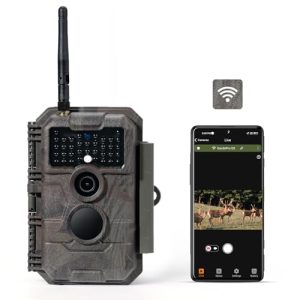
The GardePro E6 is the straightforward pick in this guide, and it suits a first WiFi trail camera setup. It captures 48MP photos and 1296P video, uses no-glow infrared for night images, and connects to a phone app over WiFi with a live view, so you can check images and adjust settings while standing near the camera. The 110-degree wide-angle lens covers a broad stretch of trail, and the external antenna helps the WiFi link hold steady through light cover.
This camera is for someone setting up a first trail camera on a feeder, a garden edge, or a wooded lot near home, who wants app viewing without a complicated setup. It is a good match for a hunter scouting a single trail or a homeowner watching wildlife at a feeder, where the camera sits within WiFi range of a regular visit spot. One caveat is that the WiFi link is a short-range, on-site connection, so you still need to visit the camera to view new images; it does not send photos to your phone from miles away. Another is that it runs on AA batteries, so a busy trail will need fresh batteries more often than a quiet one. Confirm the exact model E6 on the listing before ordering, since GardePro sells several similar-looking trail cameras and the listing carries more than one variant.
GardePro E8 WiFi Trail Camera
View the GardePro E8 WiFi Trail Camera on Amazon
The GardePro E8 steps up the detection side of the job. It captures 48MP photos and 1296P video, and it uses triple PIR sensors with a 120-degree detection angle and a 0.1-second trigger, so it wakes quickly and covers a wide area. The detection range reaches up to 100 feet, which suits a field edge or a food plot where animals may pass at a distance. No-glow night vision keeps the camera discreet after dark, and the WiFi connection lets you view images through the phone app without opening the camera.
This camera is for someone watching a wide area, such as a field edge, a food plot, or a trail junction, where animals may cross at different points and a narrow sensor would miss them. One caveat is that a wide, sensitive sensor also picks up more movement from wind-blown branches, so placement and sensitivity settings matter more here than on a narrower camera. Another is that different regional listings for the E8 show different ASINs, so confirm the exact model and variant on the Amazon US listing before ordering. The camera runs on AA batteries, so plan battery changes around how busy the location is.
CEYOMUR CY95 Solar WiFi Trail Camera
View the CEYOMUR CY95 Solar WiFi Trail Camera on Amazon
The CEYOMUR CY95 is the pick for a long deployment with little maintenance. It pairs a 4K video sensor with 68MP photos, a built-in 5200mAh rechargeable battery, and an integrated solar panel that tops the battery up during daylight. WiFi and Bluetooth connect it to a phone app for viewing images and changing settings, and a 32GB microSD card is included in the box. The 120-degree detection angle and no-glow night vision cover a wide area after dark, and the IP66 housing resists rain and dust.
This camera is for someone who wants to leave a camera out for a long stretch without carrying spare batteries, such as a wildlife watcher monitoring a remote feeder or a property owner watching a back field. One caveat is that the solar panel needs daylight to keep the battery charged, so a camera mounted in deep shade will charge more slowly than one with a clear view of the sky. Another is that 4K video files are large, so the included 32GB card fills faster on a busy trail than it would with lower resolution settings. Check the listing for the exact CY95 variant, since CEYOMUR sells similar solar models with different photo resolutions.
GardePro E8PMB WiFi Trail Camera
View the GardePro E8PMB WiFi Trail Camera on Amazon
The GardePro E8PMB is the pick for someone who wants a rechargeable trail camera with storage already handled. It captures 64MP photos and 1296P video, runs on a built-in 8000mAh rechargeable battery, and carries 32GB of built-in memory, so it can record even before you add a card. The 120-degree wide-angle motion detection and 0.1-second trigger cover a broad area quickly, and no-glow night vision keeps images clear after dark without a visible flash. WiFi connects the camera to the phone app for viewing and settings.
This camera is for someone who dislikes buying batteries and forgetting memory cards, and who wants a camera that is ready to mount straight out of the box. One caveat is that the built-in battery must be recharged, so a camera on a distant trail needs a charging plan, either a solar panel or a trip home to a charger. Another is that 32GB of built-in memory fills faster with 64MP photos and video on a busy trail, so check the storage through the app on your visits and clear old files when needed. Confirm the exact model E8PMB on the listing before ordering, since GardePro sells several E8 variants with different power setups.
Comparison Table
| Camera | Photos | Video | Detection | Night Vision | Power | Storage |
|---|---|---|---|---|---|---|
| GardePro E6 | 48MP | 1296P | 110-degree lens | No-glow infrared | AA batteries | microSD card |
| GardePro E8 | 48MP | 1296P | 120-degree, 0.1s trigger, up to 100 ft | No-glow infrared | AA batteries | microSD card |
| CEYOMUR CY95 | 68MP | 4K | 120-degree | No-glow infrared | 5200mAh rechargeable plus solar panel | 32GB card included |
| GardePro E8PMB | 64MP | 1296P | 120-degree, 0.1s trigger | No-glow infrared | 8000mAh rechargeable | 32GB built-in memory |
Which One Is Right for You?
If you are setting up your first WiFi trail camera and want a simple, proven design, the GardePro E6 is the natural starting point. It covers the basics well and suits a feeder or a single trail near home. If your camera needs to watch a wide area, such as a field edge or a trail junction, the GardePro E8 earns its place with triple sensors, a 120-degree detection angle, and a fast trigger.
If you want to leave the camera out for weeks without carrying batteries, the CEYOMUR CY95 is the strongest choice, thanks to its solar panel, rechargeable battery, and 4K video, as long as the solar panel gets daylight. If you want a rechargeable camera that is ready to mount with storage already inside, the GardePro E8PMB fits, with its large battery and built-in memory.
Before you order, settle the practical questions. Measure how far the camera will sit from the spot where you will stand to view images, and pick a model whose WiFi range covers that distance. Decide whether you want to buy batteries or recharge a pack, and whether the camera will get enough daylight for a solar panel. Then confirm the exact model and variant on the listing, since several of these brands sell look-alike models with different power setups and resolutions.
Frequently Asked Questions
Do WiFi trail cameras need a monthly plan?
No. A WiFi trail camera connects directly to your phone over a short-range wireless link, and it carries no monthly plan. You open the app while you are near the camera and view or download the images it has captured. A cellular trail camera is the type that sends images over a mobile network from anywhere with signal, and that type does need a data plan. If your camera sits near a cabin, a barn, or a wooded lot close to home, a WiFi model gives you remote viewing without a recurring plan.
How far away can I view images from a WiFi trail camera?
It depends on the model, the antennas, and what stands between the camera and your phone. Most WiFi trail cameras connect at a distance of roughly 30 to 165 feet, and models with dual external antennas generally hold a steadier link through trees and around building corners. Mount the camera where you can stand within range when you visit.
Will a WiFi trail camera scare animals at night?
A no-glow infrared camera produces no visible flash, which keeps animals calm and keeps the camera hard to spot after dark. All four cameras in this guide use no-glow infrared. Animals may still notice a camera if its lens reflects light or if it sits at eye level on a narrow trail, so mount it slightly above animal height and angle it down the trail.
What memory card does a WiFi trail camera need?
Most models take a microSD card, and the maximum supported size varies by model, so check the listing for the card size the camera accepts before you buy one. The CEYOMUR CY95 ships with a 32GB card in the box, and the GardePro E8PMB carries 32GB of built-in memory, so both can record without a separate card purchase. Higher resolution photos and 4K video fill storage faster, so a camera on a busy trail benefits from a larger card and a routine for clearing old files.
Disclosure: As an Amazon Associate, we may earn from qualifying purchases.
More from Amazon
Programs that pair well with the guide above. Offers and eligibility are set by Amazon and may change.
Free shipping on eligible items, Prime Video and more. Eligible new members can start with a free trial.
Start a Prime free trialAd-free music streaming. Eligible new subscribers can start with a free trial.
Try Music Unlimited freeA Prime membership for ages 18-24 with a trial period. Eligibility is set by Amazon.
See Prime for Young AdultsAudiobooks and podcasts to listen to on the go. Eligible new members can start with a free trial.
Try Audible freeAs an Amazon Associate we earn from qualifying purchases.






Write Your Review
No reviews yet. Be the first to share your experience!