
Our Short List of 3
All 4 Picks at a Glance
| Product | Specs | Action |
|---|---|---|
 1. Canon EOS Rebel T7 with EF-S 18-55mm f/3.5-5.6 IS II | Check price on Amazon | |
 2. Canon EOS 90D with EF-S 18-135mm f/3.5-5.6 IS USM | Check price on Amazon | |
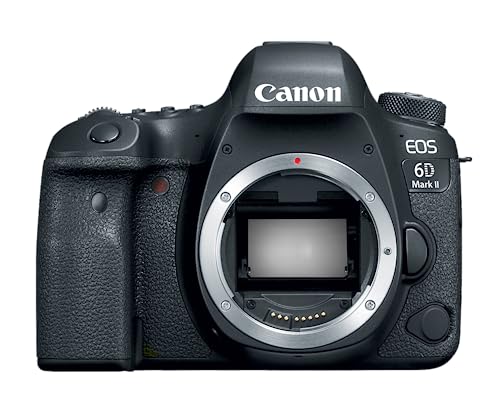 3. Canon EOS 6D Mark II (Body Only) | Check price on Amazon | |
 4. Canon EOS 5D Mark IV (Body Only) | Check price on Amazon |
Key takeaways
- Compare the Canon DSLR cameras still sold today, from the Rebel T7 kit and EOS 90D to the 6D Mark II and 5D Mark IV, by sensor, autofocus and video specs.
As an Amazon Associate, we earn from qualifying purchases made through links on this page.
Canon no longer develops new DSLR models. Its engineering effort sits with the EOS R mirrorless line, and no new EOS DSLR body has been announced since the flagship 1D X Mark III in 2020. What remains is a finished, mature system: well-understood bodies, an optical viewfinder in every one, battery life no mirrorless camera matches, and the deepest lens catalogue Canon has ever built, because EF and EF-S lenses have been produced since 1987.
That changes how a Canon DSLR roundup has to be built in 2026. The question is no longer which body is newest, but which of the surviving bodies can still be bought with confidence and which one fits your subjects. This guide covers the four Canon DSLRs whose Amazon US listings could be verified as live at the time of writing: the Rebel T7 kit, the EOS 90D, the EOS 6D Mark II and the EOS 5D Mark IV, running from entry point to professional flagship. Every camera here is a true DSLR with a reflex mirror and a Canon EF or EF-S mount. No EOS R or EOS M mirrorless body appears, because those are a different system with a different mount. One further model, the EOS Rebel SL3, is named without a link near the end, with the reason stated plainly.
What to look for
Sensor size divides the line in two. The Rebel T7 and the EOS 90D use APS-C sensors measuring about 22.3 x 14.9 mm. The 6D Mark II and the 5D Mark IV use full-frame sensors at 36 x 24 mm, gathering roughly two and a half times the light per frame. The full-frame bodies hold cleaner files at high ISO settings and give shallower depth of field with the same lens, while the APS-C bodies multiply lens reach by a factor of 1.6, a free bonus for wildlife and sports shooters, and keep body and lens combinations smaller. Resolution runs from 24.1 megapixels in the T7 to 32.5 megapixels in the 90D, the highest pixel count Canon has put in a crop-sensor DSLR.
The mount decides your lens library. APS-C bodies accept both EF-S and EF lenses. Full-frame bodies accept EF lenses only, because EF-S optics project a smaller image circle that cannot cover the larger sensor. A buyer who begins with a Rebel and a pair of EF-S zooms owns glass that cannot follow them to a 6D Mark II, while EF lenses bought once serve every body in this guide. Check any lens you already own against this split before choosing a body.
Every body here focuses two different ways. Through the optical viewfinder, a dedicated phase-detection module does the work: 9 points in the Rebel T7, 45 all cross-type points in both the 90D and the 6D Mark II, and a 61-point reticular array in the 5D Mark IV. Switch to live view or video and Canon’s Dual Pixel CMOS AF takes over on the three newer bodies, reading focus directly from the sensor with smooth, confident tracking. The Rebel T7 predates that system in live view and relies on slower contrast detection there, the single biggest handling gap on this list.
Video ceilings differ sharply. The Rebel T7 stops at Full HD 1080p at 30 frames per second. The 6D Mark II reaches 1080p at 60 frames per second but has no 4K mode at all. The 90D records uncropped 4K at 30 frames per second and 1080p at up to 120 frames per second for slow motion. The 5D Mark IV records DCI 4K at 30 frames per second in Motion JPEG, which produces very large files and reads from a cropped area of the sensor of about 1.64x. If video matters as much as stills, those four lines decide the shortlist on their own.
Battery life and the viewfinder are the DSLR dividend. Canon’s CIPA figures run from about 500 shots per charge in the Rebel T7 to about 1,300 in the 90D, numbers mirrorless bodies rarely approach, because the optical viewfinder draws almost no power. The finders themselves improve as you climb: about 95 percent frame coverage in the T7, about 98 percent in the 6D Mark II, and a full 100 percent in the 90D and the 5D Mark IV. A brighter, complete finder rewards careful composition at the edges of the frame.
The Canon DSLRs, compared
1. Canon EOS Rebel T7 with EF-S 18-55mm f/3.5-5.6 IS II
See the Rebel T7 kit on Amazon
The Rebel T7 is the entry point of the Canon DSLR system and the body most first-time buyers will meet. Its 24.1 megapixel APS-C sensor and DIGIC 4+ processor deliver clean files at sensible ISO settings, and the bundled EF-S 18-55mm f/3.5-5.6 IS II zoom covers the everyday range from group shots to short telephoto portraits, with optical stabilisation that helps in dim rooms. The 9-point autofocus system has a cross-type centre point and handles static and slow-moving subjects without fuss, while Scene Intelligent Auto and the guided display mode explain settings in plain language as you learn. Built-in Wi-Fi and NFC pass images to a phone through Canon’s Camera Connect app, and the LP-E10 battery is good for about 500 shots per charge, enough for a full day out.
The limits are the limits of its generation. Continuous shooting runs at 3 frames per second, so fast action is a matter of timing one frame rather than holding the button. Video stops at 1080p30 with no Dual Pixel AF, which means live view and movie focus hunt in a way the other bodies here do not. The rear screen is fixed rather than tilting, and the viewfinder shows about 95 percent of the frame. None of that prevents good photographs; it marks the T7 as a stills-first learning camera, the job it was built for.
Key specs: 24.1MP APS-C sensor, DIGIC 4+, ISO 100-6400 (expandable to 12800), 9-point AF, 3 fps, 1080p30 video, 3.0-inch fixed screen, Wi-Fi and NFC, about 500 shots per charge, 475 g with battery and card, kit lens included.
2. Canon EOS 90D with EF-S 18-135mm f/3.5-5.6 IS USM
See the EOS 90D with 18-135mm lens on Amazon
The 90D is the most capable APS-C DSLR Canon has made, and for action shooters it is arguably the strongest body in this guide. The 32.5 megapixel sensor is the highest-resolution crop sensor in the EOS DSLR line, DIGIC 8 processing pushes continuous shooting to 10 frames per second through the viewfinder and 11 in live view, and the 45-point all cross-type autofocus module is backed by a 220,000-pixel metering sensor that adds face detection even when you shoot through the finder. Dual Pixel CMOS AF covers live view and video, and the video specification leads the crop-sensor class: uncropped 4K at 30 frames per second and Full HD at up to 120 frames per second. The body is sealed against dust and moisture, the 3.0-inch vari-angle touch screen flips for self-recording, and the LP-E6N battery lasts about 1,300 shots. The EF-S 18-135mm IS USM lens it is commonly sold with uses a Nano USM motor that focuses quickly for stills and quietly for video, and its range replaces two lesser zooms.
Two honest caveats apply. First, the 90D’s dense pixel pitch rewards good lenses and steady technique; soft kit glass will show its limits at 32.5 megapixels. Second, Canon’s own body and kit listings for the 90D have thinned out, and the live Amazon US listings are now largely configurations from authorised Canon sellers built around the 18-135mm kit, so check exactly which lens and accessories a given listing contains before ordering.
Key specs: 32.5MP APS-C sensor, DIGIC 8, ISO 100-25600 (expandable to 51200), 45-point all cross-type AF plus Dual Pixel CMOS AF, 10 fps, 4K30p and 1080p120 video, 3.0-inch vari-angle touch screen, Wi-Fi and Bluetooth, about 1,300 shots per charge, 701 g with battery and card.
3. Canon EOS 6D Mark II (Body Only)
See the EOS 6D Mark II body on Amazon
The 6D Mark II is Canon’s lightest full-frame DSLR and the natural step up for a Rebel owner whose EF lenses are waiting for a bigger sensor. The 26.2 megapixel full-frame sensor and DIGIC 7 processor produce clean files to ISO 40000 on the standard range, the 45-point all cross-type autofocus system is the same layout as the 90D’s, and Dual Pixel CMOS AF handles live view and video focus smoothly. It is the only full-frame body here with a vari-angle touch screen, which makes it the friendliest of the three senior bodies for video diaries, low-angle work and self-portraits, and it adds built-in GPS for geotagging on trips. Battery life of about 1,200 shots per charge and a body weight of 765 g with battery and card keep it travel-friendly by full-frame standards.
The compromises are clear on paper. There is no 4K video at all, with Full HD capped at 60 frames per second, and a single SD card slot means no in-camera backup for paid work. The viewfinder shows about 98 percent of the frame rather than all of it, and the sensor’s dynamic range at base ISO trails the 5D Mark IV. For stills-led shooters who want full-frame rendering without the bulk or file sizes of the flagship, those trades are reasonable.
Key specs: 26.2MP full-frame sensor, DIGIC 7, ISO 100-40000 (expandable to 102400), 45-point all cross-type AF plus Dual Pixel CMOS AF, 6.5 fps, 1080p60 video, 3.0-inch vari-angle touch screen, built-in GPS, Wi-Fi, NFC and Bluetooth, about 1,200 shots per charge, 765 g with battery and card, body only.
4. Canon EOS 5D Mark IV (Body Only)
See the EOS 5D Mark IV body on Amazon
The 5D Mark IV is the professional anchor of the Canon DSLR line and the body wedding, portrait and editorial shooters built their EF lens collections around. Its 30.4 megapixel full-frame sensor and DIGIC 6+ processor deliver the best stills quality of any camera in this guide, with a 61-point High Density Reticular autofocus system (41 cross-type points) that tracks subjects through the finder with a confidence the other bodies cannot match. Dual Pixel CMOS AF covers live view work, and Dual Pixel RAW recording even allows small focus adjustments to compatible files after the shot. Working photographers get the practical hardware too: dual card slots (CompactFlash and SD) for instant backup, a magnesium alloy body sealed against dust and water, a 100 percent viewfinder, built-in GPS and Wi-Fi, and a shutter built for heavy professional use. Continuous shooting runs at 7 frames per second.
Its age shows in video and in the details. The DCI 4K mode records Motion JPEG files that fill cards quickly and reads a cropped area of the sensor, the rear screen is fixed and the SD slot is UHS-I speed, and at 890 g with battery and card it is the heaviest body here. The files, the focusing and the build are still the benchmark the rest of the line is measured against.
Key specs: 30.4MP full-frame sensor, DIGIC 6+, ISO 100-32000 (expandable to 102400), 61-point AF with 41 cross-type points plus Dual Pixel CMOS AF, 7 fps, DCI 4K30p and 1080p60 video, 3.2-inch touch screen, built-in GPS and Wi-Fi, dual CF and SD slots, about 900 shots per charge, 890 g with battery and card, body only.
A note on the EOS Rebel SL3
On specification alone the Rebel SL3 would sit between the T7 and the 90D in this list: a 24.1 megapixel sensor with DIGIC 8, Dual Pixel CMOS AF, a vari-angle touch screen, 4K video and the smallest, lightest body in the EOS DSLR line at 449 g with battery and card. It is named here without a purchase link because, at the time of writing, the availability signals for its Amazon US kit listing conflicted across the channels checked, with one mirror showing the listing out of stock and another showing only a single used copy. Confirm the SL3’s live listing directly if that body is the one you want.
Comparison table
| Camera | Sensor | Viewfinder AF | Burst | Top video | Screen | Shots per charge (about) |
|---|---|---|---|---|---|---|
| EOS Rebel T7 (18-55mm kit) | 24.1MP APS-C | 9 points | 3 fps | 1080p30 | 3.0-inch fixed | 500 |
| EOS 90D (18-135mm kit) | 32.5MP APS-C | 45 points, all cross-type | 10 fps | 4K30p | 3.0-inch vari-angle touch | 1,300 |
| EOS 6D Mark II (body) | 26.2MP full frame | 45 points, all cross-type | 6.5 fps | 1080p60 | 3.0-inch vari-angle touch | 1,200 |
| EOS 5D Mark IV (body) | 30.4MP full frame | 61 points | 7 fps | DCI 4K30p | 3.2-inch touch, fixed | 900 |
Frequently asked questions
Is Canon still making DSLR cameras?
Canon has directed its development work to the EOS R mirrorless system, and no new EOS DSLR model has been announced since the 1D X Mark III in 2020. The bodies in this guide are existing models still moving through retail channels, which is why stock depth varies by model. A finished system also means a stable lens line and a deep second-hand market.
Can I use EOS R lenses on these cameras?
No. RF-mount lenses for the EOS R system cannot be fitted to an EF or EF-S DSLR body, and no adapter changes that, because the RF mount sits closer to the sensor than a DSLR mirror box allows. The compatibility runs the other way: EF and EF-S lenses adapt forward onto EOS R bodies with Canon’s mount adapter. Buy DSLR lenses in the EF or EF-S mount only.
Which Canon DSLR is best for video?
The EOS 90D, on specification. It records uncropped 4K at 30 frames per second, Full HD at up to 120 frames per second, and focuses in video with Dual Pixel CMOS AF behind a vari-angle touch screen. The 5D Mark IV also records 4K, but in a cropped DCI format with very large Motion JPEG files. The 6D Mark II is a capable 1080p camera with the same Dual Pixel focusing, and the Rebel T7 is the weakest of the four for video, with 1080p30 and contrast-detection focus in live view.
Will my EF-S lenses work on the full-frame bodies?
No. EF-S lenses are built for the smaller APS-C image circle and cannot be mounted on the 6D Mark II or the 5D Mark IV. EF lenses work on every body in this guide, which is why buyers who expect to move to full frame later should favour EF glass from the beginning, though an EF lens behaves as a longer focal length on an APS-C body because of the 1.6x crop factor.
Why buy a DSLR at all when mirrorless exists?
Three reasons: battery life measured in thousands of shots rather than hundreds for the 90D and 6D Mark II, an optical viewfinder that shows the scene with no lag and no power draw, and access to decades of EF and EF-S lenses at second-hand prices mirrorless glass has not reached. The trade is size, weight and the live-view focusing and video features mirrorless bodies do better.
Conclusion
The Canon DSLR line in 2026 is a short list, and each surviving body owns a clear job. The Rebel T7 is the learning camera, simple and light with everything a first DSLR needs. The EOS 90D is the action and video pick, with the resolution, burst speed and 4K specification for serious enthusiasts. The 6D Mark II is the traveller’s full-frame body, light and flexible with the line’s friendliest screen. The 5D Mark IV remains the professional standard for stills, with the focusing system, build and dual slots that paid work demands. Choose by sensor first and by the lenses you own or plan to own second, and every body here will keep producing strong work for years.
More from Amazon
Programs that pair well with the guide above. Offers and eligibility are set by Amazon and may change.
Free shipping on eligible items, Prime Video and more. Eligible new members can start with a free trial.
Start a Prime free trialAd-free music streaming. Eligible new subscribers can start with a free trial.
Try Music Unlimited freeA Prime membership for ages 18-24 with a trial period. Eligibility is set by Amazon.
See Prime for Young AdultsAudiobooks and podcasts to listen to on the go. Eligible new members can start with a free trial.
Try Audible freeAs an Amazon Associate we earn from qualifying purchases.



Write Your Review
No reviews yet. Be the first to share your experience!