

Our Short List of 3

- Screen size: 85 inches (QN85QN90DAFXZA)
- Panel: Neo QLED, Quantum Mini LED backlight
- Resolution: 4K Ultra HD (3,840 x 2,160)
- Refresh rate: Up to 144Hz (Motion Xcelerator Turbo+)

- Screen size: 83 inches (OLED83C4PUA)
- Panel: OLED evo, self-lit pixels
- Resolution: 4K Ultra HD (3,840 x 2,160)
- Refresh rate: Native 120Hz, up to 144Hz with a PC

- Screen size: 85 inches (85U7K)
- Panel: Mini LED ULED with quantum dot colour, full array local dimming
- Resolution: 4K Ultra HD (3,840 x 2,160)
- Refresh rate: Native 144Hz
All 3 Picks at a Glance
| Product | Specs | Action |
|---|---|---|
| 2. Samsung QN90D — 85-Inch Neo QLED for Bright Rooms |
| Check price on Amazon |
| 4. LG OLED evo C4 — 83-Inch OLED for Dark Rooms and PC Gaming |
| Check price on Amazon |
| 5. Hisense U7K — 85-Inch Mini LED With a 144Hz Gaming Panel |
| Check price on Amazon |
Key takeaways
- Compare the best 80-inch class TVs from Sony, Samsung, TCL, LG and Hisense — 83 to 85 inch 4K panels compared on panel type, refresh rate, HDMI 2.1 and HDR.
A note on size before anything else: almost no major brand sells a TV that measures exactly 80 inches. The 80-inch class is really the 82 to 85 inch bracket, and the models in this guide are an 83-inch OLED and four 85-inch sets. That is the size the phrase “80 TVs” points to when people shop for it, and every pick below states its exact screen size in its heading and specifications, so there is no guesswork about what arrives on the delivery truck. If your wall, stand or doorway was planned around a specific width, check the physical dimensions in each listing as well as the diagonal, because an 85-inch panel is roughly 75 inches wide before the stand is added.
At this size, the screen becomes the room. A 4K picture is stretched over a much larger area than on a 55-inch set, so panel quality, backlight control and motion handling matter more, not less. For mixed viewing, most households sit about 9 to 11 feet from an 85-inch 4K screen. Measure your room first, then choose the panel technology that suits how the room is lit.
This guide compares five 80-inch class TVs: a full array LED Sony, a Neo QLED Mini LED Samsung, a QD-Mini LED TCL, an OLED LG and a Mini LED Hisense.
Disclosure: As an Amazon Associate, we earn from qualifying purchases made through links in this article, at no extra cost to you.
Our top picks
Quick Picks
- Best for PlayStation and film processing: Sony X90L, 85 inch — Full array LED with strong picture processing, Dolby Vision and Google TV.
- Best for bright rooms: Samsung QN90D, 85 inch — Neo QLED Mini LED brightness, an anti-glare screen and up to 144Hz motion for sport and gaming.
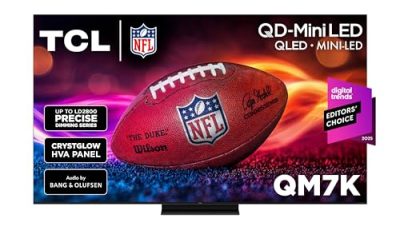
- Best Mini LED feature set: TCL QM7K, 85 inch — QD-Mini LED with Halo Control local dimming, a 144Hz panel and Dolby Vision IQ.
- Best for dark-room movies and PC gaming: LG OLED evo C4, 83 inch — Self-lit OLED contrast, four HDMI 2.1 ports and up to 144Hz with a PC.
- Best big-screen gaming value in the class: Hisense U7K, 85 inch — Mini LED, a native 144Hz panel and Game Mode Pro with Dolby Vision gaming.
1. Sony X90L — 85-Inch Full Array LED for Movies and PlayStation
The Sony X90L, model XR85X90L, is an 85-inch 4K TV built around a full array LED backlight with local dimming. Instead of the Mini LED systems used by most rivals here, Sony pairs a conventional full array backlight with its XR processing, and the result is a picture that handles film grading, shadow detail and upscaled broadcast content with particular care. For households whose big-screen time is mostly films, streamed series and a PlayStation 5, that processing-first approach is a sensible priority.
The panel runs at a native 120Hz, and two HDMI ports support the full HDMI 2.1 feature set, including 4K at 120Hz, variable refresh rate and auto low latency mode. Sony also adds PlayStation-specific features such as auto HDR tone mapping during console setup. Dolby Vision is supported alongside HDR10, and Google TV handles apps and recommendations.
The trade-offs are straightforward. Peak brightness is lower than the Mini LED sets in this guide, so a very bright room with direct daylight is not its strongest setting, and only two HDMI ports carry the full gaming feature set, so a console, a PC and a capture device cannot all have a full-bandwidth port at once.
Key specifications
- Screen size: 85 inches (XR85X90L)
- Panel: Full array LED with local dimming
- Resolution: 4K Ultra HD (3,840 x 2,160)
- Refresh rate: Native 120Hz
- HDR: Dolby Vision, HDR10, HLG
- Smart platform: Google TV
- HDMI: 4 ports, 2 with HDMI 2.1 features (4K at 120Hz, VRR, ALLM)
Pros
- Careful picture processing and upscaling for films and broadcast sport
- Dolby Vision support, which the Samsung in this guide lacks
- PlayStation 5 setup features and 4K 120Hz gaming support
- Google TV with a broad app library
Cons
- Less peak brightness than the Mini LED rivals for very bright rooms
- Only two full-bandwidth HDMI 2.1 ports
- No native 144Hz mode for PC gaming
Check the Sony X90L 85-inch on Amazon
2. Samsung QN90D — 85-Inch Neo QLED for Bright Rooms
- Screen size: 85 inches (QN85QN90DAFXZA)
- Panel: Neo QLED, Quantum Mini LED backlight
- Resolution: 4K Ultra HD (3,840 x 2,160)
- Refresh rate: Up to 144Hz (Motion Xcelerator Turbo+)
The Samsung QN90D, model QN85QN90DAFXZA, is an 85-inch Neo QLED TV that uses a Quantum Mini LED backlight to reach the high brightness a large screen needs in a lit room. Size alone can make a picture look washed out when daylight competes with it, and this set answers with brightness, an anti-glare screen treatment and strong local dimming. For daytime sport, news and family viewing in a room you do not want to darken, it is the most direct fit in this guide.
Motion is a strength. The panel supports up to 144Hz through its Motion Xcelerator Turbo+ processing, and all four HDMI ports support HDMI 2.1 features, so a console and a gaming PC can stay connected without cable swapping. The NQ4 AI Gen2 processor handles upscaling, which matters at 85 inches because older content is magnified. Object Tracking Sound+ and Q-Symphony cover the audio side.
The main omission is Dolby Vision. Samsung supports HDR10, HDR10+ and HLG, and HDR10+ is well supported on some streaming services, but films mastered in Dolby Vision will play in HDR10 instead. Buyers with a large Dolby Vision library should weigh that against the brightness advantage.
Key specifications
Pros
Cons
Check the Samsung QN90D 85-inch on Amazon
3. TCL QM7K — 85-Inch QD-Mini LED With Halo Control
The TCL QM7K, model 85QM7K, is an 85-inch QD-Mini LED TV from TCL’s 2025 line. Its headline technology is the Halo Control system, which combines the lens over each Mini LED, the dimming control and the panel itself to reduce the glow, or halo, that can appear around bright objects on a dark background. On a screen this large, haloing is easy to spot in film scenes with street lights, subtitles or stars, so tighter backlight control is a practical improvement rather than a spec-sheet flourish.
The panel is a 144Hz native design, and TCL lists Dolby Vision IQ, which adjusts the picture using a light sensor, alongside HDR10+. Google TV is the smart platform, and the set includes hands-free voice control and an Onkyo-designed audio system with Dolby Atmos support. HDMI 2.1 ports carry full-bandwidth signals for consoles and PCs, with eARC for a soundbar.
As with most TCL sets, the sensible checks are about refinement rather than features: viewing angles narrow off-centre, as on most VA-type panels, and the software experience is functional rather than polished. Seating arranged directly in front of the screen suits it best.
Key specifications
- Screen size: 85 inches (85QM7K)
- Panel: QD-Mini LED with Halo Control local dimming
- Resolution: 4K Ultra HD (3,840 x 2,160)
- Refresh rate: Native 144Hz panel (120Hz to 144Hz range listed)
- HDR: Dolby Vision IQ, HDR10+, HDR10, HLG
- Smart platform: Google TV
- HDMI: Includes HDMI 2.1 ports with 4K at 144Hz support and eARC
Pros
- Halo Control dimming targets a visible weakness of big Mini LED screens
- Native 144Hz panel for smooth sport and PC gaming
- Dolby Vision IQ and HDR10+ both supported
- Anti-reflective screen treatment for mixed lighting
Cons
- Picture narrows and shifts when viewed well off-centre
- Fewer full-bandwidth HDMI ports than the Samsung
- Newer model line, so long-term software support is still being proven
Check the TCL QM7K 85-inch on Amazon
4. LG OLED evo C4 — 83-Inch OLED for Dark Rooms and PC Gaming
- Screen size: 83 inches (OLED83C4PUA)
- Panel: OLED evo, self-lit pixels
- Resolution: 4K Ultra HD (3,840 x 2,160)
- Refresh rate: Native 120Hz, up to 144Hz with a PC
The LG C4, model OLED83C4PUA, is the OLED entry in this guide and, at 83 inches, the closest pick to a true 80-inch diagonal. OLED pixels light themselves individually, so black is genuinely black: a night scene has no backlight glow, and contrast holds up in a dark room in a way no LED set in this guide can match. For film-first households that watch with the lights low, that difference is visible in every scene, not just test patterns.
Gaming support is the most complete here. All four HDMI ports support HDMI 2.1 with 4K at 120Hz for consoles, and the panel runs up to 144Hz with a compatible PC. Nvidia G-Sync and AMD FreeSync Premium are both supported, along with variable refresh rate and auto low latency mode. The alpha 9 AI Processor Gen7 drives webOS 24, and Dolby Vision and Dolby Atmos are both on board.
The limits are the familiar OLED ones. Full-screen brightness is lower than the Mini LED sets, so a sunlit room will flatten its advantage, and static elements left on screen for very long periods carry a burn-in risk that LED panels do not share. Mixed, varied viewing suits it best.
Key specifications
Pros
Cons
Check the LG OLED evo C4 83-inch on Amazon
5. Hisense U7K — 85-Inch Mini LED With a 144Hz Gaming Panel
- Screen size: 85 inches (85U7K)
- Panel: Mini LED ULED with quantum dot colour, full array local dimming
- Resolution: 4K Ultra HD (3,840 x 2,160)
- Refresh rate: Native 144Hz
The Hisense U7K, model 85U7K, is an 85-inch Mini LED ULED TV with quantum dot colour, full array local dimming and a native 144Hz panel. It was built to deliver the features big-screen buyers ask for first — Mini LED brightness, high refresh gaming and Dolby Vision — in a single set, and at 85 inches it gives sports and games the scale they need without moving to the flagship tier of its own range.
Game Mode Pro brings variable refresh rate, auto low latency mode and AMD FreeSync Premium Pro, and the set supports Dolby Vision gaming, which suits an Xbox Series X setup. Two HDMI ports carry HDMI 2.1 bandwidth for 4K at 144Hz signals. For films, Dolby Vision IQ and HDR10+ are both supported, and IMAX Enhanced and a filmmaker mode are included for viewers who prefer an unprocessed picture. Google TV handles streaming, with hands-free voice control built in.
The compromises show in processing and polish. Upscaling and motion handling are a step behind the Sony and Samsung in this guide, and the viewing angle is narrow, so seats at the edge of a wide sofa see a weaker picture. Centred seating and native 4K sources play to its strengths.
Key specifications
Pros
Cons
Check the Hisense U7K 85-inch on Amazon
How to Choose an 80-Inch Class TV
Start with the room, not the panel. Measure the viewing distance and the wall or stand width. An 85-inch TV is about 75 inches wide, needs a stand at least that wide if it is not wall-mounted, and needs a doorway and stair path it can actually travel through on delivery day. Confirm the exact width, depth and weight in the listing for the specific size, because listings group several sizes together.
Match the panel to your lighting. OLED, the LG here, wins in a controlled, darker room. Mini LED sets — the Samsung, TCL and Hisense — hold brightness and contrast in daylight and under ceiling lights. The Sony full array LED sits between them, with processing quality as its main argument.
Count full-bandwidth HDMI ports honestly. A console uses one HDMI 2.1 port; a console plus a gaming PC uses two; add a capture card or a second console and the two-port sets in this guide run out. The Samsung and LG, with four full ports, suit multi-device gaming setups best.
Check the HDR format your library uses. Dolby Vision is common on streaming films. Samsung sets do not support it and fall back to HDR10, while the other four picks here support Dolby Vision in some form. HDR10+ support varies the other way, so match the set to the services you actually watch.
Plan sound and mounting together. Most of these sets are designed with a soundbar in mind; check for eARC on the listing. For wall mounting, confirm the VESA pattern for the exact size and use fixings rated for the set’s weight.
FAQs
Is there a TV that is exactly 80 inches?
Very few. The major brands build this class at 82, 83 and, most commonly, 85 inches, which is why this guide covers 83-inch and 85-inch models and labels each one clearly. When you shop, treat “80-inch class” as the 82 to 85 inch bracket and confirm the exact diagonal in the listing title before ordering.
How far should I sit from an 85-inch TV?
For 4K content, roughly 9 to 11 feet suits most viewers for a mix of films, sport and everyday viewing. Sit closer, around 7 to 8 feet, and films become more immersive but lower-resolution sources show their limits sooner. At 83 or 85 inches the difference between the two sizes at the same distance is minor.
Does an 80-inch class TV need HDMI 2.1?
Only for gaming at 4K and 120Hz or higher, variable refresh rate, or eARC audio to a soundbar. For streaming, broadcast and Blu-ray viewing, standard HDMI ports handle everything. If a current console or gaming PC is part of the setup, choose a set with at least two HDMI 2.1 ports, as all five picks here have.
OLED or Mini LED at this size?
Choose OLED, such as the LG C4, for dark-room films, wide seating and the strongest contrast. Choose Mini LED, such as the Samsung QN90D, TCL QM7K or Hisense U7K, for bright rooms, daytime sport and higher full-screen brightness. Both are 4K; the difference is how the picture is lit, not the resolution.
What should I check on the Amazon listing before buying?
Confirm the size in the listing title matches the 83-inch or 85-inch variant you intend, because TV listings group multiple sizes on one page and the selected size changes the product. Then check the model number, the delivery and installation options for a set of this weight, and the return terms for large items.
Conclusion
The 80-inch class is really the 83 to 85 inch class, and within it the choice is about lighting and use, not size alone. Pick the LG OLED evo C4 at 83 inches for dark-room films and the most complete gaming connections. Pick the Samsung QN90D at 85 inches for a bright room and four full HDMI 2.1 ports, the Sony X90L for film processing and PlayStation features, the TCL QM7K for its Halo Control Mini LED dimming and 144Hz panel, or the Hisense U7K for a native 144Hz Mini LED screen with Dolby Vision gaming. Measure the room, confirm the exact size variant on the listing, and any of the five will turn a large wall into a convincing big-screen setup.
More from Amazon
Programs that pair well with the guide above. Offers and eligibility are set by Amazon and may change.
Free shipping on eligible items, Prime Video and more. Eligible new members can start with a free trial.
Start a Prime free trialAd-free music streaming. Eligible new subscribers can start with a free trial.
Try Music Unlimited freeA Prime membership for ages 18-24 with a trial period. Eligibility is set by Amazon.
See Prime for Young AdultsAudiobooks and podcasts to listen to on the go. Eligible new members can start with a free trial.
Try Audible freeAs an Amazon Associate we earn from qualifying purchases.
Write Your Review
No reviews yet. Be the first to share your experience!