

Key takeaways
- Pro: neutral, vocal-friendly voicing that makes a mix sound close to what you hear in headphones.
- Pro: the 12-inch size is the sweet spot for weight against low-end; the 10-inch DBR10 and 15-inch DBR15 share the same family sound if you want to scale.
- Pro: a long warranty and a strong used market, which keeps resale value healthy.
- Con: no DSP presets, so you handle EQ on the mixer.
- Con: the plastic cabinet handles scuffs and cold vans well but is not as rigid as wood at very high volume.
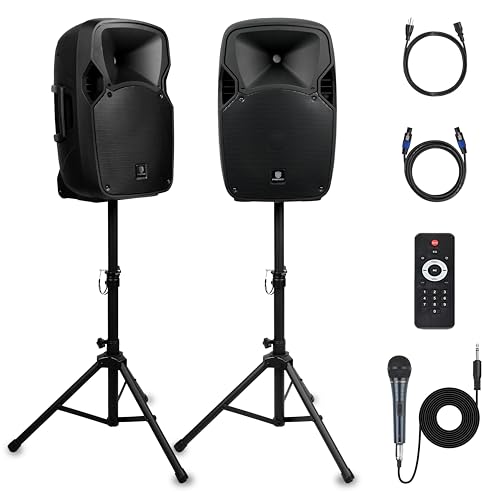
For most bands, churches and small venues, a pair of active 12-inch two-way PA speakers in the 1,000 to 2,000 watt peak class is the right answer, and the Yamaha DBR12, JBL EON712 and QSC K12.2 are the three models that keep showing up as safe choices. They cover rooms of roughly 50 to 300 people with vocals and a full band, they need no separate amplifier, and they are easy to replace or add to later. Everything below is based on manufacturer spec sheets and published reviews, so treat the numbers as the starting point for your own room.
Our top picks


As an Amazon Associate we earn from qualifying purchases at no extra cost to you.
Quick comparison of the picks
| Model | Woofer / format | Amp power (peak, per spec) | Max SPL (spec) | Price tier | Best for |
|---|---|---|---|---|---|
| Yamaha DBR12 | 12-inch, 2-way active | 1,000 W | about 129 dB | Mid | Bands, all-round PA |
| JBL EON712 | 12-inch, 2-way active, Bluetooth | 1,300 W | about 128 dB | Mid | Singer-songwriters, small clubs |
| Mackie Thump12A (current Thump series) | 12-inch, 2-way active | 1,300 W class | about 125 dB class | Entry | Tight budgets, rehearsal rooms |
| Behringer Eurolive B112D | 12-inch, 2-way active | 1,000 W | about 125 dB class | Entry | Cheapest full-range option |
| QSC K12.2 | 12-inch, 2-way active | 2,000 W | about 132 dB | Premium | Loud bands, install and touring |
| Yamaha DZR12 | 12-inch, 2-way active, DSP | 2,000 W | about 132 dB | Premium | Mixers who want presets and DSP |
| Yamaha DXR12 mkII | 12-inch, 2-way active, DSP | 1,100 W class | about 132 dB | Premium | Churches, installs, clear speech |
| JBL EON ONE Compact | Battery column, built-in mixer | Battery powered | Smaller room use | Mid | Solo acts, buskers, small rooms |
Maximum SPL and wattage figures are manufacturer claims and are measured differently from brand to brand, so use them to rank speakers within a brand and as rough guidance across brands. Real-world headroom depends on the room, speaker placement and how hard you push the mix.
Best overall for a working band: Yamaha DBR12
Spec line: 12-inch woofer, 1-inch compression driver, class-D amplifier around 1,000 W peak, XLR/TRS combo input with a second mix or thru output, and a 7-year warranty in many markets per the manufacturer.
Best for: bands that want a PA they do not have to think about. Skip if: you need Bluetooth streaming or a built-in mixer.
- Pro: neutral, vocal-friendly voicing that makes a mix sound close to what you hear in headphones.
- Pro: the 12-inch size is the sweet spot for weight against low-end; the 10-inch DBR10 and 15-inch DBR15 share the same family sound if you want to scale.
- Pro: a long warranty and a strong used market, which keeps resale value healthy.
- Con: no DSP presets, so you handle EQ on the mixer.
- Con: the plastic cabinet handles scuffs and cold vans well but is not as rigid as wood at very high volume.
Best for solo acts and small clubs: JBL EON712
Spec line: 12-inch woofer, 1-inch driver, 1,300 W peak class-D amplification, onboard Bluetooth and a simple three-band feel EQ with a speaker voicing switch, per JBL.
Best for: a vocalist with an acoustic guitar or a backing track who also wants to stream music between sets. Skip if: you play a loud rock band in a large room; step up to a K12.2 or DZR12.
- Pro: Bluetooth control and streaming are built in, which is useful for background music.
- Pro: lighter feel and a pole-mount socket make setup quick.
- Pro: a two-way sound with good vocal clarity reported by several 2026 roundups.
- Con: the high end can sound bright on cymbals when pushed.
- Con: independent long-term reviews of the newest EON generation are still limited, so rely on the spec sheet and warranty.
Best entry-level option: Mackie Thump12A and Behringer B112D
These two sit at the bottom of the full-range active 12-inch class. The Mackie Thump line is the better-known gig brand, and the current V4 generation is regularly recommended for tight budgets, with the caveat that its vocal voicing is a little hyped out of the box. Availability of the newest Thump models has been uneven in 2026, so check stock before planning a purchase around one. The Behringer Eurolive B112D is the cheapest full-range cabinet most guides recommend.
Best for: rehearsal rooms, practice spaces and acts that cannot spend mid-tier money. Skip if: the speakers will be moved or loaded in every week and you cannot afford failures.
- Pro: the lowest price tier for a real 12-inch two-way active PA.
- Pro: both include basic EQ and plenty of volume for a rehearsal or a small bar.
- Pro: easy to add a second one later and run a pair.
- Con: distortion appears sooner at maximum volume than on premium speakers.
- Con: resale value is lower and warranty periods are shorter than Yamaha or QSC.
Best for loud bands and touring: QSC K12.2
Spec line: 12-inch woofer, 1.4-inch compression driver, 2,000 W peak class-D amplifier, about 132 dB peak SPL, built-in DSP presets, roughly 36 lb per cabinet, per QSC.
Best for: bands, DJs and working sound techs who need accurate sound at high volume. Skip if: you want the lowest possible cost.
- Pro: high headroom and tight low-mids; reviewers regularly cite it as a clear step above entry-level cabinets.
- Pro: DSP presets (flat, music, speech, live) give quick tuning when the room changes.
- Pro: fly points, pole sockets and a ruggedised cabinet make it a long-term install or touring tool.
- Con: premium tier price.
- Con: the DSP and fan-cooled design are better value when you really need the headroom; a quiet acoustic act will not use it.
Best with DSP: Yamaha DZR12
Spec line: 12-inch woofer, 1.75-inch driver, 2,000 W peak class-D, DSP with crossover, EQ and presets, per Yamaha.
Best for: mixers who want more control than a DBR gives and prefer Yamaha tonality. Skip if: you want something simpler and lighter.
- Pro: 2,000 W class power with high headroom for loud rock or electronic music.
- Pro: onboard DSP and crossover tools reduce the need for external processing.
- Pro: MusicRadar named it a reliable workhorse PA in its 2026 guide.
- Con: heavier than a DBR12 and priced higher.
- Con: more menu depth than most vocalists want to deal with.
Best for churches and speech: Yamaha DXR12 mkII
Spec line: 12-inch woofer, 1.4-inch driver, 1,100 W class amplifier, DSP with selectable speaker voicings for main, monitor and sub-ready modes.
Best for: churches, schools and halls where speech intelligibility matters. Skip if: you need a very light speaker for solo use.
- Pro: smooth, flat response keeps sermons and choirs clear.
- Pro: controlled, fairly wide dispersion works well in rooms with reflective walls when aimed properly.
- Pro: install-friendly mounting points.
- Con: priced above the DBR series for the same size.
- Con: needs sensible gain staging to avoid fan noise or limiter use.
Best battery powered all-in-one: JBL EON ONE Compact
Spec line: portable column-style PA with an onboard mixer, rechargeable swappable battery, and wireless control through an app. Published sources describe it as light enough to carry in one hand and a battery runtime near 12 hours.
Best for: buskers, solo acts and small cafes. Skip if: you need to fill a church sanctuary or a loud bar.
- Pro: truly portable and easy to set up alone.
- Pro: battery power avoids outlet hunting at outdoor events.
- Pro: integrated mixer replaces a separate board for simple acts.
- Con: limited maximum volume compared with 12-inch cabinets.
- Con: the size limits low-end power for a full band.
How to choose PA speakers: the numbers that matter
Match the speaker size to the room
| Room or use | Audience | Suggested speaker class |
|---|---|---|
| Coffee shop, solo or duo | 20 to 60 | Battery column or single 10-inch active |
| Bar band, small club | 60 to 200 | Pair of 12-inch active, optional 15 to 18-inch sub |
| Church, school gym | 100 to 300 | Pair of 12 or 15-inch active with speech voicing |
| Outdoor party | 100 to 300 | Pair of 15-inch active plus subwoofers |
Do the headroom math
Every doubling of power adds about 3 dB, and every doubling of speaker count adds about 3 dB at the audience in a similar position. A pair of speakers that each hit 125 dB at 1 metre will be about 3 dB louder than a single one, but your audience will be several metres away. Sound drops roughly 6 dB each time distance doubles, so a speaker rated at 129 dB at 1 metre delivers about 105 dB at 16 metres on paper. A rock band on stage is often 100 to 110 dB, so a pair of 12-inch speakers in the 128 to 132 dB class gives headroom up to roughly 300 people in a small hall, while a 125 dB speaker runs closer to its limit.
Active versus passive
Active speakers bring their own amplifier and crossover, so setup is a single power cable and a signal cable. Passive speakers, such as the JBL JRX series, need an external power amp or powered mixer and carry an impedance rating (usually 8 ohms). Passive suits fixed installs where amplifiers sit in a rack. For mobile use, active wins on weight, speed and fewer ways to connect something wrong. If you already own a powered mixer, passive cabinets are cheaper.
Best PA speakers by use case
For a live band
Choose a pair of 12-inch actives in the 1,000 to 2,000 W class, and add a subwoofer if you play bass-heavy music. The DBR12 gives the cleanest price-to-performance, and the K12.2 or DZR12 gives extra headroom.
For church
Prioritise speech clarity and even coverage. Pick models with DSP voicing for speech and install mounting hardware, such as the DXR12 mkII. Mount speakers above head height and angled slightly downward so the front rows hear direct sound rather than reflections.
For vocals
Look for a smooth midrange and a compression driver rather than a simple dome tweeter. Both Yamaha and QSC voicings are praised for vocals, while Mackie can sound slightly hyped and may need an EQ cut around the upper mids.
For portable use
Weight matters most when you load in alone. Cabinets in the 25 to 40 lb range are manageable; battery columns drop below that. Keep a speaker bag or cover to prevent corner damage.
For passive setups
Match the amplifier to the speakers: the amplifier should deliver power at the speaker impedance, usually 8 ohms, at a level equal to or slightly above the speaker continuous rating. A 300 W RMS passive speaker pairs well with an amplifier delivering 300 to 450 W at 8 ohms. An underpowered amp that clips can damage tweeters sooner than an oversized one.
Ownership realities
- What wears first: input connectors, pole sockets and handles, followed by tweeter diaphragms if the amp is clipped repeatedly.
- Common mistakes: daisy-chaining too many speakers on one signal path, placing speakers behind microphones, and driving the limiter constantly because the mixer gain is too low.
- Feedback control: place the speakers in front of the microphones, aim monitors at the null of cardioid mics, and use a high-pass filter at 80 to 100 Hz on vocals.
- Stands and cables: a proper tripod stand rated above the speaker weight and balanced XLR cables avoid hum and tipping hazards.
Alternatives worth a look
If none of the picks fit, three alternatives are worth checking. The JBL PRX900 series gives high-end powered options with onboard DSP for fixed installs. The Mackie SRM series sits between entry and mid-tier. Powered column systems from Bose and Yamaha reduce weight for solo and duo gigs, and are covered in the line array roundups elsewhere on this site.
Frequently Asked Questions
What size PA speaker do I need for a small band?
A pair of 12-inch two-way active speakers is the standard answer for bar-sized rooms and rehearsals. Add an 15 to 18-inch subwoofer if you play bass-heavy music or fill a bigger room. A 10-inch is fine for vocals only.
Are powered or passive PA speakers better?
Powered speakers are easier for most people because the amplifier and crossover are matched to the speaker. Passive speakers suit fixed installs and people who already own a good power amp, and they weigh less each since the amp lives elsewhere.
What are the best PA speakers under 500?
The Mackie Thump12A and Behringer Eurolive B112D usually sit under 500 per speaker and are the common entry picks. The Yamaha DBR12 and JBL EON712 often fall near or just above that line depending on the market, so watch for sale cycles around Black Friday, Cyber Monday and spring.
Can I use PA speakers for church?
Yes. Choose speakers with a smooth midrange, wide even dispersion and, ideally, DSP presets for speech. The Yamaha DXR12 mkII and QSC K12.2 are common choices. Always aim speakers away from microphones and hard reflective surfaces to keep intelligibility high.
Do I need a subwoofer with PA speakers?
Not for vocals and acoustic acts. For a full band with kick drum and bass guitar, a sub adds low-end headroom, reduces strain on the 12-inch woofers and makes the system feel fuller at lower volume. Match the sub to the speaker brand if you want ready-made crossover settings.
How many watts do PA speakers need?
Wattage matters less than sensitivity and maximum SPL. A 1,000 W speaker rated at 129 dB will usually play as loud as a 2,000 W model rated at 129 dB. Look at the rated maximum SPL, the room size and the headroom you want, rather than raw wattage.
More from Amazon
Programs that pair well with the guide above. Offers and eligibility are set by Amazon and may change.
Free shipping on eligible items, Prime Video and more. Eligible new members can start with a free trial.
Start a Prime free trialAd-free music streaming. Eligible new subscribers can start with a free trial.
Try Music Unlimited freeA Prime membership for ages 18-24 with a trial period. Eligibility is set by Amazon.
See Prime for Young AdultsAudiobooks and podcasts to listen to on the go. Eligible new members can start with a free trial.
Try Audible freeAs an Amazon Associate we earn from qualifying purchases.



Write Your Review
No reviews yet. Be the first to share your experience!