

Key takeaways
- Pro: very clear voice reproduction and wide coverage.
- Pro: onboard mixer takes a wireless microphone receiver, a laptop and a phone at once.
- Pro: battery runtime covers a full school day at normal speech levels.
- Con: premium price tier.
- Con: a wireless microphone system is a separate purchase.
The best speaker for a classroom or presentation depends on the room size and whether you are speaking, playing media or hosting a video call. For a teacher who talks to 25 to 35 students, a small portable PA with a wireless headset microphone, such as the Bose S1 Pro+ or a Califone-style teacher PA, gives the clearest voice. For playing videos and audio clips, a good Bluetooth speaker is enough. For meetings and video calls, a conference speakerphone such as the Jabra Speak2 75 or Anker PowerConf S3 is the right tool, not a general speaker.
This guide is built from manufacturers’ published specifications and published professional reviews, not personal bench work. The categories matter more than any one model, so each section starts with the job to be done.
Our top picks


As an Amazon Associate we earn from qualifying purchases at no extra cost to you.
Match the speaker to the job
| Job | Room | Best class | Examples | Price tier |
|---|---|---|---|---|
| Teacher voice amplification, full day | Up to ~900 sq ft | Wearable voice amplifier or small PA with headset mic | Califone teacher PA class, Chatterbox-style amplifiers | Entry to mid |
| Teacher voice plus music and video | 600-1,500 sq ft | Portable PA with mixer and battery | Bose S1 Pro+, JBL EON ONE Compact | Premium |
| Playing video and audio clips | Up to ~800 sq ft | Bluetooth or USB powered speaker | Soundcore-class Bluetooth speaker, Edifier desktop powered speakers | Entry |
| Presentations in a medium meeting room | Up to ~1,200 sq ft | Powered 8-inch to 10-inch speaker or portable PA | Mackie Thump GO, Yamaha DBR10 | Mid |
| Video calls and small meetings | 4-12 people | Conference speakerphone | Jabra Speak2 75, Anker PowerConf S3, Poly Sync series | Entry to mid |
Why a classroom is a hard room for sound
Classrooms have hard walls, hard floors, tall ceilings and background noise from ventilation and corridors. The main enemy is the ratio of speech to noise. Research on classroom acoustics commonly recommends speech levels at least 15 dB above the background noise at the listener’s seat; a noisy room at 45 dB therefore wants speech at about 60 dB or more at the back row. A teacher’s unamplified voice drops by about 6 dB each time the distance doubles, so students at the back of a long room receive noticeably weaker speech than those at the front.
That is why a small amount of amplification, placed near the front and aimed at the room, can improve understanding for the whole class. It also reduces voice strain for the teacher, which is a practical benefit over a school year.
The picks
Bose S1 Pro+: best all-round portable PA for teachers and presenters
Spec line: portable PA around 150 W class, built-in three-channel mixer with Bluetooth, rechargeable battery of about 11 hours on the maker’s rating, weight in the mid-teens of pounds, tilt-back design for use as a floor monitor.
Best for: teachers who move between rooms, presenters at conferences, and anyone who needs a voice and media in one unit.
Skip if: you only need to be heard in a small room, since this is more than you need; it is also a premium product.
- Pro: very clear voice reproduction and wide coverage.
- Pro: onboard mixer takes a wireless microphone receiver, a laptop and a phone at once.
- Pro: battery runtime covers a full school day at normal speech levels.
- Con: premium price tier.
- Con: a wireless microphone system is a separate purchase.
Wireless teacher PA with headset (Califone and similar): best dedicated classroom voice system
Spec line: compact PA speaker, often 25 to 50 W class, wireless headset or lapel microphone included, battery or mains power, simple controls with few switches.
Best for: classrooms where the goal is simply to be heard by every student, with hands free for teaching.
Skip if: you need to play music at high quality or fill a large hall.
- Pro: headset microphone keeps a steady distance to the mouth so volume stays consistent when you turn around.
- Pro: built for school use with durable casing and simple operation.
- Pro: includes the microphone, which lowers the total system cost.
- Con: music quality is basic.
- Con: battery in the headset pack needs recharging each night.
JBL EON ONE Compact: best for larger rooms and mixed use
Spec line: battery-powered portable PA with a built-in mixer and Bluetooth, around 160 W class, rechargeable battery, compact column and subwoofer design.
Best for: lecture rooms, school halls and presenters who sometimes need music with their talk.
Skip if: you only need a speaker for a small classroom.
- Pro: wide coverage and good bass for videos and music.
- Pro: onboard mixer handles several sources.
- Pro: runs on battery for off-site presentations.
- Con: heavier than the Bose S1 Pro+.
- Con: more features than a casual user will need.
Mackie Thump GO: best battery-powered speaker for medium rooms
Spec line: 8-inch powered speaker with a rechargeable battery, built-in mixer, Bluetooth, and a lightweight cabinet.
Best for: presentations in meeting rooms and school halls where a powered speaker with a few inputs is enough.
Skip if: you need a wearable headset microphone integrated into the system.
- Pro: balanced between portability and output.
- Pro: onboard mixer takes a microphone and a laptop.
- Pro: good for both speech and background music.
- Con: a wireless microphone has to be bought separately.
- Con: the battery drains faster at higher volume.
Jabra Speak2 75 and Anker PowerConf S3: best for meetings and video calls
Spec line: speakerphones with several beamforming microphones, noise reduction, USB and Bluetooth connection, and a rechargeable battery. They are designed for small groups sitting around a table, with the Jabra Speak2 75 aimed at larger groups than the smaller Speak2 models.
Best for: remote meetings, online lessons from a desk and small group calls.
Skip if: you need loudness to fill a room; they are not PA speakers.
- Pro: microphones pick up everyone around the table and reduce room noise.
- Pro: plug-and-play over USB with common conferencing software.
- Pro: compact and carryable.
- Con: limited output for media playback in a large room.
- Con: not designed for amplifying a presenter to an audience.
Bluetooth speakers and powered desktop speakers: best budget media option
Spec line: Bluetooth speakers from brands such as Anker Soundcore, or a pair of Edifier desktop powered speakers, with 5 to 30 W class output.
Best for: playing videos, music or audio files for a class of about 20 students in a normal-size room.
Skip if: you need to project a voice, or want a microphone input.
- Pro: low cost and easy setup.
- Pro: good enough sound for videos and clips.
- Pro: can be carried or left in the room.
- Con: no real microphone support on most models.
- Con: Bluetooth adds delay, so lip sync can drift on some video players.
Best portable speakers for teachers
Teachers who move between rooms need something light and quick to set up. Look for under about 15 lb, a battery that lasts a full day, and a headset microphone. The Bose S1 Pro+ fits the premium end, while a wireless teacher PA with a headset microphone fits the entry to mid range. A voice amplifier worn on a belt is lighter still and suits teachers who only need to project their voice.
Best speakers for presentations and meetings
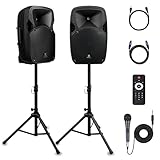
For a presentation to an audience of 20 to 100 people, a powered speaker with a microphone input is best. Place the speaker beside or slightly ahead of the presenter, so the sound comes from the same direction as the voice and does not feed back into the microphone. Use a headset or lapel microphone for natural movement, and a handheld only when passing a microphone around the room.
For conference rooms, a speakerphone on the table handles small meetings, while a larger room may need a soundbar-style conferencing system with a microphone array. If the room already has a display, a conference soundbar that sits under it can be a neat choice.
How to choose: numbers and a worked example
Step 1: estimate the area and the audience
A classroom of 800 square feet with 30 students needs speech coverage to about 30 feet. A small PA at 50 W class with a headset microphone covers that, and the Bose S1 Pro+ covers it with room to spare.
Step 2: pick the microphone type first
Headset microphones keep the distance to the mouth constant, which improves clarity and reduces feedback. Lapel microphones are less visible but more prone to clothing noise. Handheld microphones suit Q and A sessions. Choose a wireless system with a rechargeable battery that lasts a full day, and keep a spare.
Step 3: check the input list
Count what must connect: a wireless microphone receiver, a laptop for video, and perhaps a phone. If the speaker has fewer inputs than that, add a small mixer or choose a speaker with a built-in one.
Step 4: check the power and runtime
A battery rating of 10 hours at moderate level covers a school day, but loud use cuts that sharply. Plug in during long sessions if possible, and charge overnight.
Step 5: worked example
A teacher has a 30 by 25 foot room with 28 students and light corridor noise. Unamplified, a voice at 65 dB at one meter falls to about 47 dB at the back row at 25 feet, which is barely above a 45 dB noise floor. A small speaker placed near the front and set to bring the back row to about 62 to 65 dB gives roughly 15 to 20 dB of margin over the noise, which is the range associated with comfortable listening.
Quick sizing table by room
| Room | People | Speaker output class | Microphone |
|---|---|---|---|
| Small classroom, 500 sq ft | 15-20 | 10-25 W voice amplifier | Headset |
| Standard classroom, 800-1,000 sq ft | 25-35 | 25-50 W teacher PA | Headset or lapel |
| Large lecture room, 1,500 sq ft | 50-100 | 100-160 W portable PA | Headset plus handheld |
| Hall or gym | 100-300 | Pair of powered 10-12 in speakers | Wireless handheld and lapel |
These classes are rules of thumb. Rooms with soft furnishings and acoustic ceiling tiles need less output than bare, hard-walled rooms, and noisy ventilation raises the target level.
Accessibility and etiquette
Amplified sound should help every student, including those with hearing loss or attention difficulties. Keep the level moderate, give the class a short break from amplified media, and check that any videos have captions. If a student uses a hearing aid with a remote microphone system, ask the school’s specialist before connecting new audio gear, since some systems conflict with classroom amplification.
Placement and setup tips
- Put the speaker in front of the microphone line, not behind the presenter, to reduce feedback.
- Raise it above heads if possible, such as on a stand or a tall shelf, so the sound reaches the back rows.
- Turn the microphone volume up until feedback starts, then back it off by a notch or two.
- Use a separate volume control for media so videos do not drown the voice.
- Keep spare batteries and a charging cable in the same bag as the speaker.
- Test the setup from the back row before students arrive.
Ownership realities
- Rechargeable batteries age; expect noticeably shorter runtime after a couple of years of daily use.
- Wireless microphones are the most common failure point because of lost clips, cracked headsets and dead cells.
- Shared school equipment gets dropped, so rubber feet, a protective cover and a carrying bag extend life.
- Check school or workplace policies for approved wireless frequencies and equipment lists before buying.
Frequently Asked Questions
Do teachers really need a speaker in the classroom?
In rooms with more than about 20 students or with background noise, a small amplification system can improve how well the back rows hear and reduce voice strain. In small quiet rooms it is optional.
Can I use a Bluetooth speaker for teaching?
For playing videos and audio, yes. For amplifying your voice, it is a poor tool because it lacks a proper microphone input and the Bluetooth delay makes live speech awkward.
What is the difference between a PA speaker and a conference speakerphone?
A PA speaker makes a voice louder for an audience in the same room. A conference speakerphone captures a group around a table and plays back the remote side of a call. They solve different problems.
Which microphone is best for a teacher?
A wireless headset microphone is the most practical because it keeps a constant distance to the mouth and leaves both hands free. Lapel microphones are an alternative for those who dislike headsets.
How loud should a classroom speaker be?
Aim for speech about 15 dB above background noise at the back row, which is typically in the 60 to 65 dB range in a normal classroom. Louder than that adds strain without improving understanding.
Can one speaker handle both a meeting and a presentation?
A portable PA with a mixer can play a presentation and video well, but for remote calls a speakerphone with beamforming microphones gives better results. Some teams own both.
Bottom line
For a teacher who wants one solution, choose a portable PA with a wireless headset microphone, such as the Bose S1 Pro+ for a premium option or a Califone-style teacher PA for a simpler one. For meetings and calls, buy a speakerphone such as the Jabra Speak2 75 or Anker PowerConf S3. For videos only, a decent Bluetooth speaker is enough. Decide the job first, count the inputs, and size the speaker to the back row of the room rather than the front.
More from Amazon
Programs that pair well with the guide above. Offers and eligibility are set by Amazon and may change.
Free shipping on eligible items, Prime Video and more. Eligible new members can start with a free trial.
Start a Prime free trialAd-free music streaming. Eligible new subscribers can start with a free trial.
Try Music Unlimited freeA Prime membership for ages 18-24 with a trial period. Eligibility is set by Amazon.
See Prime for Young AdultsAudiobooks and podcasts to listen to on the go. Eligible new members can start with a free trial.
Try Audible freeAs an Amazon Associate we earn from qualifying purchases.



Write Your Review
No reviews yet. Be the first to share your experience!