

Key takeaways
- PLA vs PETG filament compared for first-time buyers, with five verified 1 kg spools, temperature ranges, and clear guidance on which to start with.
- Top Pick: HATCHBOX PLA Filament, Black, 1 kg
- Runner-up: eSUN PLA+ Filament, Black, 1 kg
- Also consider: OVERTURE PLA Filament, Black, 1 kg
Every first spool decision in desktop 3D printing comes down to the same two materials: PLA and PETG. PLA is the long-standing default for beginners because it prints at lower temperatures and forgives small setup mistakes. PETG runs hotter and asks a little more of your printer and your patience, but many owners move to it once they want parts that shrug off more heat and handling. Both come in the same standard format, a 1 kg spool of 1.75 mm filament, so the spools below are directly comparable.
This guide compares the two materials head to head and then lists five verified spools: three PLA options first, then two PETG options. Each pick is a real, currently listed 1 kg spool in 1.75 mm diameter, so any of them will load into a typical desktop FDM printer. Print temperatures appear only where the listing itself states a recommended range, and those ranges are starting points, not guarantees. Follow your printer maker’s directions for hot-end and bed safety, and run a small test print before a long job.
As an Amazon Associate, we earn from qualifying purchases.
Quick answer
Start with PLA if this is your first spool: it prints at lower nozzle temperatures, sticks and cools predictably, and the three PLA picks below cover basic, enhanced, and tightly wound options. Choose PETG once you are comfortable with basic settings and want a hotter-running material; the two PETG picks cover a solid black spool and a clear one. Every pick here is 1 kg and 1.75 mm.
HATCHBOX PLA Filament, Black, 1 kg

HATCHBOX is one of the most established names in desktop filament, and its standard PLA in black is the classic first-spool choice. The listing gives a dimensional accuracy of plus or minus 0.03 mm, which matters because consistent diameter feeds evenly and keeps extrusion steady across a long print. Black is a practical first color: it hides layer lines reasonably well and suits brackets, organizers, and prototypes.
Because this is plain PLA rather than a modified blend, expect the usual beginner-friendly behavior: lower-temperature printing, modest demands on the printer, and parts best kept away from sustained heat sources. The full 1 kg spool leaves enough material to learn on and still finish real projects. Keep it bagged and dry between sessions.
| Brand | Product | ASIN | Key specs |
|---|---|---|---|
| HATCHBOX | PLA Filament, Black, 1 kg Spool | B00J0ECR5I | Material: PLA; Diameter: 1.75 mm; Spool weight: 1 kg; Color: Black; Dimensional accuracy: plus or minus 0.03 mm |
eSUN PLA+ Filament, Black, 1 kg
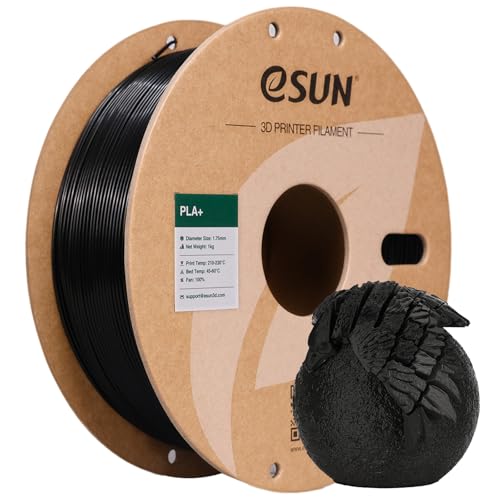
eSUN’s PLA+ is the enhanced member of the PLA family in this guide. It is still a polylactic acid filament and still prints in the PLA temperature neighborhood, but the listing states a recommended printing range of 210 to 230 degrees Celsius, with 215 degrees recommended. That is slightly hotter than plain PLA usually runs, so check that your printer’s hot end is comfortable in that range and follow the printer maker’s directions when changing temperature settings.
The spool is a 1 kg cardboard spool, which some buyers prefer over plastic spools for storage and disposal reasons. Dimensional accuracy is listed at plus or minus 0.03 mm, matching the HATCHBOX pick. If you want the tweaked formulation many owners step up to after their first plain spool, this is the natural pick; if you want the simplest possible starting point, the plain PLA spools either side of it are equally valid first buys.
| Brand | Product | ASIN | Key specs |
|---|---|---|---|
| eSUN | PLA+ Filament, Black, 1 kg Cardboard Spool | B0D256S2RQ | Material: PLA+ (enhanced PLA); Diameter: 1.75 mm; Spool weight: 1 kg; Color: Black; Nozzle temp: 210-230 °C (recommended 215 °C); Dimensional accuracy: plus or minus 0.03 mm |
OVERTURE PLA Filament, Black, 1 kg

OVERTURE’s PLA listing leads with its winding: the filament is described as neatly wound, a real practical concern for beginners, since a tangled spool can ruin a print hours in. The listing also states the tightest dimensional accuracy in this guide, plus or minus 0.02 mm, and a recommended extrusion range of 190 to 220 degrees Celsius, squarely in standard PLA territory.
This is the pick for a buyer who wants plain PLA with the paperwork to back it up: clear temperature guidance from the listing itself and a stated tolerance tighter than the other PLA spools here. Treat it as an indoor, general-purpose material for models, prototypes, and household items, and keep it away from hot environments where PLA softens sooner than PETG. One buying note: filament availability shifts over time, so if this exact black 1-pack is out of rotation when you shop, the other PLA picks here cover the same ground.
| Brand | Product | ASIN | Key specs |
|---|---|---|---|
| OVERTURE | PLA Filament, Black (1-Pack), 1 kg Spool | B07PGY2JP1 | Material: PLA; Diameter: 1.75 mm; Spool weight: 1 kg; Color: Black; Nozzle temp: 190-220 °C; Dimensional accuracy: plus or minus 0.02 mm |
eSUN PETG Filament, Solid Black, 1 kg

The first PETG pick is eSUN’s solid black spool, and its listing states a printing temperature of 230 to 250 degrees Celsius, with 240 degrees recommended. That range is the clearest illustration of the PLA-versus-PETG divide: PETG wants a genuinely hotter hot end, so confirm your printer can hold those temperatures and follow the maker’s directions for printing hotter materials.
Dimensional accuracy on this listing is plus or minus 0.05 mm, a little looser than the PLA picks, which is typical for PETG listings and another reason beginners learn on PLA first. PETG is also known for stringing, and eSUN’s own listing notes that PETG can string more after absorbing moisture and suggests drying the filament. Store this spool sealed and dry, and expect to spend a little time dialing in retraction. In return you get the material many owners choose for functional parts in warmer spots than PLA tolerates.
| Brand | Product | ASIN | Key specs |
|---|---|---|---|
| eSUN | PETG Filament, Solid Black, 1 kg Spool | B0BN4Y1G2S | Material: PETG; Diameter: 1.75 mm; Spool weight: 1 kg; Color: Solid Black; Nozzle temp: 230-250 °C (recommended 240 °C); Dimensional accuracy: plus or minus 0.05 mm |
Polymaker PolyLite PETG Filament, Clear, 1 kg

The second PETG pick is Polymaker’s PolyLite PETG in clear, the only non-black spool in this guide. Clear filament is the choice when you want light to pass through a part, such as a lampshade insert or a diffuser, and it also shows internal infill patterns that opaque colors hide. The listing states dimensional accuracy of plus or minus 0.03 mm, the tightest figure among the PETG picks here.
PolyLite is Polymaker’s everyday printing line, positioned for reliable day-to-day use. No nozzle range was captured from this listing, so set your starting temperature from your printer maker’s PETG guidance and confirm it with a small test print before a long job. As with the eSUN PETG, keep the spool dry: moisture-laden PETG strings more and prints less cleanly, whatever the brand.
| Brand | Product | ASIN | Key specs |
|---|---|---|---|
| Polymaker | PolyLite PETG Filament, Clear, 1 kg | B09DKMCNMW | Material: PETG; Diameter: 1.75 mm; Spool weight: 1 kg; Color: Clear; Dimensional accuracy: plus or minus 0.03 mm |
How to Choose
The head-to-head comes down to three differences. First, temperature: the PLA listings here recommend roughly 190 to 230 degrees Celsius at the nozzle, while the eSUN PETG listing recommends 230 to 250 degrees. A printer that struggles to hold higher temperatures belongs on the PLA side. Second, forgiveness: PLA is the easier first material for most beginners, with more predictable first layers and less stringing to tune out. Third, the job itself: PLA suits models, prototypes, and indoor household items; PETG is the step up when a part will live somewhere warmer or take more handling, though no specific strength or heat-resistance numbers are promised for any spool here.
Within PLA, choose plain HATCHBOX or OVERTURE for the classic starting point, and eSUN PLA+ for the enhanced formulation on a cardboard spool. Within PETG, choose eSUN’s solid black for an everyday opaque spool with clear temperature guidance, and Polymaker’s clear when translucency is the point. Every spool here is 1.75 mm and 1 kg, so check only that your printer takes 1.75 mm filament, which nearly all desktop FDM machines do. Many desktop printers handle both materials without an enclosure; follow your printer maker’s guidance rather than assuming one is required or never required. Finally, do not use printed parts from any of these filaments for food contact: nothing in these listings supports food-safety claims for printed objects.
Who Should Skip
Skip this comparison if your printer uses a different filament diameter, since every pick here is 1.75 mm. Skip PETG for now if your printer’s hot end cannot reliably hold the mid-200s Celsius range, or if you have never completed a successful print and want the gentlest learning curve; start with a PLA spool instead. Skip PLA as your only material if your parts will sit in a hot car, near a heat vent, or in direct summer sun, since that is the situation PETG exists for. And skip all five picks if you need a specialty material, such as a flexible or filled blend.
FAQ
Is PLA or PETG better for a complete beginner?
PLA, for most people. It prints at lower temperatures, is more forgiving of imperfect settings, and strings less. All three PLA picks here suit a first spool. PETG becomes attractive once basic printing feels routine and you want a hotter-running material for parts that see more warmth and handling.
Can one printer use both PLA and PETG?
Usually yes, provided it takes 1.75 mm filament and its hot end can reach the PETG range of around 230 to 250 degrees Celsius stated on the eSUN PETG listing. Follow your printer maker’s directions when switching materials and printing at higher temperatures, and purge the old filament first.
Why does PETG string more than PLA?
PETG is simply more prone to leaving fine strands as the nozzle travels, and moisture makes it worse; eSUN’s own PETG listing notes that the material can string after absorbing water and suggests drying it. Sealed, dry storage and a little retraction tuning keep it manageable.
Are parts printed with these filaments food-safe?
No claim like that is made here. Nothing in these listings supports treating a printed object as food-safe or suitable for drinking vessels, whatever the material. Buy purpose-made food-contact products instead.
Final Verdict
For a first spool, buy PLA: the OVERTURE spool for the tightest stated tolerance and clear listing temperatures, the HATCHBOX spool for the classic default, or the eSUN PLA+ for the enhanced formulation on a cardboard spool. When you are ready for the step up, the eSUN PETG in solid black is the straightforward second material, and the Polymaker PolyLite PETG in clear covers translucent projects. Learn on PLA, add PETG when projects ask for it, and store every spool dry.
More from Amazon
Programs that pair well with the guide above. Offers and eligibility are set by Amazon and may change.
Free shipping on eligible items, Prime Video and more. Eligible new members can start with a free trial.
Start a Prime free trialAd-free music streaming. Eligible new subscribers can start with a free trial.
Try Music Unlimited freeA Prime membership for ages 18-24 with a trial period. Eligibility is set by Amazon.
See Prime for Young AdultsAudiobooks and podcasts to listen to on the go. Eligible new members can start with a free trial.
Try Audible freeAs an Amazon Associate we earn from qualifying purchases.


Write Your Review
No reviews yet. Be the first to share your experience!