

Key takeaways
- Compare five soldering stations for electronics work and learn how tip design, wattage, temperature control and hot air options should shape your choice.
- Top Pick: Hakko FX888D
- Runner-up: YIHUA 862BD+ 2-in-1 Soldering Iron and Hot Air Station
- Also consider: Weller WE1010NA (WE1 station with WEP70 iron)
A soldering station earns its place on the bench by holding a steady temperature, heating joints quickly and taking tips you can actually replace when they wear. The five stations in this guide cover the main designs a hobbyist or small workshop will meet: separate-heater irons with digital control, a two-in-one unit that adds hot air, and a cartridge-tip model where the heater sits inside the tip itself.
Each pick below is framed around the decisions that matter: how the tip is heated, how temperature is set and held, how much power the iron delivers, and how easy tips are to source later. Because every station here is a hot tool, the guide also covers the basic safety habits that should come with whichever model you choose.
As an Amazon Associate, we earn from qualifying purchases.
Quick answer
Start with the iron itself: choose a station whose temperature range covers your solder work, whose tips are easy to replace, and whose wattage suits the joints you make most. The Hakko FX888D and Weller WE1010NA suit most benches, the YIHUA 939D+ keeps the focus on a digital iron, the YIHUA 862BD+ adds hot air, and the KSGER T12 uses cartridge tips.
Hakko FX888D
The FX888D is the reference point for the separate-heater design: a 65 W iron whose heating element sits in the handpiece and warms a replaceable T18-series tip. Temperature is set digitally and shown on a display, with a range of 120–899 °F (50–480 °C) that covers everything from small signal joints to heavier ground-plane work. Hakko describes the station as ESD safe, which matters around sensitive components, though that remains a manufacturer claim rather than a guarantee against every static event. Tip choice is a strength: the T18 family is broad and widely stocked, so a worn or wrong-shaped tip is simple to replace.
Two cautions belong with this pick. Hakko’s own site lists the FX888D as discontinued in favour of a successor model, while the Amazon listing data does not mark it as discontinued, so check the seller and variant before ordering; the pick here is the FX888D-23BY in blue and yellow. Counterfeit FX888D units are widely reported, so buy from authorised sellers and be wary of listings that avoid naming the variant.
| Brand | Product | ASIN | Key specs |
|---|---|---|---|
| Hakko | FX888D (FX888D-23BY, blue and yellow) | B00ANZRT4M | 65 W iron; temperature range 120–899 °F (50–480 °C); digital control; T18-series tips; ESD safe per manufacturer |

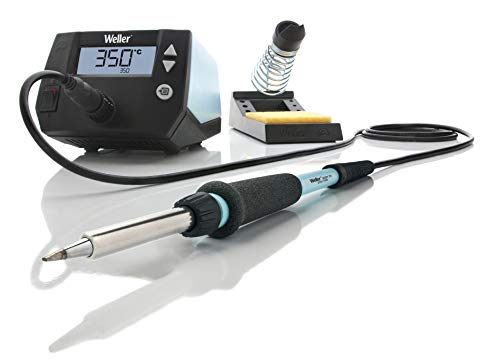

Weller WE1010NA
The WE1010NA pairs the WE1 station with the WEP70 iron for a 70 W setup aimed at education benches, repair work and serious hobby use. Its range of 200–850 °F (100–450 °C) is set digitally, and Weller quotes temperature stability of ±4 °F (2 °C), which helps when you move between fine pads and heavier joints in a single session. Weller describes the station, the iron and its silicone cable as ESD safe. Like the Hakko, it uses a separate-heater iron with replaceable tips, so it suits buyers who want an established maker behind the tip ecosystem they are buying into.
This is an iron-only station with no hot air side. If your work is mostly through-hole assembly, wired repairs and connector work rather than SMD removal, that focus is a plus rather than a gap: you are not giving bench space or complexity to a second heat source you will rarely switch on.
| Brand | Product | ASIN | Key specs |
|---|---|---|---|
| Weller | WE1010NA (WE1 station with WEP70 iron) | B077JDGY1J | 70 W; temperature range 200–850 °F (100–450 °C); stability ±4 °F (2 °C); digital control; ESD safe per manufacturer |
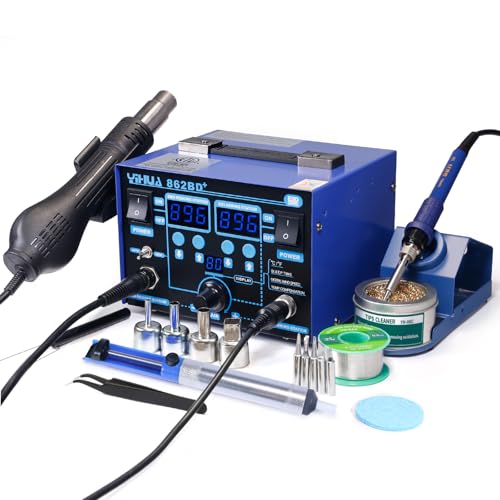
YIHUA 862BD+
The 862BD+ is the two-in-one in this guide: a 75 W soldering iron covering 392–896 °F (200–480 °C) plus a hot air side covering 212–896 °F (100–480 °C), with a display that switches between °F and °C. The listing describes the unit as ESD safe. Buy it for the iron if your bench work is mainly soldering, and treat the hot air as the step-up that makes SMD removal and rework practical when you need it; it should not be bought as a rework-only tool.
With two heat sources, bench discipline matters even more. Park the iron in its stand between joints, keep the hot air nozzle pointed away from cables, plastics and your hands, and let both tools cool fully before tidying the bench or changing a tip or nozzle.
| Brand | Product | ASIN | Key specs |
|---|---|---|---|
| YIHUA | 862BD+ 2-in-1 Soldering Iron and Hot Air Station | B07RY5XWVG | Iron 75 W, 392–896 °F (200–480 °C); hot air 212–896 °F (100–480 °C); °F/°C display; ESD safe per listing |
YIHUA 939D+
The 939D+ is an iron-only digital station rated at 75 W equivalent, with precision temperature control from 392 °F to 896 °F, a built-in transformer and a display that switches between °C and °F. The listing describes it as ESD safe. The pick here is the Black version, and it is worth checking the colour and kit contents on the listing before ordering, because the 939D+ name is also used by other versions and bundles that are different products.
Set against the 862BD+ above, the 939D+ gives up hot air and keeps the focus on the iron. That suits through-hole work, connectors, wiring and general board repair, where a second heat source would sit idle and a single-purpose control layout is easier to live with.
| Brand | Product | ASIN | Key specs |
|---|---|---|---|
| YIHUA | 939D+ Digital Soldering Station (Black) | B07RVMZNYR | 75 W equivalent; temperature range 392–896 °F; built-in transformer; °C/°F display; ESD safe per listing |
KSGER T12 Soldering Station

The KSGER T12 is the cartridge-tip design in this guide. Its T12 tips carry the heating element inside the tip itself, which generally means fast heat-up and close temperature control at the joint. The station is rated at 72 W, with a temperature range of 150–480 °C and quoted stability of ±10 °C with no load. Control comes from an STM32 V2.1S board with an OLED display, the case is aluminium alloy, and the listing bundles T12-K, T12-D16 and T12-JL02 tips.
Two cautions apply. This guide makes no ESD-safe claim for this unit, because the earthing evidence around it is inconsistent, so treat that question as unanswered if static protection is critical to your work. Replacements must be T12 cartridges, so confirm a reliable supply of the tip shapes you use before committing to the platform.
| Brand | Product | ASIN | Key specs |
|---|---|---|---|
| KSGER | T12 Soldering Station, STM32 V2.1S OLED | B07PYFSCJ9 | 72 W; temperature range 150–480 °C; stability ±10 °C (no load); aluminium alloy case; T12 cartridge tips |
How to Choose
Separate-heater or cartridge tip. On the Hakko, Weller and YIHUA 939D+, the heater sits in the iron and warms a separate metal tip; tips are cheap and shapes are plentiful. On the KSGER, the heater is built into each T12 cartridge, which heats quickly and holds temperature close to the joint, but every replacement tip costs more because it includes the element. Choose based on how often you swap tip shapes.
Digital or dial control. All five picks here set temperature digitally, which makes repeat settings easy to return to. What differs is stability: tighter quoted stability, like the Weller figure, helps when one session mixes fine pads with heavy joints.
Wattage and range. Wattage is about recovery, not maximum heat: a higher-wattage iron returns to temperature faster after a big joint pulls heat away. Check the range covers delicate board work at the low end and heavier connectors at the high end.
Iron-only or two-in-one. Add hot air, as on the 862BD+, only if you genuinely remove or refit surface-mount parts. Otherwise an iron-only station is simpler and takes less bench.
ESD claims and safety habits. Treat ESD-safe wording as a manufacturer claim, not a promise that components cannot be damaged. Whatever you buy, follow the manufacturer’s directions: rest the iron in its stand, never leave a powered station unattended, keep the bench clear of flammables, and let tips cool before changing them. Work with ventilation or a fume extractor, since solder fume comes mainly from flux, and do not assume any solder type makes the work risk-free.
Who Should Skip
Skip this category upgrade if you only solder a joint or two a year; a basic iron you already own will finish those jobs. Skip the two-in-one if you never touch surface-mount parts, and skip the cartridge-tip platform if you cannot confirm a steady supply of T12 tips in your region. Anyone who needs certified static control for production work should look at professional ESD workstations rather than relying on claims in a buying guide, and anyone unwilling to follow hot-tool safety habits should not run a station that reaches these temperatures.
FAQ
What temperature should I set for general electronics work?
Stay in the middle of your station’s range for ordinary board work and follow the solder manufacturer’s guidance, raising the setting for large joints that pull heat away and lowering it for small pads. The exact figure matters less than letting the iron recover between joints instead of forcing cold joints with pressure.
What does ESD safe mean for these stations?
It is a claim by the manufacturer that the station is built to limit static build-up at the iron. For the Hakko, Weller and both YIHUA picks, that claim appears in the manufacturer’s or listing’s own description. It is not a guarantee that components cannot be damaged, and this guide makes no such claim for the KSGER T12, where the evidence is inconsistent.
Is a two-in-one hot air station worth it?
Only if you remove or refit surface-mount components. The YIHUA 862BD+ earns its place when its iron does your everyday soldering and the hot air side handles occasional SMD work. If everything you do is through-hole, an iron-only station such as the 939D+ covers the same joints with less to manage on the bench.
Are cartridge tips better than separate tips?
Neither is better outright. Cartridge tips, like the KSGER’s T12 design, put the heater in the tip for fast heat-up and close control, but replacements cost more. Separate tips, as used by the Hakko, Weller and 939D+, are cheaper to stock in several shapes. Pick the system whose tip supply suits your bench.
Final Verdict
For most electronics benches, the Hakko FX888D and Weller WE1010NA are the safe centre of this category: proven separate-heater designs, digital control and deep tip support, with the Weller quoting tighter temperature stability. The YIHUA 939D+ is the focused iron-only alternative, the 862BD+ is the pick when hot air will genuinely be used, and the KSGER T12 suits buyers who want the cartridge-tip design and accept its unanswered ESD question. Whichever you choose, confirm the exact variant on the listing, buy tips you can replace easily, and follow the manufacturer’s safety directions from the first session.
More from Amazon
Programs that pair well with the guide above. Offers and eligibility are set by Amazon and may change.
Free shipping on eligible items, Prime Video and more. Eligible new members can start with a free trial.
Start a Prime free trialAd-free music streaming. Eligible new subscribers can start with a free trial.
Try Music Unlimited freeA Prime membership for ages 18-24 with a trial period. Eligibility is set by Amazon.
See Prime for Young AdultsAudiobooks and podcasts to listen to on the go. Eligible new members can start with a free trial.
Try Audible freeAs an Amazon Associate we earn from qualifying purchases.


Write Your Review
No reviews yet. Be the first to share your experience!