

Our Short List of 3
All 3 Picks at a Glance
| Product | Specs | Action |
|---|---|---|
 Samsung Galaxy S25 | Check price on Amazon | |
 Google Pixel 9a | Check price on Amazon | |
 Motorola razr 2024 | Check price on Amazon |
Key takeaways
- Find the best pocket sized smartphones that are easy to carry and use one-handed, from compact flagships to a tiny foldable and a classic small phone.
The best pocket sized smartphones prove that a phone does not need to be enormous to be powerful. For years, phones have grown larger, and many people now carry devices that barely fit in a jeans pocket, demand two hands for basic tasks, and feel top-heavy during calls. A pocket-sized phone fixes all of that: it slips into a small pocket, sits comfortably in one hand, and disappears into a jacket without pulling the fabric down.
This guide covers four phones that stay genuinely pocketable in different ways. One is a compact flagship with a 6.2-inch screen, one is a well-balanced mid-range phone, one is a classic small phone with a 5.9-inch display, and one folds in half to become a tiny square. Each one is a complete smartphone, not an accessory, and each suits a different kind of buyer who is tired of oversized handsets.
How to Choose
1. Size and one-handed use
The first question is how the phone feels in your hand. A phone with a screen under 6.3 inches and a narrow body is usually comfortable to use one-handed, with the thumb able to reach most of the screen. Width matters more than height: a narrow phone is easier to grip than a wide one, even if both have similar screen sizes. A foldable phone adds another dimension, since it can shrink to half its height when closed. Hold the phone in your hand if you can before buying, and check whether you can reach the top corners without shifting your grip.
2. Display quality
A small phone should still have a good screen. Look for a bright OLED or AMOLED panel with sharp resolution and a smooth refresh rate, since you will read, watch, and browse on it every day. A high refresh rate makes scrolling feel fluid, and good brightness keeps the screen readable outdoors. Screen size is a trade-off: a larger screen shows more content, but a smaller screen is easier to carry and use one-handed. A 6.1-inch or 6.2-inch display is a good middle ground for most people.
3. Battery life
Small phones have less room for batteries, so battery life varies more than it does on large phones. Look for a phone with a battery of at least 4,000 mAh and efficient power management, and check whether it supports fast charging and wireless charging. A phone that lasts a full day of normal use is the minimum to aim for. If you use your phone heavily for navigation, video, and calls, prioritize the model with the largest battery and the most efficient processor in this guide.
4. Camera quality
A pocket-sized phone should still take good photos. Look for a main camera with a large sensor and optical image stabilization, which helps in low light and reduces blur. An ultrawide camera is useful for landscapes and group shots, while a telephoto lens helps with distant subjects. Software processing matters too: the best small phones use computational photography to improve detail and color. Decide which matters more to you, zoom range or low-light quality, and choose accordingly.
5. Performance and storage
A small phone should not feel slow. Look for a modern processor and at least 8 GB of memory, which keeps apps responsive and multitasking smooth. Storage matters as well: 128 GB is a sensible minimum, and 256 GB is better if you keep many photos, videos, and apps on the device. Check whether the phone supports expandable storage, since most compact flagships do not include a microSD slot.
6. Software support and updates
A phone is a long-term purchase, so software support matters. Look for a manufacturer that promises several years of operating system and security updates, since that keeps the phone safe and current for longer. A phone with seven years of updates is a better long-term buy than one with three, even if the hardware is similar. Also consider the software experience itself: clean, uncluttered software is easier to live with than a heavily customized interface.
7. Durability and water resistance
A phone that lives in a pocket gets knocked around, dropped, and exposed to rain. Look for water and dust resistance, toughened glass, and a sturdy frame. A phone with an IP68 rating can survive submersion, while an IP67 rating handles splashes and brief dips. A slim case adds protection without adding much bulk, and it is worth using on any pocket-sized phone.
Top Picks
Samsung Galaxy S25
The Samsung Galaxy S25 is the best compact flagship in this guide. Its 6.2-inch Dynamic AMOLED 2X display is bright, sharp, and smooth, with a 120 Hz refresh rate that makes scrolling feel effortless. Despite the large screen, the phone is narrow and light enough to use one-handed, and it slips easily into a jeans pocket. The Snapdragon 8 Elite processor is one of the fastest chips available in a phone, and 12 GB of memory keeps everything responsive, from gaming to multitasking.
The triple camera system covers wide, ultrawide, and telephoto shooting, with a 50 MP main camera that captures detailed photos in good light and respectable shots in dim conditions. Galaxy AI features help with photo editing, note taking, and translation, and the phone receives years of software updates. The 4,000 mAh battery lasts a full day of normal use, and the phone supports fast wired charging and wireless charging.
This phone is for buyers who want flagship performance in a pocketable body. It is the best choice in this guide for anyone who wants the fastest compact phone, the most versatile camera system, and the longest software support. It is less suited to anyone who wants the absolute smallest phone, since its 6.2-inch screen is compact but not tiny.
Key specifications include a 6.2-inch Dynamic AMOLED 2X display with a 120 Hz refresh rate, the Snapdragon 8 Elite processor, 12 GB of memory, 128 GB of storage, a 50 MP main camera with a 10 MP telephoto and 12 MP ultrawide camera, a 4,000 mAh battery, and Android 15 with Galaxy AI.
Caveats: storage is not expandable, the battery is smaller than on larger phones, and charging is slower than on some rivals. Confirm that the unlocked model works with your carrier before buying.
Google Pixel 9a
The Google Pixel 9a is the best value pocket-sized phone in this guide. Its 6.3-inch OLED display is bright and smooth, and the phone is slim and light enough to carry comfortably all day. The Tensor G4 chip powers Google’s AI features, including an excellent camera system that produces some of the best photos of any phone at this size. The Pixel camera is especially strong in low light and in portrait mode, where its software processing produces natural-looking results.
The Pixel 9a stands out for software support: Google promises seven years of operating system and security updates, which is the longest commitment in this guide. That makes it a smart long-term buy. The 5,100 mAh battery is large for a phone this size and lasts well into a second day of light use. The phone is water and dust resistant, and its clean Android software is easy to use, with no duplicate apps or heavy customization.
This phone is for buyers who want a great camera, clean software, and long support at a sensible size. It is the best choice in this guide for photography lovers and for anyone who keeps a phone for many years. It is less suited to gamers who need the fastest possible chip, since the Tensor G4 prioritizes AI features over raw gaming performance.
Key specifications include a 6.3-inch OLED display with a 120 Hz refresh rate, the Google Tensor G4 processor, 8 GB of memory, 128 GB of storage, a 48 MP main camera with a 13 MP ultrawide camera, a 5,100 mAh battery, and Android 15 with seven years of updates.
Caveats: charging is slower than on many rivals, there is no telephoto camera, and storage is not expandable. The phone is slightly taller than the other compact picks here.
ASUS Zenfone 10
The ASUS Zenfone 10 is the smallest traditional phone in this guide, with a 5.9-inch display that makes it genuinely easy to use one-handed. At 172 grams, it is light enough to forget in a pocket, and its narrow body fits comfortably in small hands. Despite its size, it packs a flagship Snapdragon 8 Gen 2 processor and 8 GB of memory, so performance is strong for everyday use, gaming, and multitasking.
The 50 MP main camera uses a gimbal stabilizer, which keeps video steady and reduces blur in photos. The phone has a headphone jack, which is rare on modern flagships and useful for anyone who prefers wired audio. The 4,300 mAh battery is generous for a phone this small, and the phone supports fast wired charging and wireless charging. The compact size also makes it easy to use with one hand for typing, scrolling, and taking photos.
This phone is for buyers who want the smallest possible full-featured phone. It is the best choice in this guide for one-handed use, small pockets, and anyone who misses the compact phones of a few years ago. It is less suited to buyers who want the longest software support, since ASUS promises fewer years of updates than Samsung or Google.
Key specifications include a 5.9-inch AMOLED display with a 144 Hz refresh rate, the Snapdragon 8 Gen 2 processor, 8 GB of memory, 128 GB of storage, a 50 MP main camera with gimbal stabilization and a 13 MP ultrawide camera, a 4,300 mAh battery, and a headphone jack.
Caveats: software support is shorter than on the Samsung and Google picks, the phone is an older model so availability may vary, and there is no telephoto camera. Confirm the exact model and carrier compatibility before buying.
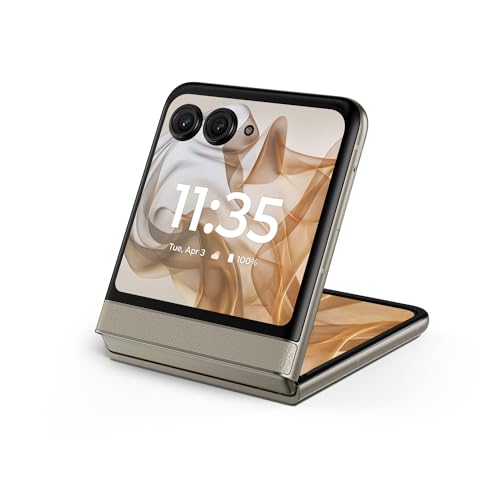
Motorola razr 2024
The Motorola razr 2024 takes a different approach to pocket size: it folds in half. Open, it is a full 6.9-inch smartphone with a large, vivid display. Closed, it becomes a compact square that fits in the smallest pocket, the palm of a hand, or a tiny purse. The 3.6-inch external display lets you check notifications, control music, and take selfies without opening the phone at all.
The phone is powered by a MediaTek Dimensity 7300X processor with 8 GB of memory and 256 GB of storage, which is ample for everyday use and multitasking. The 50 MP main camera takes sharp photos, and the external display doubles as a viewfinder for high-quality selfies using the main camera. The 4,200 mAh battery lasts a full day, and the phone supports fast charging and wireless charging. The vegan leather finish gives it a distinctive look and a secure grip.
This phone is for buyers who want a full-size screen that still fits in a tiny pocket. It is the best choice in this guide for anyone who carries a small bag or tight jeans and wants a phone that folds away neatly. It is less suited to buyers who want the most durable phone, since the folding mechanism needs more care than a solid slab, and the hinge should be kept free of dust and grit.
Key specifications include a 6.9-inch foldable LTPO AMOLED main display with a 144 Hz refresh rate, a 3.6-inch AMOLED external display, the MediaTek Dimensity 7300X processor, 8 GB of memory, 256 GB of storage, a 50 MP main camera with a 13 MP ultrawide camera, a 4,200 mAh battery, and an IPX8 water resistance rating.
Caveats: the folding screen needs careful handling, the phone is thicker than a slab phone when folded, and the processor is less powerful than the flagship chips in the Samsung and ASUS picks. Keep the hinge clean and avoid pressing hard on the inner display.
Comparison Table
| Feature | Galaxy S25 | Pixel 9a | Zenfone 10 | Motorola razr 2024 |
|---|---|---|---|---|
| Display | 6.2-inch AMOLED, 120 Hz | 6.3-inch OLED, 120 Hz | 5.9-inch AMOLED, 144 Hz | 6.9-inch foldable, 144 Hz |
| Folded size | Full slab | Full slab | Full slab | Compact square |
| Processor | Snapdragon 8 Elite | Tensor G4 | Snapdragon 8 Gen 2 | Dimensity 7300X |
| Memory | 12 GB | 8 GB | 8 GB | 8 GB |
| Storage | 128 GB | 128 GB | 128 GB | 256 GB |
| Main camera | 50 MP, triple camera | 48 MP, dual camera | 50 MP gimbal, dual camera | 50 MP, dual camera |
| Battery | 4,000 mAh | 5,100 mAh | 4,300 mAh | 4,200 mAh |
| Software support | Long | Seven years | Shorter | Moderate |
| Best for | Compact flagship | Camera and value | Smallest slab phone | Folds to pocket size |
Which One Is Right for You?
Choose the Samsung Galaxy S25 if you want the fastest compact flagship with the most versatile camera and the broadest feature set. It is the best all-rounder in this guide and the safest choice for most buyers who want a small phone without compromises.
Choose the Google Pixel 9a if you want the best camera software, the cleanest Android experience, and the longest software support. Its large battery and seven years of updates make it the best long-term buy in this guide.
Choose the ASUS Zenfone 10 if you want the smallest traditional phone here. Its 5.9-inch display and light body make it the easiest to use one-handed, and its headphone jack and gimbal camera are rare bonuses.
Choose the Motorola razr 2024 if you want a full-size screen that folds down to pocket size. It is the only phone here that shrinks to half its height, making it the most pocketable option when closed, even though it opens into the largest screen in this guide.
If you are still unsure, think about your pockets and your hands. Small hands and tight pockets point to the Zenfone 10. A balance of power and size points to the Galaxy S25. Camera quality and long support point to the Pixel 9a. A tiny folded footprint points to the razr. Any of the four is a genuine pocket-sized phone, so the best choice is the one that matches how you carry and use your phone every day.
Frequently Asked Questions
What counts as a pocket sized smartphone?
There is no official definition, but most buyers mean a phone with a screen under 6.4 inches and a narrow body that fits comfortably in a jeans pocket and can be used one-handed. Foldable phones also qualify, since they shrink to half their open size when closed. The practical check is simple: does it fit in your pocket without bulging, and can you reach the whole screen with one thumb.
Do small phones have worse battery life than large phones?
Small phones have less room for batteries, so their batteries are usually smaller. However, a smaller screen uses less power, and an efficient processor helps too. The phones in this guide last a full day of normal use, and the Pixel 9a lasts even longer thanks to its large battery. If battery life is your top priority, choose the model with the largest battery and the most efficient chip.
Are compact phones still made in 2026?
Yes, but the choice is smaller than it used to be. Most manufacturers focus on large phones, so compact models are fewer and often sell out faster. The phones in this guide are among the best compact options still available, covering flagship, mid-range, and foldable designs. If you want a small phone, it is worth buying while current models are still in stock.
Is a foldable phone as durable as a regular phone?
Foldable phones are more delicate than solid slab phones, mainly because of the folding screen and hinge. Modern foldables are water resistant and built to survive many thousands of folds, but they still need more care: keep dust and grit away from the hinge, avoid pressing hard on the inner display, and use a case designed for the model. For most users, a foldable lasts well with normal care, but a slab phone remains the tougher option.
Disclosure: As an Amazon Associate, we may earn from qualifying purchases.
More from Amazon
Programs that pair well with the guide above. Offers and eligibility are set by Amazon and may change.
Free shipping on eligible items, Prime Video and more. Eligible new members can start with a free trial.
Start a Prime free trialAd-free music streaming. Eligible new subscribers can start with a free trial.
Try Music Unlimited freeA Prime membership for ages 18-24 with a trial period. Eligibility is set by Amazon.
See Prime for Young AdultsAudiobooks and podcasts to listen to on the go. Eligible new members can start with a free trial.
Try Audible freeAs an Amazon Associate we earn from qualifying purchases.
Write Your Review
No reviews yet. Be the first to share your experience!