
Our Short List of 3
All 5 Picks at a Glance
| Product | Specs | Action |
|---|---|---|
 Fluke TL175 TwistGuard Test Leads | Check price on Amazon | |
 Fluke TL71 Premium Test Lead Set | Check price on Amazon | |
 Klein Tools 69410 Replacement Test Lead Set | Check price on Amazon | |
 Fluke TL81A Deluxe Electronic Test Lead Kit | Check price on Amazon | |
 Handskit Electrical Multimeter Test Leads Set | Check price on Amazon |
Key takeaways
- Compare the 5 best multimeter test lead and probe kits, with real Amazon picks, safety ratings, lead lengths, and what to check before you buy.
A multimeter is only as good as the leads that connect it to the circuit. If the probes are stiff, the insulation is thin, or the tips are too blunt for the job, every reading becomes a struggle. Worn leads are also a safety problem: a cracked insulator or a slipping tip can put a hand across a live conductor. For anyone who measures mains wiring or electronics bench work, the lead set deserves as much thought as the meter.
This guide compares five test lead sets and probe kits chosen for electronics and electrical work: three Fluke sets, a Klein replacement set for heavier electrical work, and a budget Handskit set for the bench. Each pick is rated on its safety category, its lead length, its probe and clip options, and whether its construction suits the work it is meant for.
As an Amazon Associate, we earn from qualifying purchases.
Quick Answer
For most bench and electrical work, the Fluke TL175 TwistGuard is the set to buy first: long silicone leads, a high safety rating, and tips that adjust for tight or open work. The Fluke TL71 is the compact everyday alternative with right-angle plugs, while the Klein 69410 suits electrical work with its removable alligator clips.
Fluke TL175 TwistGuard Test Leads
The Fluke TL175 TwistGuard is the strongest all-round set in this guide, and it earns that place on its safety ratings and its adjustable tips. The leads are rated at 1000 V and 10 A, with CAT III 1000 V and CAT IV 600 V protection when the guard is extended, dropping to CAT II 1000 V when retracted. That spread covers household mains, distribution boards, and the higher-energy circuits at a service entrance.
The TwistGuard tip adjusts from 19 mm down to 4 mm, so the same probe can reach into a crowded terminal block with a short exposed tip or open out for a firm contact on a larger terminal. The WearGuard layer shows damage before the insulation fails, and the silicone jacket stays flexible in cold conditions. The 56.5-inch leads give room to work around a panel, the 30,000-bend strain relief survives years of coiling, and the 4 mm shrouded plugs fit most meters.
This is the set to buy when safety and versatility matter more than price. It suits anyone who measures mains circuits regularly or wants one set for both bench electronics and electrical testing.
Fluke TL71 Premium Test Lead Set
The Fluke TL71 Premium Test Lead Set is the compact everyday pick, built for the kind of probing that happens dozens of times a day. Its comfort-grip probes sit naturally in the hand, and the right-angle plugs keep the leads lying flat against the meter. That matters in a tight enclosure or a tool bag, where straight plugs get bent and strained.
The silicone leads are 1.2 m long, about 4 ft, and the 2 mm tips are slim enough for dense circuit boards and small test points. The safety rating is CAT II 1000 V, and CAT III 1000 V with CAT IV 600 V protection when the caps are fitted, with a 10 A maximum current. The operating range runs from minus 20 to 55 degrees Celsius, so the set stays usable in a cold garage or a warm plant room.
This is the set for a meter that lives on the bench or in a tool roll for electronics and general troubleshooting. It is lighter and more compact than the TL175, and for low-energy electronics work its rating and reach are more than enough. Buyers who regularly measure mains circuits should weigh the TL175 instead.
Klein Tools 69410 Replacement Test Lead Set
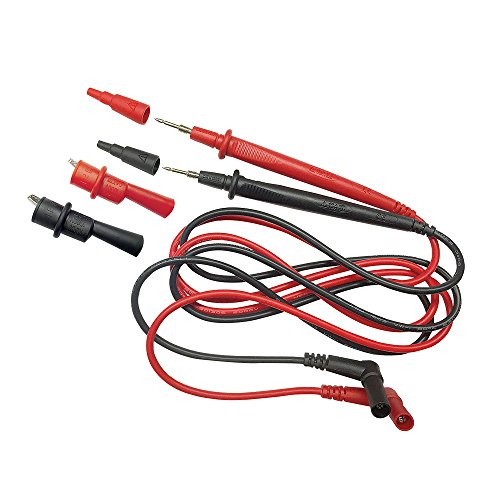
The Klein Tools 69410 Replacement Test Lead Set is the straightforward electrical-work pick. The leads are 41 inches long, a practical length for panel work and field service, long enough to reach around a distribution board without excess cable getting in the way. The set is rated CAT III 1000 V and CAT IV 600 V, the same level of protection as the higher-rated Fluke sets, so it is suitable for the same mains and distribution work.
Removable alligator clips are the feature that makes this set useful. With the clips fitted, the probes can be left attached to a terminal while a reading is noted, which is how most electrical testing actually happens in a panel. Pull the clips off and the probes work like any other test lead. That flexibility suits an electrician who needs both hands free.
This set is best bought as a replacement or a second set for electrical work rather than as a first set for electronics. Its tips and length are aimed at mains circuits, not at dense boards.
Fluke TL81A Deluxe Electronic Test Lead Kit
The Fluke TL81A Deluxe Electronic Test Lead Kit is the accessories pick of this guide, aimed squarely at electronics bench work. Where the other sets are pairs of leads, this kit is a small system: three silicone leads in red, black, and green, three alligator clips, micro-grabbers, and a nylon pouch. That spread of accessories covers the common bench jobs — clipping onto a component leg, grabbing a fine wire, or holding a probe in place while a circuit is powered.
The leads are 102 inches long, which lets the meter sit well back from the work. The alligator clips are rated at 5 A, which suits low-current electronics testing, and the micro-grabbers suit fine-pitch work where a standard probe tip would short adjacent pins. The nylon pouch keeps the small accessories from wandering off into a drawer.
This kit suits an electronics hobbyist or technician who already owns a basic lead set and wants the clips and grabbers that turn a meter into a hands-free test rig. It is not a replacement for a high-rated mains set.
Handskit Electrical Multimeter Test Leads Set
The Handskit Electrical Multimeter Test Leads Set is the budget pick, and it is honest about what it offers: a usable set of leads with tweezer probes for electronics work at a low price. The leads use 42-strand copper conductors, which keep them reasonably flexible, and the double-insulated silicone and nylon jacket gives practical protection for bench work.
The safety rating is CAT II 1000 V with a 10 A maximum, which suits electronics and low-energy circuits. The tweezer probes grip a component leg or a small wire and hold it, which is handy for testing surface-mount parts or a connection that a standard probe would slip off. For a hobbyist bench, or as a second set beside a soldering station, that is a genuinely useful capability.
This set is best bought for electronics bench work and light-duty testing. Its rating does not cover the higher-energy mains circuits that the Fluke TL175 or the Klein 69410 are built for, so buyers who measure household wiring should spend more on a CAT III or CAT IV set.
How to Choose
Start with the safety rating, because it decides which circuits the leads may touch. The CAT system describes the energy available at the point of measurement: CAT II covers appliance-level and outlet circuits, CAT III covers distribution boards and fixed installations, and CAT IV covers the service entrance and outdoor conductors. A set rated CAT III 1000 V and CAT IV 600 V, like the TL175 or the Klein 69410, is safe for mains and panel work. A CAT II set, like the Handskit, belongs on electronics and low-energy circuits.
Next, match the lead length to the work. A 41-inch or 4 ft lead suits panel work and field service, where the meter sits close to the point of measurement. A longer lead, like the 56.5-inch TL175 or the 102-inch TL81A, suits bench work where the meter needs to sit back from the circuit. Too short a lead forces the meter into awkward positions; too long a lead tangles and drags.
Then look at the probes and the accessories. Adjustable tips, like the TwistGuard on the TL175, handle both tight and open work with one set. Slim 2 mm tips suit dense boards. Alligator clips and micro-grabbers, like those in the TL81A kit, hold a connection hands-free, which matters when a reading has to be watched over time. Tweezer probes, like the Handskit set, grip small parts.
Finally, check the insulation and the plugs. Silicone stays flexible in the cold and resists heat better than the plastic used on the cheapest leads, which is why it appears on every pick in this guide except as part of a double-insulated jacket. A strain relief rated for thousands of bends, like the 30,000-bend rating on the TL175, is a sign the leads will last. The plugs should match the meter: 4 mm shrouded plugs are the standard, and right-angle plugs suit meters carried in a bag.
Who Should Skip
Skip this guide entirely if the meter already has a lead set in good condition with a rating that covers the work it does, because a new set will not change the readings. Skip the Handskit set if the work involves mains circuits or distribution boards, since its CAT II rating does not cover that energy level. Skip the TL81A kit if the goal is a single everyday lead set, because it is an accessories kit rather than a primary pair of leads. Skip the Klein 69410 if the work is fine electronics, since its tips and length are aimed at electrical panels rather than dense boards. And skip any lead set with cracked insulation, exposed wire, or a tip that no longer grips.
FAQ
What does the CAT rating on test leads mean?
The CAT rating describes the energy level of the circuit the leads are safe to measure. CAT II covers outlets and appliance-level circuits, CAT III covers distribution boards and fixed wiring, and CAT IV covers the service entrance. A higher CAT rating means the leads can withstand larger transient voltage spikes.
How long should multimeter test leads be?
For bench electronics work, leads of about 4 ft are usually enough, and a 102-inch kit is useful when the meter sits back from the work. For panel and field work, 41 to 56 inches is a practical range.
Are alligator clips useful on test leads?
Alligator clips are useful when a connection has to be held while a reading is taken or a circuit is adjusted. They free both hands and keep the probe from slipping off a terminal.
When should test leads be replaced?
Replace test leads when the insulation is cracked, nicked, or melted, when the wire shows through, when the tips are bent or loose, or when the plugs no longer fit snugly in the meter.
Final Verdict
For most bench and electrical work, the Fluke TL175 TwistGuard is the set to buy first: a high safety rating, adjustable tips, long silicone leads, and strain relief built for years of use. Add the Fluke TL71 for compact everyday probing, the Klein 69410 for electrical work, and the TL81A kit when the bench needs clips and micro-grabbers. The Handskit set covers budget electronics work. Whichever is chosen, match the CAT rating to the circuit first and retire any set whose insulation is damaged.
Product and ASIN Reference
| Product | ASIN |
|---|---|
| Fluke TL175 TwistGuard Test Leads | B005CTI592 |
| Fluke TL71 Premium Test Lead Set | B00011Q5QG |
| Klein Tools 69410 Replacement Test Lead Set | B003U2GONM |
| Fluke TL81A Deluxe Electronic Test Lead Kit | B000NI2B6A |
| Handskit Electrical Multimeter Test Leads Set | B074L1NXRX |
More from Amazon
Programs that pair well with the guide above. Offers and eligibility are set by Amazon and may change.
Free shipping on eligible items, Prime Video and more. Eligible new members can start with a free trial.
Start a Prime free trialAd-free music streaming. Eligible new subscribers can start with a free trial.
Try Music Unlimited freeA Prime membership for ages 18-24 with a trial period. Eligibility is set by Amazon.
See Prime for Young AdultsAudiobooks and podcasts to listen to on the go. Eligible new members can start with a free trial.
Try Audible freeAs an Amazon Associate we earn from qualifying purchases.


Write Your Review
No reviews yet. Be the first to share your experience!