

Key takeaways
- The right grease for your switch type. This is the most important item and the one most often wrong in cheap bundles.
- A switch opener. It pops the top housing off without scratching the plastic. Openers are specific to switch families, so confirm the one in the kit fits MX-style or Kailh housings.
- Fine brushes. Sizes 0 or 00 are standard. Wide brushes pick up too much grease and push it into places it should not be.
- A stem holder or lube station. It keeps small parts organized and makes repetitive work faster.
- Tweezers or a keycap and switch puller. Useful for removing switches from a hot-swap board.
- Spring oil. Optional but valuable for reducing spring noise, which grease cannot fix.
The best keyboard lube kit for switch modding is one that matches the lube to the switch: Krytox 205g0 for linear switches, Tribosys 3203 for tactile switches, Krytox GPL 105 oil for springs, and a switch opener plus fine brushes to apply them. A starter bundle from a keyboard shop such as Keebcats or Turtlekeebs combines these pieces, and a budget multi-tool kit works if you accept generic grease. This guide breaks the choice into the lubricants, the tools, and the kits themselves, so you can buy exactly what your switches need rather than a mismatched set.
Lubing switches is one of the few mods that changes feel and sound at the same time. Done well, it removes scratchiness, tightens the sound and makes linear travel smoother. Done badly, it makes switches mushy or sluggish. The most common mistake, repeated by almost every guide, is using too much, so the right kit is as much about restraint and tools as it is about the grease.
Our top picks

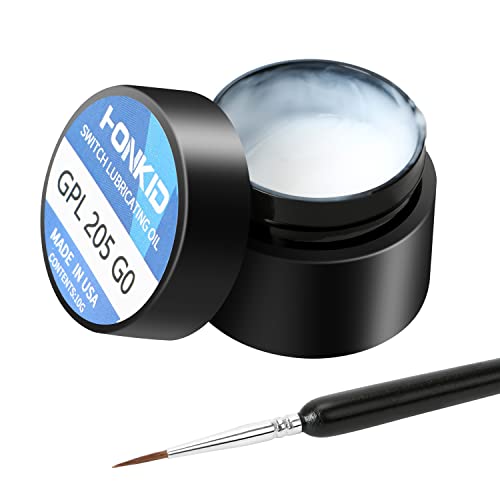


As an Amazon Associate we earn from qualifying purchases at no extra cost to you.
Quick Comparison of the Best Lube Kit Components
| Pick | Best for | Type | Where it goes | Key detail |
|---|---|---|---|---|
| Krytox 205g0 | Best for linear switches | Thick grease | Stems, housing rails, stabilizers | Thin coats; 3 ml covers roughly 300 switches |
| Tribosys 3203 | Best for tactile switches | Thin grease | Stem walls and rails | Keeps the bump close to stock |
| Tribosys 3204 | Best for a smoother tactile feel | Slightly thicker grease | Tactile stems and rails | Equivalent to a 204 Grade 0 style grease |
| Krytox GPL 105 | Best for springs | Oil | Springs only | Reduces spring ping |
| Permatex dielectric grease | Best for stabilizers | Thick grease | Stabilizer wires and housings | Do not use inside the switch |
| Kinetic Labs Kelowna Lube Station | Best tool for batch work | Switch holder | Holds 36 switch halves | Speeds up repetitive work |
| Lube starter kits (Keebcats, Turtlekeebs) | Best all-in-one | Bundle | Whole workflow | Grease, opener and brushes together |
What a Good Keyboard Lube Kit Must Contain
A kit is only useful if every item in it serves a step in the process. Guides from keyboard shops describe the same minimum set.
- The right grease for your switch type. This is the most important item and the one most often wrong in cheap bundles.
- A switch opener. It pops the top housing off without scratching the plastic. Openers are specific to switch families, so confirm the one in the kit fits MX-style or Kailh housings.
- Fine brushes. Sizes 0 or 00 are standard. Wide brushes pick up too much grease and push it into places it should not be.
- A stem holder or lube station. It keeps small parts organized and makes repetitive work faster.
- Tweezers or a keycap and switch puller. Useful for removing switches from a hot-swap board.
- Spring oil. Optional but valuable for reducing spring noise, which grease cannot fix.
Best for Linear Switches: Krytox 205g0
Krytox 205g0 is the benchmark lubricant for linear switches and the most popular choice in the keyboard community according to several lube guides. It is a thick synthetic grease, which means a thin coat on the stem walls and housing rails is enough. Applied sparingly, it removes the faint scratch of plastic rubbing on plastic, tightens the sound and makes travel feel smoother and more consistent.
Quantity is generous. A 3 ml container of 205g0 is cited as enough for roughly 300 switches with thin coats, which can cover three to four full keyboards. A full board takes about two to three hours, and the main tools are a switch opener and a fine paintbrush.
Who it is for: linear switch owners, and anyone lubing stabilizers who wants the same grease for both jobs. Pros: widely recommended, long-lasting, a small container goes far. Cons: too thick for some tactile switches, and heavy application makes switches feel slow and sound muffled. Some shops also stock Krytox 206g0 for a thicker feel; treat that as a variation rather than a starting point.
Best for Tactile Switches: Tribosys 3203
Tribosys 3203 is the thin grease usually recommended for tactile switches. Because it is thinner than 205g0, it smooths the stem walls and rails while leaving the bump of the tactile leg largely intact. Guides recommend using it mostly on the sliding surfaces, rather than on the tactile contact point, so the bump does not soften.
A retailer note suggests choosing 3203 when you want to preserve a pronounced bump, since it affects that feel least. Kinetic Labs and several other shops carry it in small containers alongside Krytox lubes.
Who it is for: tactile switch owners who want smoothness without losing feedback. Pros: keeps the tactile character, easy to apply thinly. Cons: less effective than thicker grease at deadening sound on linears, and it can disappear faster if the housing is rough.
Best for a Smoother Tactile Feel: Tribosys 3204
Tribosys 3204 is slightly thicker than 3203 and is described by retailers as the choice for a smoother but still bumpy result. It is made by Miller-Stephenson and is described as the equivalent of Krytox GPL 204 Grade 0 style grease. The trade-off is that the bump becomes slightly softer, so it suits typists who find raw tactile switches too sharp.
Who it is for: tactile users who want a rounder, quieter bump. Pros: a good middle ground between 3203 and 205g0. Cons: softens the bump, so it is a poor fit for those who bought tactile switches precisely for a sharp feel.
Best for Springs: Krytox GPL 105 Oil
Springs are the part grease cannot help. A bare metal spring can produce a faint ping, which is especially noticeable on a quiet linear board. Krytox GPL 105 is a light oil used for exactly that, applied to springs only and never to stems or housings, where it would run and cause problems. One guide notes that a bag toss, where springs are shaken in a small bag with a drop of oil, gives an even and repeatable coat.
Who it is for: anyone chasing a clean sound after lubing stems. Pros: reduces spring ping, a tiny amount goes a long way. Cons: too much oil makes a mess and can creep onto other parts, so measure carefully.
Best for Stabilizers: Permatex Dielectric Grease
Stabilizers are lubed separately from switches because they are a different part with a different job. Switch and Click describes Permatex dielectric grease as a cheap, thick option and a close alternative to Krytox 205g0 for stabilizer wires and housings. A comparison table lists it for stabilizer wires and housings only, and warns that it is too thick for most switches, where it can make them feel sluggish.
Another approach is to use Krytox 205g0 on stabilizer housings and a different grease on the wire. Either route works; the goal is to coat contact points so the spacebar and shift keys stop rattling.
Who it is for: builders who want a cheap solution for stabilizer rattle. Pros: inexpensive, easy to find at hardware shops. Cons: keep it away from switches, and use thin coats so it does not slow the stabilizer.
Best Tool for Batch Work: Kinetic Labs Kelowna Lube Station
Lubing a hundred switches by hand is repetitive, and a station reduces mistakes. Kinetic Labs sells a Kelowna Switch Lube Station that holds 36 switches and sits alongside its other tools, including a two-in-one switch opener, nylon lube brushes, a lube palette and the Krytox and Tribosys grease line. Its guide to lubing tactile switches lists the opener, Krytox 205g0, a size 00 brush, a lube palette and a stem holder as the core toolset.
Who it is for: anyone doing a whole keyboard or several in a row. Pros: keeps parts ordered and cuts handling time. Cons: a station is not necessary for a small number of switches, and it adds to the total cost.
Best All-in-One: Lube Starter Kits From Keyboard Shops
For a first project, a curated bundle removes guesswork. Keebcats’ Lube Starter Kit is listed with Krytox 205g0, Krytox 105 or Tribosys 3203/3204, an MX or Kailh switch opener, a stem holder, a keycap and switch remover and a brush pack. Turtlekeebs’ Lube Starter Pack includes 3 ml each of Krytox 205g0, Krytox 105 and Tribosys 3203, plus two fine lubrication brushes. Both bundle the right lube types rather than a single generic grease.
Who it is for: first-time modders. Pros: correct lubes grouped together, brushes included, no need to piece things together. Cons: contents vary by shop and version, so read the listing to see what is actually in the box before assuming it covers your switch type.
Budget Multi-Tool Kits: What You Gain and Lose
Budget kits in the 12-piece style bundle a lube station, aluminum switch opener, two brushes, a four-claw grabber, tweezers, gloves, O-rings and a tube of grease. They are convenient and cover tools you would otherwise buy separately. The caveat is that the included grease is often a generic product sold under a name like “205G0” rather than genuine Krytox. It may work well enough for a first experiment, but it is not the same formulation, and results can differ. If you like the tools, consider pairing the kit with a small container of genuine grease.
Match Lube to Switch: A Decision Matrix
| Your situation | Recommended lube | Application note |
|---|---|---|
| Linear switches, want smooth and quiet | Krytox 205g0 | Thin coat on stem walls and rails |
| Tactile switches, keep the bump | Tribosys 3203 | Sliding surfaces only, avoid the tactile leg |
| Tactile switches, softer bump | Tribosys 3204 | Thin coat on stem and rails |
| Springs ping or buzz | Krytox GPL 105 | Oil springs only, bag toss method |
| Spacebar or shift rattles | Permatex dielectric grease | Wires and housings, not switches |
| Magnetic Hall-effect switches | Check manufacturer first | Lube can contaminate the sensor |
A Worked Example: Lubing a 75% Board
Take a 75% keyboard with 82 keys. You need 82 switches plus a few spares, and each switch has a stem, housing, spring and sometimes a tactile leg. The 3 ml of 205g0 that covers roughly 300 switches means a single container is plenty for one board with a lot left over. At about two to three hours per full board, expect an evening of work and about 90 seconds per switch once you find a rhythm. Add spring oil for another round: oiling springs in bulk by the bag method takes a few minutes. The time breakdown looks like this.
- Switch removal and sorting: around 20 minutes
- Opening and lubing 82 switches: around two hours
- Spring oiling and reassembly: around 30 minutes
- Stabilizer work: around 30 to 45 minutes
- Testing and refitting: around 15 minutes
That totals roughly four hours for a first-timer, and less with practice.
Step-by-Step Process and Why Each Step Matters
- Remove keycaps and switches. Hot-swap boards let you pull switches without soldering. Do this on a clean, well-lit surface so small parts cannot disappear.
- Open the switch. Use the opener to pop the top housing off. Pry evenly so the plastic does not crack.
- Apply grease to the stem. Use a size 0 or 00 brush and coat only the sides and rails. Thinner is better, because a thick layer increases friction and dulls the sound.
- Lube the housing rails. A thin line where the stem slides is enough.
- Treat the spring. Use the bag toss method with a very small amount of oil, so the coating is even and minimal.
- Reassemble and test. Close each switch, press it a few times, and set aside any that feel gritty or catch.
- Handle stabilizers separately. Lube the wire ends and housings with a thick grease, clip if needed, and install before the switches go in.
Switch Lubing Mistakes to Avoid
- Using too much. The most common error. More grease means slower return, a muffled sound and a messy workspace.
- Using the wrong lube on tactile legs. Thick grease on the tactile contact can erase the bump you paid for.
- Using household products. WD-40 and silicone spray are not suitable for keyboard switches.
- Using stabilizer grease inside switches. Dielectric grease is too thick and makes switches sluggish.
- Lubing Hall-effect switches without approval. Magnetic switches such as those in some Wooting or Keychron HE boards should not be lubed unless the manufacturer says so, because grease can contaminate the sensor.
- Mixing up parts. Keep each switch’s components together so springs and stems do not get scrambled across a batch.
Ownership Realities: What Happens After Lubing
Lubed switches usually need no regular maintenance, but a few realities apply. Grease can migrate slightly over months, especially if applied heavily, which is another reason to use thin coats. If a few switches develop a different feel, you can reopen and refresh only those. Keep leftover containers sealed and away from heat, and store spare brushes in a bag so dust does not contaminate them. A small container lasts for many boards, so the consumable cost per keyboard is low even when the kit looks expensive up front.
How to Choose a Kit by Project Size
The right purchase depends on how much you plan to do, not just which brand looks best. Use these scenarios as a guide.
- One board, first attempt. Buy a starter bundle with 205g0 or 3203, a switch opener and two brushes. You will use almost none of the grease, but the tools matter most on a first run.
- Several boards or a mixed collection. Buy lubes individually so you can match each switch family, and add a lube station to save time.
- Only stabilizer rattle. Skip the switch kit entirely. A small tub of thick grease and a brush will fix a rattling spacebar in minutes.
- Hall-effect keyboard. Do not buy a lube kit for the switches. Check the manufacturer guidance, and limit work to stabilizers if allowed.
Cost-per-board thinking
Because a 3 ml container can treat roughly 300 switches, the grease itself is a small share of any project. The real spend is on tools, which you keep, and on switches if you decide to replace faulty ones. Spending a little more on a reliable opener and fine brushes usually pays off by avoiding cracked housings and uneven coats.
Documenting your results
Keep a simple note of what you used on which board: lube type, how many switches, and how it felt afterward. It sounds fussy, but when you build your next keyboard you will know whether 3203 or 3204 suited your tactile switches, and you will avoid repeating a mistake like over-greasing a set.
Frequently Asked Questions
What is the best lube for keyboard switches?
For linear switches, Krytox 205g0 is the most common recommendation. For tactile switches, Tribosys 3203 or 3204 is usually preferred because they preserve more of the bump. Springs benefit from a light oil such as Krytox GPL 105.
How much lube do I need?
Very little. A 3 ml container of 205g0 is cited as enough for roughly 300 switches with thin coats. The most common mistake is applying too much, so aim for a barely visible layer.
Can I use the same lube on stabilizers and switches?
Sometimes. Krytox 205g0 works for both linear switches and stabilizers. Thicker greases such as Permatex dielectric grease are fine for stabilizers but too heavy for switch stems.
Should I lube tactile switches?
Yes, but carefully. A thin grease such as Tribosys 3203 on the sliding surfaces smooths the feel without removing the bump. Avoid coating the tactile leg heavily.
Is it safe to lube magnetic switches?
Not without checking first. Hall-effect switches contain sensors that grease can contaminate, so confirm with the manufacturer before applying anything.
How long does it take to lube a whole keyboard?
Guides cite about two to three hours for the switches on a full board, plus extra time for springs and stabilizers. Expect a few hours for a first attempt and less on later builds.








Write Your Review
No reviews yet. Be the first to share your experience!