

Key takeaways
- Pro: dedicated mic and guitar controls with separate volume and effects keep vocals clear.
- Pro: enough output for a 40 to 60 person gathering, indoors or outdoors.
- Pro: wheels make it easy to move across a yard or hall.
- Con: heavy compared with portable Bluetooth speakers.
- Con: the battery drops quickly at high volume with lights on.
A good karaoke speaker needs two microphone inputs, enough power to keep a voice clear over backing music, and either a lyric source or a way to connect one. For most households in 2026 the JBL PartyBox line is the safest choice: the PartyBox 110 suits small parties, the Stage 320 suits mixed singing and instruments, and the larger PartyBox 520 suits big rooms. If you gig as a singer, a portable PA such as the Bose S1 Pro+ is a better tool than any party speaker.
This guide uses manufacturers’ published specifications and published professional reviews rather than personal bench work. Where a figure varies between sources, it is given as an approximate range or the speaker is described by spec class.
Our top picks


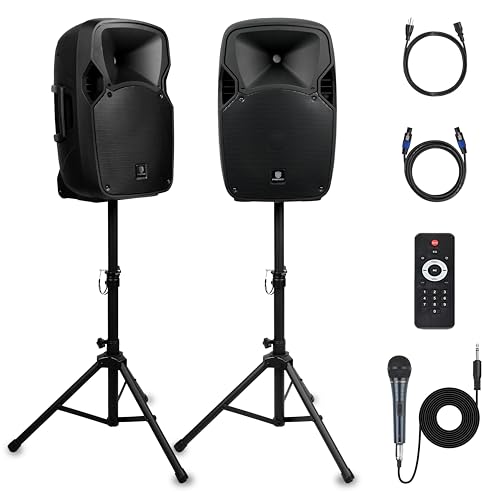
As an Amazon Associate we earn from qualifying purchases at no extra cost to you.
Karaoke speakers at a glance
| Speaker | Mic inputs | Power (rated) | Battery | Price tier | Best for |
|---|---|---|---|---|---|
| JBL PartyBox 110 | 1 mic plus 1 guitar | ~160 W | ~12 h | Mid | Home parties, light shows |
| JBL PartyBox Stage 320 | 2 (mic and guitar combo) | ~240 W | ~14 h | Mid to premium | Duets, outdoor, live vocals |
| JBL PartyBox 520 | 2, independent controls | Large-room class | Mains-focused | Premium | Large rooms, serious karaoke |
| JBL PartyBox Encore Essential 2 | 1-2 with wireless mics included | Compact class | ~10 h class | Entry to mid | Kids, apartments |
| ION Block Rocker | 2 plus radio | ~100-120 W class | Very long | Entry to mid | Backyard, wheeled |
| Bose S1 Pro+ | 3-channel mixer | ~150 W class | ~11 h | Premium | Singers who gig |
| Soundcore Rave 3S | 1 mic input | Party-speaker class | Long | Mid | Casual singing |
Battery and wattage numbers are manufacturers’ ratings and change with volume; treat them as ceilings, not guarantees.
Why speakers matter more than the karaoke “machine”
Karaoke is mostly a sound-quality problem. A voice sits in the 100 Hz to 4 kHz range, and the backing track fills the same space. When the speaker has weak mic preamps or a single shared volume control, the singer either drowns or shouts. A speaker built for karaoke solves three things: separate mic volume, echo or reverb control, and enough headroom so that vocals stay clear when the track gets loud.
A “karaoke machine” is usually a speaker plus a screen or a lyric app. Most modern setups skip the dedicated machine and use a tablet or TV with a lyric app, then send audio to a speaker through Bluetooth or an AUX cable. That is why this guide covers speakers first.
The picks, one by one
JBL PartyBox Stage 320: best overall for mixed singing and instruments
Spec line: roughly 240 W output, two combo inputs (microphone and guitar) with independent controls, up to about 14 hours of battery on the maker’s rating, built-in light show, wheeled and handled body.
Best for: households that sing duets, bands that play small gigs, and anyone who wants one speaker for a backyard, a living room and a school event.
Skip if: you want a small, desk-friendly speaker; the Stage 320 is large and heavy for its class.
- Pro: dedicated mic and guitar controls with separate volume and effects keep vocals clear.
- Pro: enough output for a 40 to 60 person gathering, indoors or outdoors.
- Pro: wheels make it easy to move across a yard or hall.
- Con: heavy compared with portable Bluetooth speakers.
- Con: the battery drops quickly at high volume with lights on.
JBL PartyBox 110: best for small to mid-size home parties
Spec line: about 160 W output, 12-hour battery class, built-in synchronized light show, microphone and guitar inputs, splashproof body.
Best for: living rooms, small patios and families who want lights and bass without the size of a Stage 320.
Skip if: you need two microphones at the same time without an external mixer.
- Pro: balanced size and output, easy to lift with the handle.
- Pro: strong bass for its size, with a bass boost mode.
- Pro: lights respond to the music, which is popular with kids and party guests.
- Con: a single mic input limits duets.
- Con: no wheels, so it is less suited to long carries.
JBL PartyBox 520: best for large rooms and serious karaoke nights
Spec line: large-format party speaker, two microphone inputs with separate gain and volume controls, wide frequency range with dedicated bass and treble controls. Professional reviewers have named it a top karaoke speaker because the mic channels are easy to control.
Best for: large living rooms, event halls and repeat karaoke hosts who want the most volume and clearest vocals from the PartyBox family.
Skip if: you want something light or cheap; this is a heavy, premium speaker.
- Pro: independent mic gain on both channels makes duets sound balanced.
- Pro: high output without harshness at party levels.
- Pro: ample bass for pop and dance tracks.
- Con: heavy and bulky.
- Con: premium price tier, which only pays off if you use it often.
JBL PartyBox Encore Essential 2: best compact karaoke speaker with included mics
Spec line: compact party speaker designed around karaoke with wireless microphones included in the box, lights, and a battery in the 10-hour class.
Best for: families, apartments and kids’ birthday parties, where setup should be minimal and the speaker gets moved from room to room.
Skip if: you want enough power for an outdoor crowd or rich low-end.
- Pro: ready to sing out of the box with included mics.
- Pro: small enough for a bookshelf or a car trunk.
- Pro: simple controls for echo and mic volume.
- Con: limited headroom at higher volumes.
- Con: wireless mics need charging and are easy to misplace.
ION Block Rocker: best outdoor and wheeled option on a budget
Spec line: roughly 100 to 120 W class, wheels and a pull handle, AM/FM radio, Bluetooth, two inputs, splash-resistant body, and a very long battery rating compared with most rivals.
Best for: backyard events, tailgates and anyone who wants a long runtime more than refined sound.
Skip if: you want tight bass or detailed highs; the sound is more party than hi-fi.
- Pro: long runtime means a whole afternoon without a plug.
- Pro: wheels and handle make it simple to move.
- Pro: radio and Bluetooth cover most music sources.
- Con: tonal quality is behind JBL and Bose at high volume.
- Con: limited mic control compared with a dedicated karaoke unit.
Bose S1 Pro+: best for singers who also gig
Spec line: portable PA, about 150 W class output, built-in three-channel mixer, battery of roughly 11 hours on the maker’s rating, Bluetooth and an app for EQ, and a tilt-back design that works as a floor monitor.
Best for: solo singers, teachers who sing in class, and anyone who wants premium vocal clarity with a simple mixer onboard.
Skip if: you want party lights and heavy bass; it is a PA, not a party speaker.
- Pro: very clear vocals and wide coverage for its size.
- Pro: three-channel mixer with reverb options.
- Pro: built to travel with a strap and a carry handle.
- Con: premium price tier.
- Con: bass is controlled rather than booming, so dance tracks sound less dramatic.
Soundcore Rave 3S: best for casual singing from a general party speaker
Spec line: party speaker with a microphone input, a light ring, long battery rating and a water-resistant body in the Anker Soundcore range.
Best for: people who mostly play music and sing a few songs per night.
Skip if: your priority is two-singer karaoke, since inputs are limited.
- Pro: strong bass and balanced tuning for general music.
- Pro: durable and easy to carry.
- Pro: app control for EQ and lights.
- Con: one mic input.
- Con: mic effects are basic compared with the JBL range.
Best karaoke speakers by use
Best karaoke speakers for home
For a living room, the JBL PartyBox 110 or Encore Essential 2 offer enough volume and simple controls. If you have a TV or a tablet showing lyrics, a speaker with a clear AUX or Bluetooth input will work. Place the speaker beside the screen, not behind the singer, to avoid feedback.
Best portable karaoke speakers
Wheels and a pull handle matter more than the size of the woofer once a speaker passes about 15 lb. The Stage 320 and ION Block Rocker are the easiest to move across ground; the Bose S1 Pro+ is the lightest of the louder options.
Best Bluetooth karaoke speakers
Almost every speaker above has Bluetooth, but Bluetooth adds delay. For singing, the microphone input should be wired to the speaker’s own mixer so your voice is not delayed. Use Bluetooth only for the backing track, and if lyrics lag behind the audio on a video, switch the player to a wired connection.
Best speakers for singing
If singing quality matters more than party effects, choose a speaker with a mixer and good vocal clarity. The Bose S1 Pro+ is the standout; for budget buyers, the JBL PartyBox Stage 320 gives similar control with more bass.
Best karaoke machine speakers
Dedicated machines from brands such as Singing Machine and ION combine a speaker, screen or lyric connection and mic. They are convenient for children but usually have weaker sound than the JBL and Bose options. A better value path is a speaker plus an app-based lyric source.
How to choose: the numbers
Mic inputs and channels
Count the singers. One mic is fine for solo use. Two inputs matter for duets and kids. Look for independent volume or gain per channel; shared controls make one singer too loud and the other too quiet.
Power and room size
As a rule of thumb for party speakers: about 100 W class for a room up to 250 square feet, 160 to 240 W class for 250 to 600 square feet, and more than that for large rooms or outdoor use. Outdoor use usually needs twice the power for the same perceived volume.
Battery and mains use
Battery ratings are measured at moderate volume. A speaker rated at 12 hours may deliver 5 to 6 hours at party volume with lights on. If you sing for long sessions, plug in.
Echo and effects
Echo and reverb should be adjustable on their own knob. Too much echo hides pitch problems for a few songs, but it turns muddy fast. Choose a speaker where the echo level does not change the main mic volume.
Worked example
You host monthly karaoke nights for 15 people in a 20 by 15 foot room. That is 300 square feet, so a speaker in the 160 W class is enough. You want two mics for duets, so the Stage 320 fits better than the 110. Add a tablet with a lyric app and a TV for display, and you have a full setup without a dedicated machine.
Setup tips for better vocals
- Place the speaker at head height or higher and in front of the singers to reduce feedback.
- Set the mic gain so the loudest singing reaches about two-thirds of the meter, then raise the master volume.
- Add echo last, in small steps.
- Keep the backing music 3 to 6 dB below the voice.
- Use a pop filter or hold the mic two to three finger-widths from the mouth.
Ownership realities
- Wireless mics lose charge and are the most frequently lost accessory; buy a spare if the speaker uses them.
- Rubber feet, handles and wheels wear first on portable speakers.
- Lithium batteries age; expect noticeably shorter runtime after a few years of regular use.
- Splash resistance is not waterproofing; check the rating before outdoor use in rain.
Frequently Asked Questions
What do I need for karaoke at home?
You need a speaker with a microphone input, a lyric source such as a tablet, TV or phone app, and one or two microphones. Many JBL and Bose speakers cover the first and third items; the lyric source is usually something you already own.
Can any Bluetooth speaker be used for karaoke?
Only if it has a microphone input. Pairing a phone mic over Bluetooth adds delay and usually sounds poor. A speaker with a wired mic input and its own mixer gives better results.
How many watts do I need for karaoke?
For a living room, around 100 to 160 W class is enough. For parties of 30 or more or outdoor use, move up to 240 W class. Ratings differ between brands, so use them as a rough guide only.
Do I need a dedicated karaoke machine?
No. A speaker with a mic input and an app or TV for lyrics does the same job and usually sounds better. Dedicated machines make sense for young children who want something simple and sturdy.
Why does my voice echo or squeal?
Squealing is feedback: the mic hears the speaker. Move the speaker ahead of the mic line, lower the mic gain, and avoid pointing the mic at the speaker. Too much echo is a setting, so reduce the echo knob.
Is a PA speaker better than a party speaker for karaoke?
For voice clarity, usually yes. A PA speaker like the Bose S1 Pro+ is tuned for speech and singing. A party speaker is tuned for music, bass and lights. Pick by whether you value lights and bass or vocal clarity.
Bottom line
Choose the JBL PartyBox Stage 320 if you want one speaker for duets, parties and outdoor use; the PartyBox 110 or Encore Essential 2 if you are on a smaller budget or have little space; the PartyBox 520 for large rooms; and the Bose S1 Pro+ if your voice is the priority. Match the number of mic inputs to the number of singers, keep the mic and backing levels separate, and treat battery ratings as best-case numbers.
More from Amazon
Programs that pair well with the guide above. Offers and eligibility are set by Amazon and may change.
Free shipping on eligible items, Prime Video and more. Eligible new members can start with a free trial.
Start a Prime free trialAd-free music streaming. Eligible new subscribers can start with a free trial.
Try Music Unlimited freeA Prime membership for ages 18-24 with a trial period. Eligibility is set by Amazon.
See Prime for Young AdultsAudiobooks and podcasts to listen to on the go. Eligible new members can start with a free trial.
Try Audible freeAs an Amazon Associate we earn from qualifying purchases.



Write Your Review
No reviews yet. Be the first to share your experience!