

Key takeaways
- Compare the best hardware samplers by pads, memory, effects and connectivity as listed, for producers making beats away from the computer daily.
A hardware sampler earns its place by doing the whole job — recording, chopping, sequencing and playing back sounds — without a laptop in the chain. The real decision is which engine fits how you make beats: a full production center that finishes tracks, a performance box built for fast hands, or a pocket machine that captures ideas anywhere. Screens, pads, memory and power all pull in different directions, so the best choice depends on where and how you work.
This guide compares five standalone samplers sold on Amazon for three kinds of buyers: producers who want one box to build complete tracks, live performers who play beats with their fingers, and mobile creators who sketch ideas on battery power. Every pick records and plays samples on its own hardware — no computer or phone app is required to make sound — and each was chosen from its listing’s pads, memory, effects and connectivity.
Quick Picks
As an Amazon Associate we earn from qualifying purchases.
| Product | Best for | Key spec from title |
|---|---|---|
| Akai Professional MPC One+ | Finishing complete tracks standalone | 7-inch touchscreen with WiFi and Bluetooth |
| Roland SP-404MKII | Live finger drumming and DJ sets | 16GB internal storage, 32-voice polyphony |
| teenage engineering EP-133 K.O. II | Sketching beats anywhere on batteries | 128MB memory with built-in microphone |
| Novation Circuit Rhythm | Sequencing a tabletop hardware rig | 8 sample tracks |
| Roland AIRA Compact P-6 | A first, pocket-size sampler | Granular sound design with built-in mic |
How to Choose
Start With the Sampling Engine
Every machine here samples on its own hardware, but the engines differ. Some chop and resample loops, some add granular engines that stretch tiny grains into textures, and some focus on one-shot drums and chromatic playback. If you mostly flip records or field recordings, prioritise fast chopping, resampling and generous per-project sample counts. Producers coming from MIDI pad controllers should note the difference: a controller only triggers sounds in software, while these boxes generate and sequence the audio themselves, even with the computer switched off.
Pads, Screens and Performance Control
Pads decide how a sampler feels to play. Sixteen large velocity-sensitive pads suit finger drumming and melodic parts, while a 32-pad grid doubles as a step sequencer you can read at a glance. Smaller sets of pressure-sensitive keys trade pad count for portability. Screens matter just as much: a large touchscreen makes waveform editing and mixing fast, while compact displays rely on shortcuts and muscle memory. If you plan to perform, look for performance effects you can trigger live, such as beat repeat, stutter and punch-in effects that reshape a pattern while it plays.
Memory, Storage and Project Size
Sample memory shapes how big a project can grow. Fixed internal storage measured in gigabytes holds whole libraries and long loops, while card-based systems expand with inexpensive microSD media but depend on you managing packs and files. Check three figures on the listing: total storage, how many samples fit in one project, and the maximum length of a single sample. Pocket samplers often cap individual samples at a few seconds, which suits drums and granular grains but not full-song stems or long ambient recordings.
Connectivity and Power for Your Setup
Decide how the sampler joins the rest of your rig before you buy. Full-size MIDI ports link older synths and drum machines, USB audio turns some units into an interface for recording finished beats, and CV/gate outputs speak to modular gear. Power is the other dividing line: mains-only desktops anchor a studio, while battery models run for a few hours per charge and suit couches, trains and park benches. Built-in microphones and speakers remove friction for quick ideas, but you still need headphones or line outputs for serious listening.
The 5 Best Options
Akai Professional MPC One+

The MPC One+ is the closest thing here to a studio in a box: it samples, sequences, mixes and applies effects on its own multi-core processor, then arranges the result into finished tracks. Its 16 RGB pads and 7-inch touchscreen suit producers who build songs step by step rather than only jamming loops. WiFi and Bluetooth add Ableton Link sync and wireless updates, while CV/gate outputs reach modular rigs. Choose it if you want one standalone centre for hip-hop, house or sample-based production and do not need battery power.
Specs
- Pads: 16 velocity-sensitive RGB backlit pads
- Display: 7-inch multi-gesture touchscreen
- Storage: 16GB internal storage with 2GB of preinstalled exclusive content
- Memory: 2GB RAM
- Tracks: up to 128 MIDI tracks and 8 audio tracks per project
- Connectivity: WiFi, Bluetooth MIDI and Ableton Link 3
- Inputs and outputs: MIDI In/Out, dual 1/4-inch TRS inputs, dual 1/4-inch TRS main outputs, four TRS CV/Gate jacks, headphone output
- Expansion: SD card slot, USB-A host and USB-B; works as a class-compliant USB audio interface
- Power: mains-powered desktop unit with no internal battery
Best for: Producers who want to record, sequence, mix and finish complete tracks on one standalone unit.
Watch out for: It has no internal battery, so it only works near a mains outlet; also check which MPC3 extras, such as stem separation, are paid unlocks rather than included features.
ASIN: B0C3RN1RTS
Roland SP-404MKII Creative Sampler and Effector

The SP-404MKII is built for speed and live hands. Seventeen velocity-sensitive pads, an OLED screen and quick startup get you from a raw recording to a chopped, effected beat in moments, and its effects library is the reason many performers treat it as an instrument rather than a recorder. It holds 160 samples per project across 16 projects, resamples internally for layered phrases, and runs on batteries or USB power away from the desk. Choose it for live sets, DJ work and lo-fi beatmaking where immediacy beats deep sequencing.
Specs
- Pads: 17 velocity-sensitive RGB pads with a no-click design
- Display: OLED screen for waveform editing and menus
- Storage: 16GB internal storage
- Polyphony: 32 voices
- Samples: 160 samples per project, 16 projects, 144 pre-loaded samples and patterns
- Editing: real-time and auto chop, auto BPM detection, pitch shift and resampling
- Power: USB-C, mobile battery, six AA batteries or AC adaptor
- Weight: 2.6 lb (1.2 kg)
Best for: Performers and lo-fi beatmakers who play effects and chops live with their fingers.
Watch out for: Older SP-404SX and SP-404A listings look similar — confirm the listing title says MKII before ordering, as the older models lack the OLED screen and expanded effects.
ASIN: B09J1TMSYV
teenage engineering EP-133 K.O. II
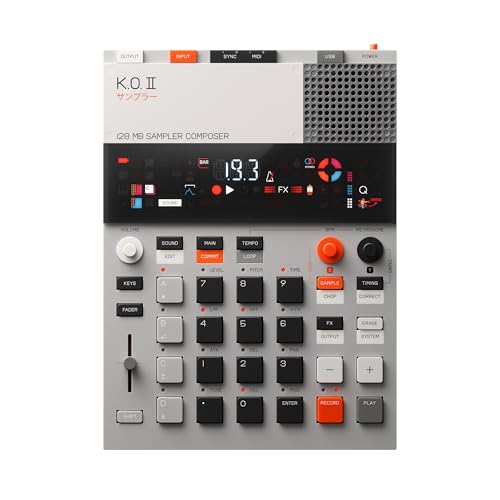
This 128MB revision of the K.O. II turns sampling into a pocket habit. Twelve pressure-sensitive pads, a built-in microphone and a built-in speaker mean you can capture a sound, chop it and sequence a beat without cables, and it runs on four AAA batteries or USB-C. Six master effects, twelve punch-in effects and a proper song mode carry sketches further than its toy-like looks suggest. Choose it if you make beats on trains, in parks or on the sofa and want the smallest complete sampler in this roundup.
Specs
- Memory: 128MB sample memory with 999 sample slots
- Pads: 12 pressure- and velocity-sensitive pads
- Polyphony: 16 mono voices or 12 stereo voices
- Sampling: 46 kHz / 16-bit with a 32-bit internal signal chain
- Built-in microphone and built-in speaker
- Effects: 6 master effects and 12 punch-in effects
- Connectivity: USB-C, MIDI in and out, sync in and out, 3.5mm stereo audio in, 3.5mm stereo headphone/line out
- Power: 4 AAA batteries or USB-C
- Included in the box: USB-C cable
Best for: Mobile creators who sketch beats anywhere on battery power with a built-in mic and speaker.
Watch out for: This listing is the 128MB revision; the older 64MB version is discontinued, so check the style name. Batteries are not included, and the listing’s dimension field conflicts with the manufacturer’s published size.
ASIN: B0GJFH9V6W
Novation Circuit Rhythm

Circuit Rhythm takes the grid route: 32 RGB pads lay out eight sample tracks and their 32-step patterns in one view, so building and mutating beats feels visual rather than menu-driven. It records directly from phones, turntables and synths, slices and resamples onboard, and its Grid FX — vinyl-style lo-fi, beat repeat, stutter — are made for live tweaks. Storage grows with microSD sample packs, and full-size MIDI in, out and thru make it a natural sequencer brain for a tabletop studio of synths and drum machines.
Specs
- Pads: 32 RGB backlit velocity-sensitive pads
- Tracks: 8 sample tracks
- Sequencer: 32-step patterns per track, chainable to 256 steps
- Storage: microSD card slot for 31 extra sample packs (card sold separately); 128 samples per pack
- Effects: Grid FX including lo-fi tape, beat repeat and stutter
- Connectivity: full-size MIDI In, Out and Thru; stereo sample input; USB-C
- Power: built-in rechargeable lithium-ion battery, up to 4 hours
Best for: Tabletop studios that want a visual grid sequencer to drive other hardware via MIDI.
Watch out for: Your own sample packs live on a microSD card that is sold separately, so factor a card into the purchase if you plan to expand beyond the internal pack.
ASIN: B097F7LJP5
Roland AIRA Compact P-6 Creative Sampler

The P-6 squeezes Roland’s sampling approach into a pocket AIRA Compact body. It records through a built-in microphone or line input, chops samples across its keyboard, and adds a granular engine that turns short grains into pads and textures — unusual at this level of the range. A 64-step sequencer with probability and micro-timing keeps patterns lively, and the rechargeable battery lasts around three hours. Choose it as a first hardware sampler, a travel sketchpad, or a granular effects source alongside bigger machines.
Specs
- Sample capacity: 48 samples across 8 banks
- Polyphony: 16 voices for samples, 4 voices for the granular engine
- Sequencer: 64 steps with 64 user patterns, probability and micro-timing
- Effects: 20 multi-effect types plus delay and reverb sends; granular sound design
- Microphone: built-in mono microphone
- Connectivity: USB-C for audio and MIDI, MIDI in and out, sync in and out, stereo mix in and out
- Power: built-in rechargeable lithium-ion battery (up to about 3 hours) or USB bus power
- Weight: 305 g including the battery
Best for: Beginners and travellers who want a genuinely pocket-size sampler with granular sound design.
Watch out for: A single sample tops out at a few seconds at full quality (about 5.9 seconds at 44.1 kHz mono), so it suits hits and grains rather than long loops.
ASIN: B0DCGQ417C
Which One Fits Your Situation
You Want to Finish Full Tracks Without a Computer
The MPC One+ is the pick. With up to 128 MIDI tracks, eight audio tracks, a mixer, synth plug-ins and arranging tools onboard, it covers the whole path from first sample to finished song. The touchscreen keeps editing fast, and WiFi updates and Ableton Link mean it still plays nicely with the rest of a modern studio when you want it to.
You Play Beats Live in Front of People
Reach for the SP-404MKII. Its pads, performance effects and resampling are designed to be worked in real time, the unit starts fast, and battery or USB power lets it sit in a DJ booth or on a stage without hunting for a spare outlet. The Circuit Rhythm is the alternative if your live set is built around step-sequenced patterns and Grid FX.
You Make Music Away From Your Desk
The EP-133 K.O. II fits a jacket pocket, runs on AAA batteries, and samples through its own microphone and plays back through its own speaker, so an idea can go from sound to sequenced beat in minutes anywhere. If you want the same freedom with a rechargeable battery and a deeper sequencer, step up to the Roland P-6 — or the Circuit Rhythm for longer sessions.
You Are Building a Tabletop Hardware Rig
Make the Circuit Rhythm the brain. Its eight tracks sequence samples internally while full-size MIDI out and thru drive your synths and drum machines, and patterns chain to 256 steps for full arrangements. Producers who later want deeper sequencing and more tracks should step up to the MPC One+ instead, whose CV/gate outputs and USB host support cover bigger rigs.
Common Mistakes
- Buying a pad controller by mistake: if the listing says it needs a computer or app to make sound, it is a controller, not a standalone sampler.
- Ignoring per-sample time limits on pocket machines, then discovering your long loops will not fit at full quality.
- Forgetting storage media: card-based samplers may not include the microSD card your sample packs live on.
- Choosing by pad count alone, when sequencer depth, effects and resampling shape your workflow more day to day.
- Skipping the power question: a mains-only desktop cannot join battery jam sessions without an outlet nearby.
Frequently Asked Questions
Do hardware samplers need a computer to work?
No. Every machine in this roundup records, edits, sequences and plays back samples on its own hardware. A computer only becomes useful for optional extras such as backing up projects, loading large sample libraries or firmware updates. That standalone design is exactly what separates these samplers from pad controllers, which make no sound without software.
Can I sample directly from a phone, turntable or synth?
Yes, on most of them. The SP-404MKII, Circuit Rhythm, P-6 and MPC One+ all record through audio inputs, and the EP-133 and P-6 add built-in microphones for found sounds. Check the connector types on the listing before buying: some compact units use 3.5mm stereo jacks, so you may need inexpensive adapter cables for turntables or mixers.
How much sample memory do I actually need?
For drums, one-shots and short loops, even the EP-133’s 128MB holds hundreds of sounds across its 999 sample slots. Long stereo loops and full stems eat space far faster, which is where the SP-404MKII’s 16GB or card-based expansion earns its keep. Match the memory to your material: short hits forgive small storage; loop-heavy sets do not.
Should I choose battery power or a mains-powered desktop?
Choose battery power if you sketch ideas in different rooms, travel with your gear or perform where outlets are scarce; the EP-133, P-6 and Circuit Rhythm all run for hours unplugged. Choose a mains-powered desktop such as the MPC One+ if the sampler will live in one studio spot and you want the largest screen and deepest track count.
More from Amazon
Programs that pair well with the guide above. Offers and eligibility are set by Amazon and may change.
Free shipping on eligible items, Prime Video and more. Eligible new members can start with a free trial.
Start a Prime free trialAd-free music streaming. Eligible new subscribers can start with a free trial.
Try Music Unlimited freeA Prime membership for ages 18-24 with a trial period. Eligibility is set by Amazon.
See Prime for Young AdultsAudiobooks and podcasts to listen to on the go. Eligible new members can start with a free trial.
Try Audible freeAs an Amazon Associate we earn from qualifying purchases.

Write Your Review
No reviews yet. Be the first to share your experience!