

Key takeaways
- 12GB of VRAM — the most in this price class, and the best insurance against future games
- Strong 1080p performance, roughly matching or beating the RTX 4060 in rasterized games
- XeSS 2 upscaling and frame generation, plus AV1 encoding
$300 does not buy what it bought a year ago. A memory supply crunch driven by AI data center demand has pushed GPU prices sharply higher in late 2026 — TechSpot reported prices up about 35 percent in three months. Price trackers in November 2026 show the RTX 5060, a card that launched at $299, selling for around $450 on Amazon US, while the RX 9060 XT 8GB, also a $299 launch card, sits near $460 to $500.
No new current-generation card from NVIDIA or AMD reliably sells under $300 on Amazon US right now. The five cards below are the ones that actually fit the budget in November 2026. Every price here is a November 2026 snapshot, so check the current price on Amazon before you buy.
Quick Picks
| Card | Best For | VRAM / Power | Price Note (Nov 2026) |
|---|---|---|---|
| Intel Arc B580 12GB | Best overall | 12GB GDDR6 / 190W | Around $288–$350 |
| Intel Arc B570 10GB | Best value | 10GB GDDR6 / 150W | $289.99 on sale |
| AMD RX 7600 8GB | Best AMD pick | 8GB GDDR6 / 165W | Around $269–$350 by seller |
| AMD RX 6650 XT 8GB | Best budget buy | 8GB GDDR6 / 176W | Around $190 used/renewed |
| MSI RTX 3050 Ventus 2X XS 8G OC | Best NVIDIA budget | 8GB GDDR6 / 130W | $282.99 |
How to Choose a 1080p Graphics Card Under $300
VRAM matters more than the GPU name
At 1080p, 8GB of VRAM is the floor in 2026, not the sweet spot. Modern games with high texture settings can push past 8GB, and when that happens the game stutters no matter how fast the GPU core is. That is why the two Intel cards lead this list: the B580 has 12GB and the B570 has 10GB. Buy as much VRAM as your budget allows if you plan to keep the card for two or three years.
Check your power supply first
Every card here needs a 6-pin or 8-pin PCIe power connector and a real power supply. The B580 draws 190W and its board partners recommend a 650W PSU. The RX 6650 XT draws 176W, the RX 7600 draws 165W, the B570 draws 150W, and the RTX 3050 draws 130W. A quality 550W to 650W PSU covers all five.
Resizable BAR is not optional for Intel Arc
Both Intel cards need Resizable BAR (ReBAR) enabled in your motherboard BIOS — Intel treats it as a prerequisite, and performance drops noticeably without it. Most motherboards from the last five years support it, but you must turn it on in the BIOS. If your motherboard has no ReBAR option, buy an AMD or NVIDIA card instead.
Measure your case and check the seller
Budget cards are usually dual-fan and under 250mm long, but some triple-fan models run longer. Measure the space from the rear bracket to the nearest obstruction and compare it with the card’s listed length before you buy. At this budget, a used card can be the fastest option per dollar, but only from a seller with a return policy. A used RX 6650 XT at around $190 beats every new card under $300 on raw speed, yet it carries no manufacturer warranty and may have spent years mining. If you buy used, test it hard in the return window: run a demanding game for an hour and watch for crashes, artifacts, or fan noise.
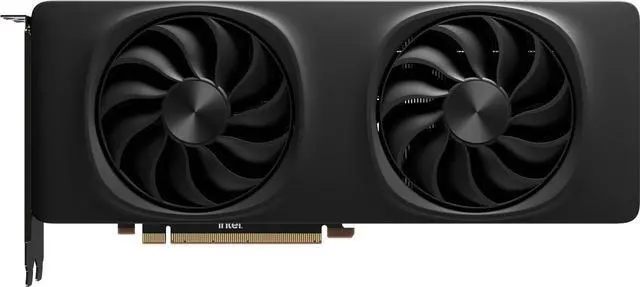
The B580 is the best graphics card for 1080p gaming under $300 because it is the only c
1. Intel Arc B580 12GB — Best Overall
Key specs: 12GB GDDR6, 192-bit bus, 20 Xe cores, 190W TDP, 1x 8-pin power connector, PCIe 4.0 x8, 3x DisplayPort 2.1 + 1x HDMI 2.1.
The B580 is the best graphics card for 1080p gaming under $300 because it is the only card near this price with 12GB of VRAM. It launched in December 2024 at $249, and listings in November 2026 run from around $288 to about $350 depending on the model and seller. In a 10-game test suite at 1080p ultra compiled by Bottleneck Calculator in November 2026, the B580 averaged about 116 frames per second, ahead of the RTX 4060 at 103. The 12GB buffer means it holds up in games that push past 8GB of textures, and it also offers XeSS 2 upscaling with frame generation, solid ray tracing for a budget card, and hardware AV1 encoding.
Pros:
- 12GB of VRAM — the most in this price class, and the best insurance against future games
- Strong 1080p performance, roughly matching or beating the RTX 4060 in rasterized games
- XeSS 2 upscaling and frame generation, plus AV1 encoding
Cons:
- Needs Resizable BAR enabled; performance suffers badly without it
- 190W power draw is the highest here, and board partners recommend a 650W PSU
- Often sits just above $300, so you may need a sale
Best for: Gamers who want the most future-proof 1080p card under $300 and have a modern motherboard with ReBAR.
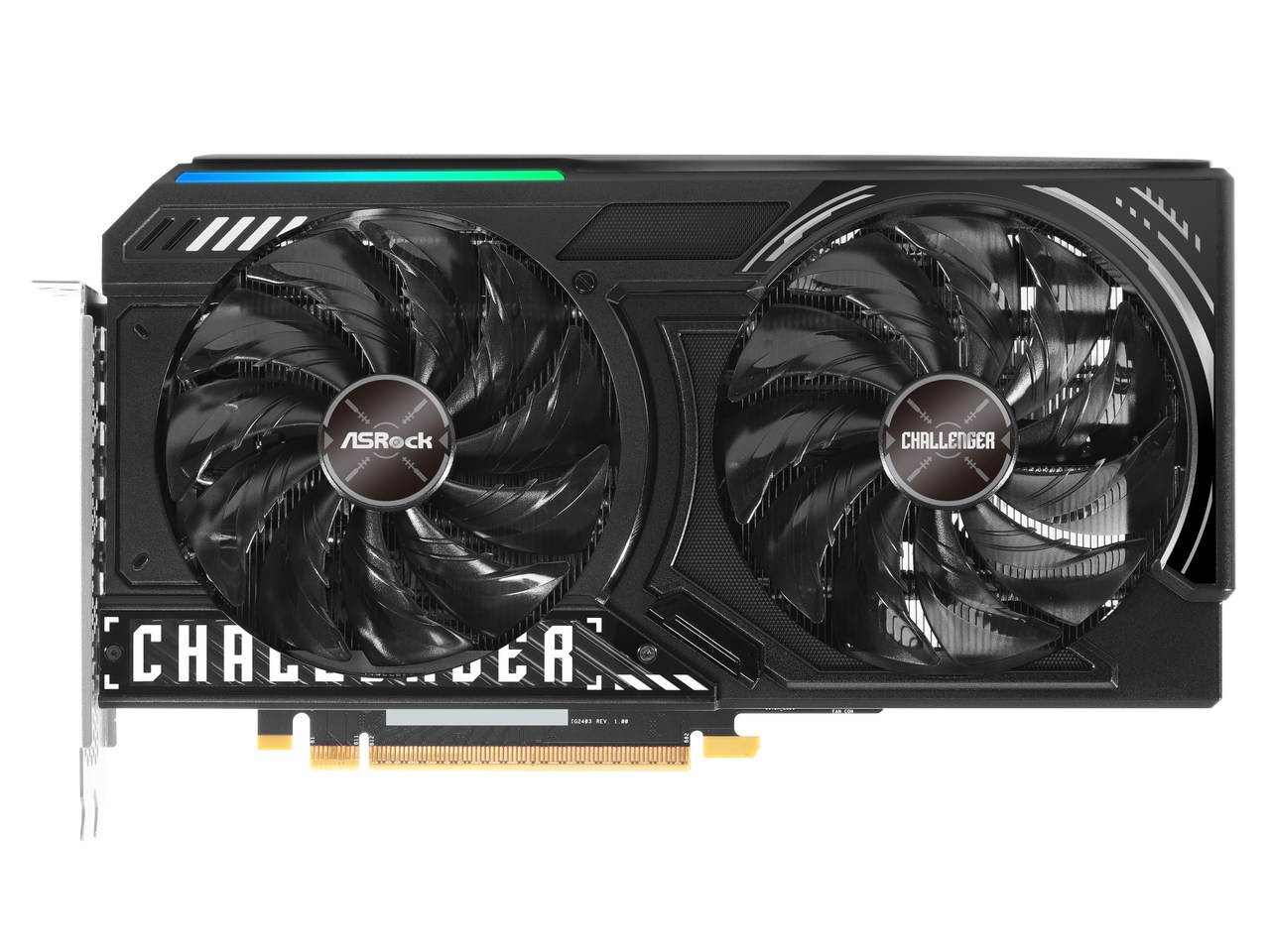
The B570 is the B580's little brother, and it is the card that most honestly fits a $30
2. Intel Arc B570 10GB — Best Value
Key specs: 10GB GDDR6, 160-bit bus, 18 Xe cores, 150W TDP, 1x 8-pin power connector, PCIe 4.0 x8, 3x DisplayPort 2.1 + 1x HDMI 2.1.
The B570 is the B580’s little brother, and it is the card that most honestly fits a $300 budget in November 2026. The ASRock Challenger B570 was seen at $289.99 on sale, with a list price of $299.99. You lose two Xe cores, 2GB of VRAM, and some memory bandwidth compared with the B580, but you keep the same modern architecture, XeSS 2 upscaling, and AV1 encoder. At 1080p, the performance gap is modest — roughly 10 to 15 percent in most games — and the 10GB buffer is still comfortably above the 8GB floor. At 150W it also runs cooler and quieter than the B580.
Pros:
- Genuinely under $300 — $289.99 on sale at a major retailer
- 10GB of VRAM beats every 8GB card here for texture-heavy games
- Same XeSS 2, AV1 encoding, and DisplayPort 2.1 as the B580
Cons:
- Needs Resizable BAR, just like the B580
- About 10 to 15 percent slower than the B580 in most games
- 160-bit bus means less memory bandwidth than the B580’s 192-bit bus
Best for: Budget builders who want a new card, a warranty, and more than 8GB of VRAM under $300.
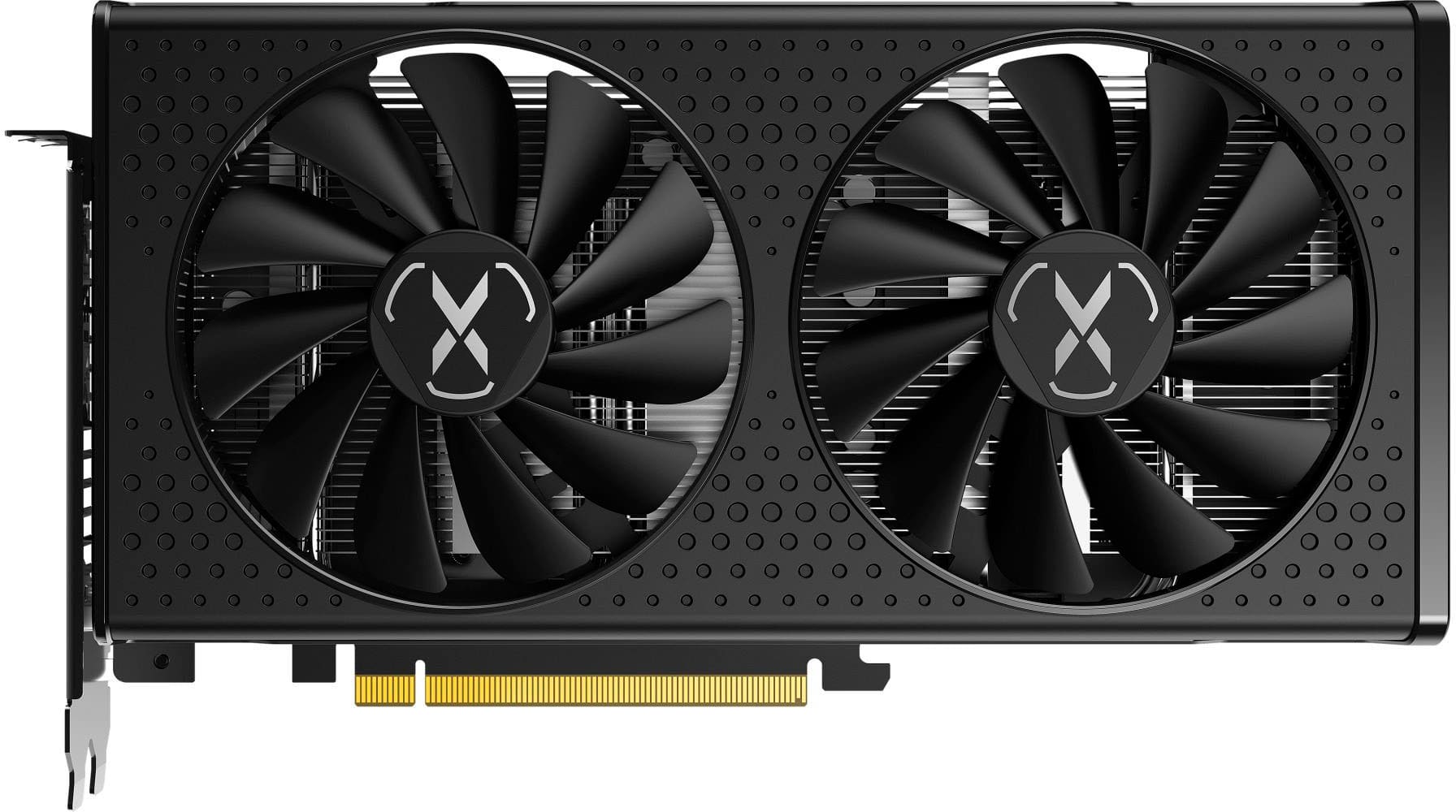
The RX 7600 is AMD's last-generation 1080p card, and it remains a strong performer:
3. AMD RX 7600 8GB — Best AMD Pick
Key specs: 8GB GDDR6, 128-bit bus, 32 compute units, 165W TDP, 1x 8-pin power connector, PCIe 4.0 x8, 3x DisplayPort 1.4 + 1x HDMI 2.1.
The RX 7600 is AMD’s last-generation 1080p card, and it remains a strong performer: it trades blows with the RTX 4060 in rasterized games at 1080p, without any ReBAR requirement or driver caveats. FSR 3 upscaling is supported, and AMD’s drivers are mature and stable.
The problem is price. The RX 7600 launched at $269, but in November 2026 name-brand models from XFX, Sapphire, and PowerColor are seen around $350 at major retailers, with cheaper marketplace listings around $269 to $292. It fits the budget only if you find the right listing — check the seller and the return policy first.
Pros:
- Strong 1080p rasterization performance, roughly on par with the RTX 4060
- No ReBAR requirement and mature, stable drivers
- FSR 3 upscaling and frame generation
Cons:
- Only 8GB of VRAM on a 128-bit bus, so texture-heavy games can stutter at high settings
- Name-brand models are often above $300 in November 2026; the under-$300 listings need careful seller checks
- Weaker ray tracing than the Intel and NVIDIA cards here
Best for: Gamers who want a no-fuss AMD card and will hunt for a well-priced listing.
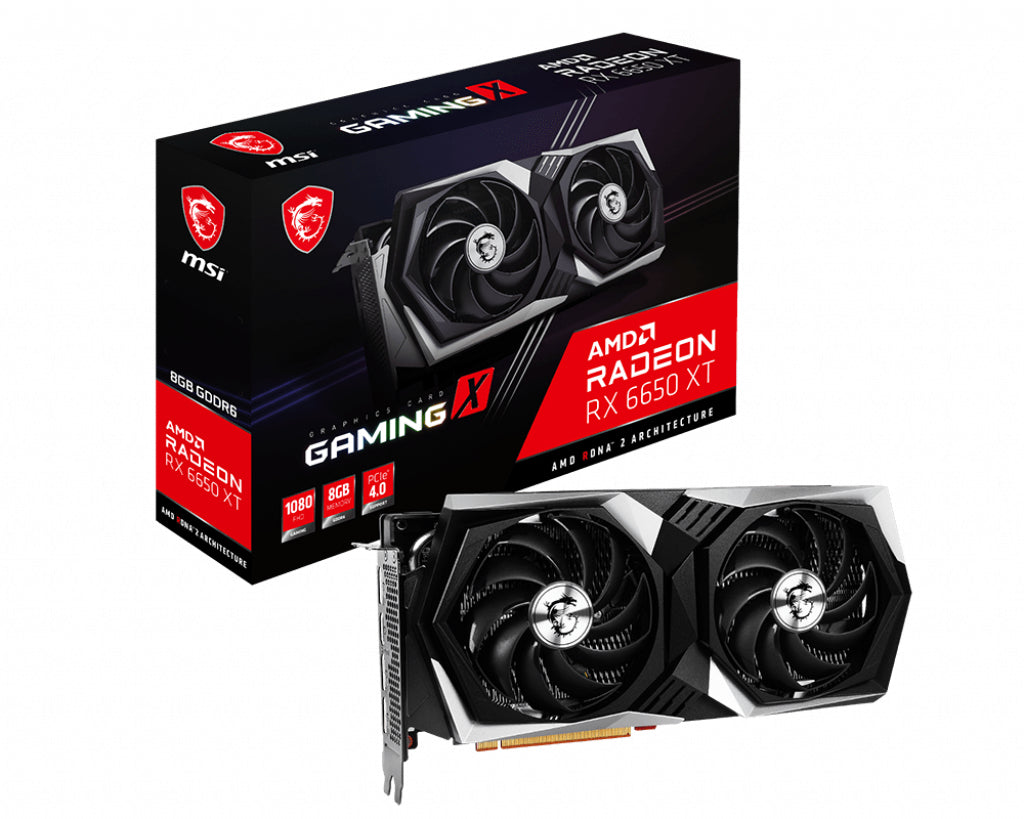
The RX 6650 XT is the fastest card per dollar on this list — if you buy it used
4. AMD RX 6650 XT 8GB — Best Budget Buy
Key specs: 8GB GDDR6, 128-bit bus, 32 compute units, 176W TDP, 1x 8-pin power connector, PCIe 4.0 x8, 3x DisplayPort 1.4 + 1x HDMI 2.1.
The RX 6650 XT is the fastest card per dollar on this list — if you buy it used. “Very Good” condition listings were seen at $189.99 in November 2026, and typical used prices run around $140 to $190. That is roughly two-thirds the price of the new cards here for performance that sits between the RX 7600 and the RTX 3060 at 1080p.
The trade-off is condition. New RX 6650 XT stock is essentially gone, so you are buying a card that someone else used, possibly for years. Buy from a seller with a clear return window and test it hard the day it arrives: run a stress test for an hour and watch for crashes, artifacts, or fan noise.
Pros:
- The cheapest way to get genuinely fast 1080p performance — around $190 used
- Faster than the RTX 3050 and close to the RX 7600 in most games
- No ReBAR requirement; mature drivers
Cons:
- Almost always a used or renewed purchase, with no manufacturer warranty
- 176W power draw is high for its performance class
- Only 8GB of VRAM, and weaker ray tracing than newer cards
Best for: Buyers comfortable with a used card who want maximum frames per dollar.
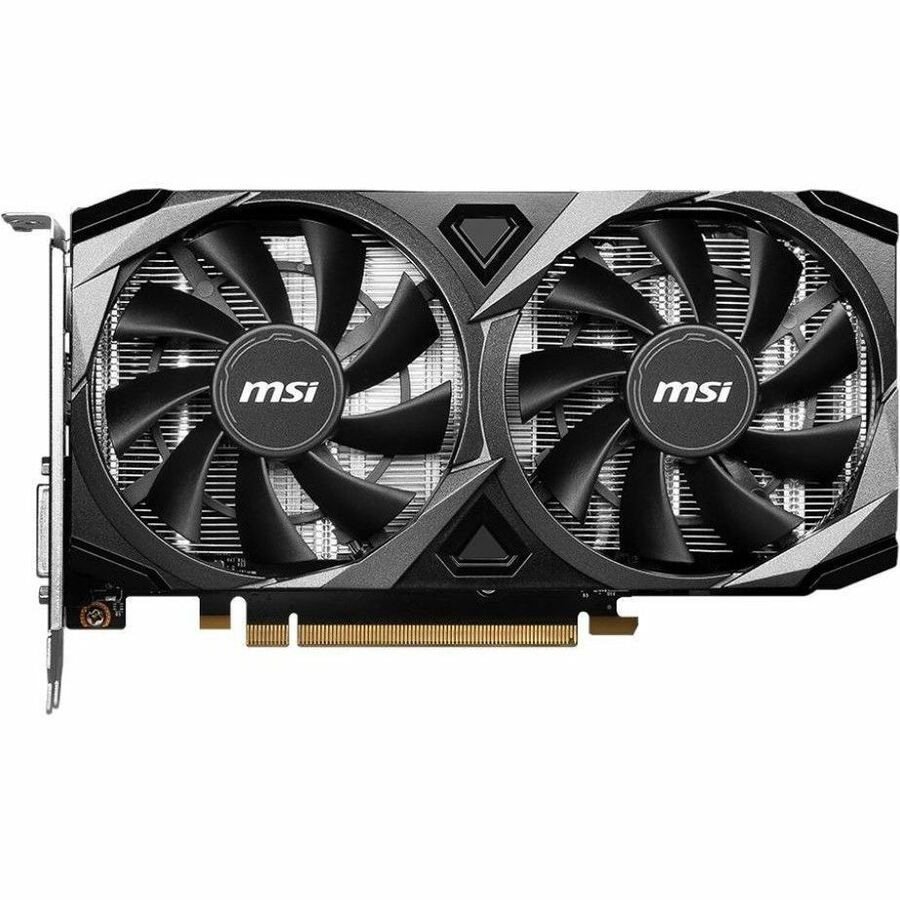
The RTX 3050 is the weakest gaming card on this list, and it is here for one reaso
5. MSI RTX 3050 Ventus 2X XS 8G OC — Best NVIDIA Budget
Key specs: 8GB GDDR6, 128-bit bus, 2,560 CUDA cores, 130W TDP, 1x 8-pin power connector, PCIe 4.0 x8, 3x DisplayPort 1.4a + 1x HDMI 2.1.
The RTX 3050 is the weakest gaming card on this list, and it is here for one reason: it is the cheapest new NVIDIA card you can actually buy under $300 in November 2026. The MSI Ventus 2X XS 8G OC was seen at $282.99 at an authorized retailer in November 2026. It plays esports titles at high frame rates, handles AAA games at 1080p medium to high settings, and brings DLSS upscaling — still the best upscaling technology available — plus NVENC encoding and NVIDIA’s polished drivers.
At 130W it runs cool and quiet and works fine with a quality 450W to 550W PSU. But be clear-eyed: the RTX 3050 is slower than every other card here, sometimes by a wide margin, and its 8GB of VRAM on a 128-bit bus is the minimum for 2026.
Pros:
- The cheapest new NVIDIA card under $300 in November 2026
- DLSS upscaling and NVENC encoding are best in class
- Low 130W power draw; works with modest power supplies
Cons:
- The slowest card on this list by a clear margin
- 8GB of VRAM on a narrow 128-bit bus limits high-texture gaming
- Older Ampere architecture with no frame generation
Best for: Gamers who need NVIDIA features — DLSS, NVENC streaming, CUDA apps — on the smallest budget.
What to Avoid
Paying $400 or more for a “$300 card.” The RTX 4060, RTX 5060, and RX 9060 XT all launched at $299, and all of them cost roughly $400 to $600 on Amazon US in November 2026. If you see one at $500, you are paying the inflated market price, not getting a deal.
4GB cards. The RX 6500 XT and similar 4GB cards still appear under $300. Four gigabytes of VRAM is not enough for modern games at 1080p, and the 6500 XT’s x4 PCIe interface further chokes it on older PCIe 3.0 systems. Skip it.
Cards with no warranty and no return policy. A GPU with no return window is a gamble. If the seller cannot be checked and the listing cannot be returned, walk away.
Ignoring your CPU. At 1080p, your CPU often limits frame rates before the GPU does. Pairing a B580 with a ten-year-old quad-core CPU wastes the card. If you are still on an old CPU, the RX 6650 XT or RTX 3050 is a better match — see our guide to the best CPU for gaming under $300.
FAQ
What is the best graphics card for 1080p gaming under $300 in 2026?
The Intel Arc B580 12GB is the best overall pick, thanks to its 12GB of VRAM and strong 1080p performance. The catch is that its street price in November 2026 often sits just above $300, so the Intel Arc B570 10GB at around $290 is the best value pick that genuinely fits the budget. Both need Resizable BAR enabled.
Can you still buy a good 1080p graphics card for under $300 in November 2026?
Yes, but the choices are narrower than a year ago. A memory shortage has pushed the RTX 5060 and RX 9060 XT to roughly $450–$500 on Amazon US, so the under-$300 market is led by Intel’s Arc B570 and B580, last-generation AMD cards, and the RTX 3050.
Is 8GB of VRAM enough for 1080p gaming?
For most games at 1080p high settings, 8GB is still enough in 2026. But some newer titles with high texture packs already push past 8GB, which causes stuttering. If you plan to keep the card for several years, 10GB or 12GB — as on the Arc B570 and B580 — is a safer buy.
Is a used graphics card worth it under $300?
Often, yes. A used RX 6650 XT at around $190 is faster per dollar than any new card under $300. The risk is condition and warranty, so buy from a seller with a return policy and test the card hard during the return window.
Verdict
The best graphics card for 1080p gaming under $300 in November 2026 is the Intel Arc B580 12GB — the most VRAM, the best feature set, and 1080p performance that beats the RTX 4060 in rasterized games. Buy it if you can find it at or near $300 and your motherboard supports Resizable BAR.
If your budget is truly fixed at $300, buy the Intel Arc B570 10GB. At $289.99 on sale it is the best value new card in this class. If you would rather not deal with Intel’s ReBAR requirement, the AMD RX 7600 8GB is the straightforward alternative — just check the seller carefully, since name-brand models often sit above $300 right now. And if every dollar counts, a used RX 6650 XT at around $190 is the fastest card per dollar you can buy.
As an Amazon Associate, we earn from qualifying purchases.
Suggested Internal Links
- Best graphics card for 1440p gaming under $600 — /best-graphics-card-for-1440p-gaming-under-600/
- Best CPU for gaming under $300 — /best-cpu-for-gaming-under-300/
- Best gaming PC build under $2,100 — /best-gaming-pc-build-under-2100/
More from Amazon
Programs that pair well with the guide above. Offers and eligibility are set by Amazon and may change.
Free shipping on eligible items, Prime Video and more. Eligible new members can start with a free trial.
Start a Prime free trialAd-free music streaming. Eligible new subscribers can start with a free trial.
Try Music Unlimited freeA Prime membership for ages 18-24 with a trial period. Eligibility is set by Amazon.
See Prime for Young AdultsAudiobooks and podcasts to listen to on the go. Eligible new members can start with a free trial.
Try Audible freeAs an Amazon Associate we earn from qualifying purchases.
Write Your Review
No reviews yet. Be the first to share your experience!