

Key takeaways
- Buying the biggest cooler for a small chip. A Ryzen 5 65 W processor does not benefit from a 360 mm AIO.
- Ignoring case clearance. Tall towers require room; check the specification before you buy.
- Mounting the AIO tubes upward. Position the radiator so that pump is not at the highest point, to avoid air collecting in it.
- Leaving the plastic film on the cooler base. Remove it before installation.
- Judging by temperature alone. Ryzen processors are designed to run warm, so look at clock speeds and noise rather than only the temperature reading.
The best AMD CPU cooler for most Ryzen builds in 2026 is a dual-tower air cooler such as the Thermalright Peerless Assassin 120 SE, because it cools most Ryzen chips quietly for a low cost. Step up to the Noctua NH-D15 G2 for the best air cooling and lowest noise, or to a 360 mm liquid cooler such as the Arctic Liquid Freezer III 360 when you run a Ryzen 9 with sustained heavy loads.
Ryzen chips run warm by design. AMD’s recent processors are built to boost until they reach a temperature limit around 95 degrees Celsius, so a better cooler does not just lower temperatures, it lets the chip hold higher clocks for longer. This guide ranks seven coolers that work with both the AM5 and AM4 sockets, shows the numbers that separate them, and explains how to match a cooler to the specific Ryzen processor you own.
Our top picks


As an Amazon Associate we earn from qualifying purchases at no extra cost to you.
Quick comparison of the best coolers for Ryzen
| Pick | Best for | Type | Height / size | Heatpipes or radiator | Fans | Market tier |
|---|---|---|---|---|---|---|
| DeepCool AK400 | Budget Ryzen 5 builds | Single tower | about 155 mm tall | 4 heatpipes | 1 x 120 mm | Budget |
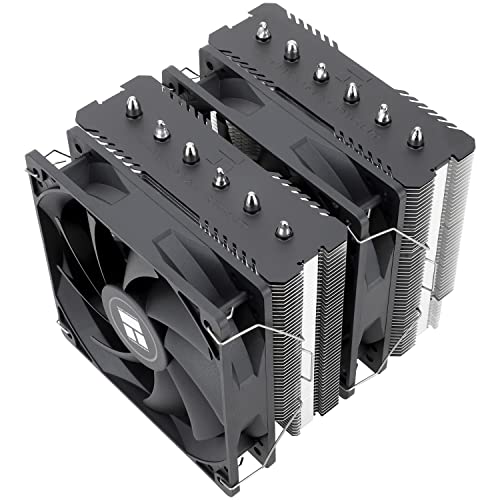
| Thermalright Peerless Assassin 120 SE | Best value overall | Dual tower | about 155 mm tall | 6 heatpipes | 2 x 120 mm | Budget |
| Thermalright Phantom Spirit 120 SE | Premium-feel value | Dual tower | about 157 mm tall | 7 heatpipes | 2 x 120 mm | Budget to mid |
| DeepCool AK620 | Strong all-round air | Dual tower | about 160 mm tall | 6 heatpipes | 2 x 120 mm | Mid-range |
| Noctua NH-D15 G2 | Best air cooler | Dual tower | about 168 mm tall | Multiple heatpipes | 2 x 140 mm | Premium |
| Arctic Liquid Freezer III 240 | Compact liquid option | 240 mm AIO | 240 mm radiator | Radiator | 2 x 120 mm | Mid-range |
| Arctic Liquid Freezer III 360 | Ryzen 9 and heavy loads | 360 mm AIO | 360 mm radiator | Radiator | 3 x 120 mm | Upper mid-range |
Dimensions follow each manufacturer’s specification sheet and vary slightly between revisions and fan configurations, so confirm the figures for the exact version you buy. Prices change often, so this guide uses tiers rather than fixed amounts.
How Ryzen cooling is different
Ryzen processors use a thick integrated heat spreader and small hot chiplets underneath, so heat is concentrated in small areas. This is why a processor that draws only 100 W can show temperatures in the 70s while a larger Intel chip at the same wattage may look cooler. High temperature on a Ryzen chip is not automatically a problem, as AMD designs them to boost until they hit their limit.
A better cooler still helps in practice. Lower temperatures give the boost algorithm more room, and in sustained workloads like rendering, a stronger cooler maintains clock speeds. The benefit is largest for 105 W to 170 W processors, such as the Ryzen 9 series, and smaller for 65 W models like the Ryzen 5 7600 or Ryzen 5 9600X.
Matching the cooler to your Ryzen chip
| Processor class | Typical power (TDP) | Recommended cooler |
|---|---|---|
| Ryzen 5 7600, 9600X, 5600 | 65 W | Single tower such as the AK400 |
| Ryzen 7 7800X3D, 9800X3D, 5800X3D | 105 W to 120 W | Dual tower or 240 mm AIO |
| Ryzen 7 9700X | 65 W | Single or dual tower |
| Ryzen 9 7900X, 9900X | 120 W to 170 W | Dual tower or 280 mm to 360 mm AIO |
| Ryzen 9 7950X, 9950X, 9950X3D | up to 170 W | 360 mm AIO or the best dual tower |
A useful rule is to treat the TDP as a minimum, not a maximum. Actual package power on high-end Ryzen chips can reach about 1.35 times the TDP under load. A 170 W chip can draw around 230 W, so choose a cooler with a rating well above the processor’s TDP.
Best for budget builds: DeepCool AK400
The DeepCool AK400 is a compact single-tower cooler with four heatpipes and one 120 mm fan. It stands roughly 155 mm tall, fits most mid-tower cases and supports both AM5 and AM4. DeepCool rates it for about 220 W of thermal load.
For a 65 W Ryzen 5 or Ryzen 7 chip, it is a sizeable upgrade over a box cooler, and it makes less noise at the same temperatures. The mounting uses the standard AM5 and AM4 brackets, so installation is simple. It is not the best choice for a 105 W or 120 W chip under sustained loads, where a dual tower holds temperatures lower.
Who it suits: budget gaming builds and Ryzen 5 processors. Main trade-off: a single fan and four heatpipes limit its headroom with hotter chips.
Best value overall: Thermalright Peerless Assassin 120 SE
The Thermalright Peerless Assassin 120 SE is a dual-tower cooler with six copper heatpipes and two 120 mm PWM fans. It stands about 155 mm tall, weighs a little over 700 grams and supports AM5, AM4 and recent Intel sockets. Reviews list its noise at roughly 25 dBA at low speed, rising to the mid-30s at full speed.
The cooler’s reputation rests on delivering performance close to coolers that cost several times more. For Ryzen 7 X3D chips and Ryzen 9 chips at moderate loads, it holds temperatures within a few degrees of far more expensive models. Its two-tower design is wide, so check memory clearance: tall RAM heatsinks may need the front fan moved up.
Who it suits: nearly every Ryzen builder who wants low cost and strong cooling. Main trade-off: it is plain looking, and the fit around tall memory modules needs care.
Premium-feel value: Thermalright Phantom Spirit 120 SE
The Thermalright Phantom Spirit 120 SE is a dual-tower cooler with seven heatpipes and two 120 mm fans. It stands at about 157 mm and uses a more refined fin layout than the Peerless Assassin, with an asymmetric design intended to improve airflow over the memory area and graphics card.
Performance is slightly higher than the Peerless Assassin in most reviews, and it holds up well against larger and more expensive coolers. It supports AM5 and AM4 and offers a rated thermal capacity of well over 250 W according to the manufacturer. If it costs only a little more than the Peerless Assassin, it is a sound upgrade.
Who it suits: buyers who want top air cooling at a modest price. Main trade-off: a bulky tower may crowd small cases, and availability varies by region.
Strong all-round air cooler: DeepCool AK620
The DeepCool AK620 is a dual-tower cooler with six heatpipes and two 120 mm fans, standing roughly 160 mm tall. DeepCool rates it for around 260 W. It has a clean black design, a sturdy mounting kit and a reputation for being easy to install.
It performs very close to the Thermalright models, with a slightly more traditional design. For Ryzen 7 and Ryzen 9 processors, it provides a significant margin for sustained loads. The mounting system works well on AM5, which uses the existing AM4 style backplate for many coolers.
Who it suits: builders who want a well-known brand with strong all-round performance. Main trade-off: it costs more than the Thermalright coolers with similar performance.
Best air cooler overall: Noctua NH-D15 G2
The Noctua NH-D15 G2 is the successor to one of the most respected air coolers, with a dual-tower design that stands about 168 mm tall and uses two 140 mm fans. Noctua designed it with an offset mount for modern sockets and includes a long warranty. Third-party reviews rate its cooling at the top of the air-cooler class, with very low noise.
It is the best choice for a quiet system with a hot processor, such as a Ryzen 9, because its large fans move air at low speeds. It is also a good fit for people who want a cooler that will last many years. The drawbacks are size and price. It is tall, so confirm case clearance, and it comes with Noctua’s beige and brown color scheme.
Who it suits: enthusiasts who want the quietest high-performance air cooling. Main trade-off: the highest price in the air category, plus large size and appearance.
Compact liquid option: Arctic Liquid Freezer III 240
The Arctic Liquid Freezer III 240 is a 240 mm all-in-one liquid cooler with two 120 mm fans and a thick radiator. It includes a fan for the voltage regulators around the socket, a feature that helps keep the motherboard cool. It supports AM5 and AM4 with a contact frame for AM5.
For a Ryzen 7 X3D chip, it provides strong cooling with low noise, and it frees up space around the memory compared with a tall air cooler. Check that your case supports a 240 mm radiator at the top or front, and consider the pump’s noise at idle.
Who it suits: cases that cannot fit a tall air cooler, and users who want clean looks. Main trade-off: more parts that can fail than an air cooler, and a high price compared with the best budget towers.
Best for Ryzen 9 and heavy loads: Arctic Liquid Freezer III 360
The Arctic Liquid Freezer III 360 is a 360 mm all-in-one liquid cooler with three 120 mm fans and a radiator about 38 mm thick. It is rated by reviewers for handling 300 W or more of heat, and it keeps noise moderate at normal use. The AM5 contact frame improves mounting pressure on the processor.
It suits the Ryzen 9 processors, like the 7950X, 9950X and 9950X3D, which draw their highest power in sustained multi-core work such as rendering. In gaming, the difference from a good dual tower is small, so do not buy it for a Ryzen 5 build. Make sure your case supports a 360 mm radiator and that the tubes reach the processor socket.
Who it suits: creators and enthusiasts running high-power Ryzen 9 chips. Main trade-off: installation is more complicated, and it needs a case with a 360 mm mount.
Air or liquid: how to choose
| Factor | Air cooler | Liquid cooler (AIO) |
|---|---|---|
| Cost for the same performance | Lower | Higher |
| Typical lifespan | Fans last many years, no pump | Pump may fail after roughly five to seven years |
| Memory clearance | Can interfere with tall RAM | No interference |
| Case requirement | Enough height for tower | Radiator mount at top or front |
| Maintenance | Dust cleaning only | Dust cleaning, occasional pump check |
| Best with | Ryzen 5, Ryzen 7, many Ryzen 9 | Ryzen 9 and sustained high loads |
For most people, an air cooler is the more reliable and cost-effective choice. Liquid cooling makes sense when the case has limited height, when the processor is a very high-power model, or when you simply prefer the look.
Compatibility and installation checklist
- Check the socket. Confirm support for AM5 or AM4 on the product page. Most current coolers include both mounting kits.
- Measure case clearance. Compare the cooler’s height with your case’s listed maximum CPU cooler height. A cooler that is too tall prevents the side panel from closing.
- Check memory clearance. Dual-tower coolers with a front fan may overlap tall memory modules. Choose low-profile memory or move the fan.
- Check radiator support. For an AIO, confirm that the case supports the radiator size at the top or front and that your motherboard has room for tubes.
- Apply thermal paste correctly. A pea-sized amount in the center is enough for most chips. Spread patterns are rarely needed.
- Tighten the screws evenly. Tighten in a cross pattern a little at a time until the cooler sits flat and firm.
- Connect the fan to the CPU fan header. This allows the motherboard to control the speed. Set a fan curve in the BIOS to balance noise and temperature.
A worked example: Ryzen 7 9800X3D
Take a Ryzen 7 9800X3D at 120 W TDP in a mid-tower case. Under gaming loads, the processor typically draws well below its maximum, so a Peerless Assassin 120 SE or AK620 holds temperatures comfortably in the 60s Celsius range with quiet fan speeds. Under an all-core stress test, the temperatures rise but remain below the thermal limit.
If you then move to a Ryzen 9 9950X3D at up to 170 W, the same air cooler will still work, but the chip will reach its temperature target sooner and fan noise will increase. A 360 mm liquid cooler or an NH-D15 G2 keeps clocks higher and the noise lower. The decision comes down to how much sustained work you do, not how much you game.
Durability and ownership realities
Air coolers have the simplest failure pattern: fans wear out after several years, and fans are replaceable. Liquid coolers also have pumps, which can fail, and fluid slowly permeates through the tubing over time. Most AIOs carry warranties of three to six years, and replacing one costs more than replacing a pair of fans.
Thermal paste dries over the years, so plan to replace it every three to five years or when you notice rising temperatures. Dust build-up on fins reduces cooling. Cleaning every six months with compressed air and a soft brush keeps the performance steady. Never force a cooler off a processor that seems stuck, as lifting the processor from its socket can bend pins. Gently twist the cooler or warm the system first.
Common mistakes
- Buying the biggest cooler for a small chip. A Ryzen 5 65 W processor does not benefit from a 360 mm AIO.
- Ignoring case clearance. Tall towers require room; check the specification before you buy.
- Mounting the AIO tubes upward. Position the radiator so that pump is not at the highest point, to avoid air collecting in it.
- Leaving the plastic film on the cooler base. Remove it before installation.
- Judging by temperature alone. Ryzen processors are designed to run warm, so look at clock speeds and noise rather than only the temperature reading.
Frequently Asked Questions
What is the best CPU cooler for Ryzen 7 9800X3D?
A quality dual-tower air cooler like the Thermalright Peerless Assassin 120 SE or Noctua NH-D15 G2 handles it well. A 240 mm or 360 mm liquid cooler is also a good choice if your case supports it.
Do Ryzen processors need an aftermarket cooler?
Some Ryzen models include a box cooler, mainly the lower-end 65 W parts, while most X3D and high-end models do not. Even where one is included, an aftermarket cooler is quieter and usually runs cooler.
Will AM4 coolers fit AM5 sockets?
Yes, most of them do, because AM5 uses the same mounting hole layout as AM4. Some coolers need a different bracket or hardware, so check the manufacturer’s compatibility list.
Is a liquid cooler better than an air cooler for Ryzen?
Not necessarily. High-end air coolers match many 240 mm liquid coolers in performance and are simpler and more durable. Liquid coolers have an advantage with very high power processors and in cases where tall towers do not fit.
What temperature is safe for a Ryzen CPU?
Modern Ryzen chips are designed to operate up to about 95 degrees Celsius under heavy load. Consistently reaching that limit in gaming suggests the cooler is undersized or mounted poorly.
How often should I replace thermal paste?
Every three to five years is a sensible interval for most systems. Replace it sooner if you remove the cooler or if temperatures slowly rise without a change in workload.




Write Your Review
No reviews yet. Be the first to share your experience!