
Our Short List of 3

- Best for: A photographer-videographer who wants the strongest stated screen figures and a discrete GPU in one 16-inch machine.
- Display: 16-inch 3.2K (3200×2000) OLED touch, 120Hz, Dolby Vision, DisplayHDR 1000 per listing bullets
- Colour gamut (listing-stated): 100% DCI-P3, 100% Adobe RGB, 100% sRGB per listing bullets
- Brightness: 1600 nits peak, 1000 nits typical per listing bullets
- Processor: Intel Core Ultra 9 285H, 16 cores, up to 5.4 GHz per listing

- Best for: A creator who edits on the move and wants a convertible OLED machine with a discrete GPU at 13 inches.
- Display: 13.3-inch OLED touchscreen, 3K 2880 x 1800, 500 nits per listing
- Colour gamut: none stated in this listing’s captured text
- Processor: AMD Ryzen AI 9 HX 370, up to 5.1 GHz per listing
- Graphics: NVIDIA GeForce RTX 4050, 6GB GDDR6 per listing

- Best for: A stills-led creator who wants maximum memory and a stated-gamut OLED panel in a 13-inch convertible.
- Display: 13.3-inch Lumina OLED touchscreen, 2880 x 1800 per listing copy
- Colour gamut (listing-stated): 100% DCI-P3, Pantone Validation, HDR Black 500 per listing bullets
- Processor: AMD Ryzen AI Max+ 395, 16-core, up to 126 TOPS per listing copy
- Memory and storage: 64GB LPDDR5X; 2TB SSD per listing copy
All 4 Picks at a Glance
| Product | Specs | Action |
|---|---|---|
| Lenovo Yoga Pro 9i 16 (Aura Edition) |
| Check price on Amazon |
| ASUS ProArt PX13 (Ryzen AI 9 HX 370, RTX 4050) |
| Check price on Amazon |
| ASUS ProArt PX13 (Ryzen AI Max+ 395, 64GB) |
| Check price on Amazon |
 Apple MacBook Pro 14-inch (M4) |
| Check price on Amazon |
Key takeaways
- Five laptops for photo and video editing compared on listing specs: OLED displays, stated colour gamut figures, graphics chips, memory and storage.
Choosing a laptop for photo and video editing is a decision about the screen first and the timeline second. A panel whose colour you cannot trust makes every edit a guess, while a weak processor or thin memory makes 4K footage a waiting exercise. This set covers both jobs together, stills and moving work, because the site already carries a photo-only guide and the listings here were chosen for stated editing strength across the pair: display claims, graphics, memory and storage as each maker prints them.
Colour-gamut figures appear only where a listing states them in its own text, which is the case for three of these five; the other two entries say plainly that their listings state none, rather than borrowing figures from elsewhere. Most Amazon creator-laptop listings are seller-configured, and that is flagged per entry. Every pick was chosen from the names and specifications on its Amazon product page.
Quick Picks
As an Amazon Associate we earn from qualifying purchases.
| Product | Best for | Key spec from title |
|---|---|---|
| Lenovo Yoga Pro 9i 16 (Aura Edition) | A photographer-videographer who wants the strongest stated screen figures and a discrete GPU in one 16-inch machine. | 16-inch 3.2K OLED touch, 100% DCI-P3 stated, RTX 5060 |
| ASUS ProArt PX13 (Ryzen AI 9 HX 370, RTX 4050) | A creator who edits on the move and wants a convertible OLED machine with a discrete GPU at 13 inches. | 13.3-inch 3K OLED touch 2-in-1, RTX 4050, 32GB |
| ASUS ProArt PX13 (Ryzen AI Max+ 395, 64GB) | A stills-led creator who wants maximum memory and a stated-gamut OLED panel in a 13-inch convertible. | 13.3-inch 3K OLED touch, 100% DCI-P3 stated, 64GB |
| ASUS Zenbook 14 OLED (Core Ultra 7 255H) | A travelling photographer who wants a stated-gamut OLED screen in a light machine for stills and lighter video work. | 14-inch WUXGA OLED touch, 100% DCI-P3 in title, 16GB |
| Apple MacBook Pro 14-inch (M4) | An editor already in Apple’s ecosystem who wants the M4 MacBook Pro’s stated hardware in a 14-inch body. | 14.2-inch Liquid Retina XDR, M4 chip, 24GB unified memory |
How to Choose
The screen claim is only real if the listing states it
Colour gamut is the figure sellers most often imply and least often print. In this set, three listings state a DCI-P3 figure in their own text and two state none, and the entries keep that difference visible. An editor choosing for colour-critical stills should start from the stated-gamut machines; an editor whose delivery is social video may weight brightness, size and portability instead. Either way, decide from printed figures, not from a model’s reputation.
Photo and video work load a laptop differently
Stills editing leans on the panel, memory and fast storage; video adds sustained processor and graphics load on every export. The set spans both: a 16-inch machine with a discrete RTX GPU for timelines, convertibles that trade size for flexibility, and an integrated-graphics traveller that suits stills and light cuts. Name your heavier job honestly, because a laptop bought for photos alone will announce the mistake on the first long render. The honest dividing line is the graphics: integrated graphics edit stills happily and cut simple timelines, while discrete graphics change export times and effects work outright.
Memory and storage are the quiet specifications
Editing eats both: layered stills and 4K timelines fill RAM, and project libraries fill drives. The listings here run from 16GB and 1TB to 64GB and 2TB, and none of these machines invites easy internal upgrades later. Buy the memory figure for the projects you will have in two years, and treat the stated storage as the working space your archive workflow must fit around. An external drive strategy belongs in the same decision, since stated internal storage fills with two or three serious video projects faster than buyers expect.
Seller-configured listings need a configuration check
Most creator laptops on Amazon are configured and sold by third-party sellers, and near-identical titles hide different memory, storage and even graphics. The entries flag this where it applies, and one listing’s own table contradicts its title on graphics. Before ordering, match the live page’s configuration line against the figures in the entry you chose; the model name alone does not guarantee them. Ports belong in this audit too: an SD reader and full-size HDMI on some listings remove the dongle bag that other machines quietly require.
The 5 Best Options
Lenovo Yoga Pro 9i 16 (Aura Edition)
- Best for: A photographer-videographer who wants the strongest stated screen figures and a discrete GPU in one 16-inch machine.
- Display: 16-inch 3.2K (3200×2000) OLED touch, 120Hz, Dolby Vision, DisplayHDR 1000 per listing bullets
- Colour gamut (listing-stated): 100% DCI-P3, 100% Adobe RGB, 100% sRGB per listing bullets
- Brightness: 1600 nits peak, 1000 nits typical per listing bullets
- Processor: Intel Core Ultra 9 285H, 16 cores, up to 5.4 GHz per listing
A photographer-videographer who wants the strongest stated screen figures and a discrete GPU in one 16-inch machine.
Amazon listings for this model are largely seller-configured, and one product-information field contradicts the title on graphics; rely on the title and bullets, and confirm the exact configuration on the live page.
The Yoga Pro 9i is the fullest creator listing here: its bullets state a 16-inch 3.2K OLED touchscreen at 120Hz with 100% DCI-P3, 100% Adobe RGB and 100% sRGB gamut figures printed directly, brightness of 1600 nits peak and 1000 typical, and PureSight Pro colour accuracy positioning under the line ‘Built for Creators’. An Intel Core Ultra 9 285H, an RTX 5060 with 8GB of GDDR7, 32GB of memory and a 1TB SSD drive the work, and an SD card reader plus two Thunderbolt 4 ports serve the desk. It is the benchmark entry of the set.
Watch out for: Amazon listings for this model are largely seller-configured, and one product-information field contradicts the title on graphics; rely on the title and bullets, and confirm the exact configuration on the live page.
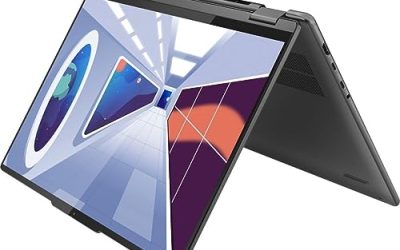
ASUS ProArt PX13 (Ryzen AI 9 HX 370, RTX 4050)
- Best for: A creator who edits on the move and wants a convertible OLED machine with a discrete GPU at 13 inches.
- Display: 13.3-inch OLED touchscreen, 3K 2880 x 1800, 500 nits per listing
- Colour gamut: none stated in this listing’s captured text
- Processor: AMD Ryzen AI 9 HX 370, up to 5.1 GHz per listing
- Graphics: NVIDIA GeForce RTX 4050, 6GB GDDR6 per listing
A creator who edits on the move and wants a convertible OLED machine with a discrete GPU at 13 inches.
This is a seller-configured listing whose description contains copy errors; the specifications above follow its title and technical details, which are the fields to re-check live.
The PX13 is the portable creator option: a 13.3-inch 2-in-1 convertible whose OLED touchscreen states 3K resolution at 2880 by 1800 and 500 nits, folding through laptop, tent and tablet positions for presenting and annotating work. A Ryzen AI 9 HX 370 processor, 32GB of memory, a 1TB SSD and an RTX 4050 with 6GB of GDDR6 handle edits and exports, and the ProArt line is ASUS’s creator series, positioned as such throughout the listing. One discipline applies: this listing states no colour-gamut figure, so none is claimed for it here.
Watch out for: This is a seller-configured listing whose description contains copy errors; the specifications above follow its title and technical details, which are the fields to re-check live.
ASUS ProArt PX13 (Ryzen AI Max+ 395, 64GB)
- Best for: A stills-led creator who wants maximum memory and a stated-gamut OLED panel in a 13-inch convertible.
- Display: 13.3-inch Lumina OLED touchscreen, 2880 x 1800 per listing copy
- Colour gamut (listing-stated): 100% DCI-P3, Pantone Validation, HDR Black 500 per listing bullets
- Processor: AMD Ryzen AI Max+ 395, 16-core, up to 126 TOPS per listing copy
- Memory and storage: 64GB LPDDR5X; 2TB SSD per listing copy
A stills-led creator who wants maximum memory and a stated-gamut OLED panel in a 13-inch convertible.
Do not merge this configuration with the RTX 4050 PX13 above: they are separate listings, and each figure in this entry belongs to this listing only.
The second PX13 is a different machine under a shared name: a Ryzen AI Max+ 395 configuration with 16 cores, 64GB of memory and a 2TB SSD, whose own bullets state 100% DCI-P3 colour gamut, Pantone Validation and HDR Black 500 for its 13.3-inch Lumina OLED touchscreen, with stylus support and a microSD reader. Its bullets name content creation, photo editing and video production directly. No discrete RTX graphics are claimed in its captured bullets, so its case rests on the processor, the memory and the stated panel, a different balance from its sibling.
Watch out for: Do not merge this configuration with the RTX 4050 PX13 above: they are separate listings, and each figure in this entry belongs to this listing only.
ASUS Zenbook 14 OLED (Core Ultra 7 255H)
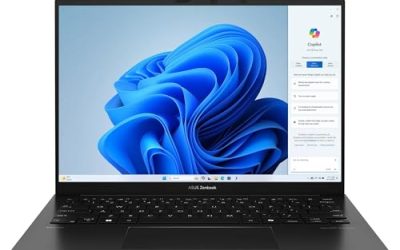
The Zenbook 14 OLED is the mainstream OLED option, presented honestly as such: its own fields describe business use, and its editing case rests on the panel its title states, a 14-inch WUXGA OLED touchscreen with 100% DCI-P3 and 500 nits HDR printed in the title itself. A Core Ultra 7 255H with integrated Intel Arc graphics, 16GB of memory and a 1TB SSD suit photo work and lighter video timelines, in a 2.66 lb body with a 75Wh battery and two Thunderbolt 4 ports. It is the traveller’s editing machine rather than a render station.
Specs
- Display: 14-inch OLED touch, 1920 x 1200 (WUXGA), 16:10 per listing
- Colour gamut (listing-stated): 100% DCI-P3, 500 nits HDR per listing title
- Processor: Intel Core Ultra 7 255H, 16 cores per listing
- Graphics: Intel Arc 140T integrated graphics per listing
- Memory and storage: 16GB DDR5 per listing fields; 1TB SSD per listing
- Ports: 2 x Thunderbolt 4, 1 x USB-A 3.2, HDMI 2.1 per listing
- Battery and weight: 75Wh; 2.66 lb per listing
- Extras: FHD IR camera with privacy shutter; fingerprint reader per listing
Best for: A travelling photographer who wants a stated-gamut OLED screen in a light machine for stills and lighter video work.
Watch out for: Integrated graphics only: heavy 4K timelines and effects work will feel the difference against the discrete-GPU picks in this set.
Apple MacBook Pro 14-inch (M4)
- Best for: An editor already in Apple’s ecosystem who wants the M4 MacBook Pro’s stated hardware in a 14-inch body.
- Chip: Apple M4, 10-core CPU and 10-core GPU per listing title
- Display: 14.2-inch Liquid Retina XDR, up to 1600 nits peak brightness per listing bullets
- Colour gamut: none stated in this listing’s captured text
- Memory and storage: 24GB unified memory; 1TB SSD per listing title
An editor already in Apple’s ecosystem who wants the M4 MacBook Pro’s stated hardware in a 14-inch body.
Apple sells several M4 configurations under near-identical titles; confirm the live listing’s memory and storage match this 24GB and 1TB configuration before ordering.
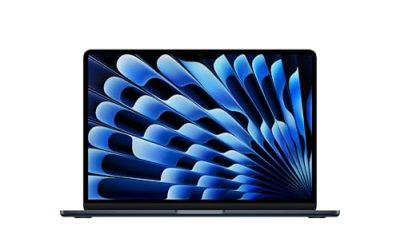
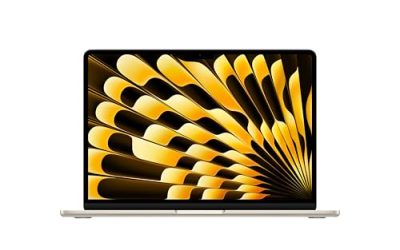
The MacBook Pro 14 with M4 is the Apple route: a 10-core CPU and 10-core GPU in Apple’s own chip, 24GB of unified memory and a 1TB SSD in this configuration, behind a 14.2-inch Liquid Retina XDR display whose bullets state up to 1600 nits peak brightness. The listing frames it as built for Apple Intelligence with all-day battery life. Two disciplines apply to this entry: the captured listing text states no colour-gamut figure, so none is printed, and no resolution figure is used beyond the display’s own name. Judge it on the ecosystem and the stated hardware.
Watch out for: Apple sells several M4 configurations under near-identical titles; confirm the live listing’s memory and storage match this 24GB and 1TB configuration before ordering.
Which One Fits Your Situation
A studio desk handling stills and 4K timelines
Take the Lenovo Yoga Pro 9i: the strongest stated screen figures in the set, an RTX 5060, 32GB of memory and an SD reader for the ingest side of the day. The SD reader earns its line here, because a studio day begins with cards, and the fastest ingest is the one that needs no adapter hunt.
A creator who edits in the field and presents on site
Take a ProArt PX13: the RTX 4050 version for GPU-driven work, or the AI Max+ version for its 64GB of memory and stated-gamut panel. The convertible form earns its keep in client work, where folding the machine to show a frame beats passing a laptop around a table.
A travelling photographer with lighter video needs
Take the Zenbook 14 OLED for its stated DCI-P3 panel in a 2.66 lb body, accepting integrated graphics as the trade. At under three pounds it also disappears into a camera bag beside the bodies and lenses, which is where a travel editing machine actually lives.
An editor committed to macOS
Take the MacBook Pro 14 with M4 in this 24GB and 1TB configuration, judging it on its stated display brightness and unified memory rather than borrowed figures. Its unified memory architecture also suits large stills libraries, where the whole catalogue stays responsive while other work continues.
Common Mistakes
- Assuming a famous creator model carries a gamut figure its actual listing never states, then colour-grading on an unverified assumption.
- Treating two configurations of the same laptop name as one product, when memory, storage and graphics differ between their listings.
- Buying 16GB of memory for a video workload because the screen looked right, then meeting the limit on the first multicam timeline.
- Trusting a listing’s product-information table over its title and bullets where they conflict, when the table fields are the ones most often garbled.
- Choosing integrated graphics for effects-heavy video because the panel specifications matched a discrete-GPU machine’s.
Frequently Asked Questions
Which laptop has the best screen for colour work?
On stated figures, the Lenovo Yoga Pro 9i: its bullets print 100% DCI-P3, 100% Adobe RGB and 100% sRGB for a 3.2K OLED panel. The ProArt AI Max+ and the Zenbook 14 also state 100% DCI-P3 in their own text. The other two listings state no gamut figure.
Why do two entries print no colour-gamut figure?
Because their listings’ captured text states none. A sibling listing’s figure or a retailer’s copy cannot be transferred to a different listing, so the ProArt RTX 4050 and the MacBook Pro entries rest on the facts their own pages do state.
Are the two ProArt PX13 entries duplicates?
No. They are separate listings with different processors, memory, storage and graphics claims: one pairs a Ryzen AI 9 with an RTX 4050, the other a Ryzen AI Max+ 395 with 64GB of memory and a stated DCI-P3 figure. Each entry prints only its own listing’s facts.
Which pick suits heavy video editing best?
The Yoga Pro 9i, on stated hardware: an RTX 5060 discrete GPU, a 16-core Ultra 9 processor and 32GB of memory behind the set’s largest stated-gamut screen. The Zenbook’s integrated graphics sit at the other end of the set for video weight.
More from Amazon
Programs that pair well with the guide above. Offers and eligibility are set by Amazon and may change.
Free shipping on eligible items, Prime Video and more. Eligible new members can start with a free trial.
Start a Prime free trialAd-free music streaming. Eligible new subscribers can start with a free trial.
Try Music Unlimited freeA Prime membership for ages 18-24 with a trial period. Eligibility is set by Amazon.
See Prime for Young AdultsAudiobooks and podcasts to listen to on the go. Eligible new members can start with a free trial.
Try Audible freeAs an Amazon Associate we earn from qualifying purchases.
Write Your Review
No reviews yet. Be the first to share your experience!