

Key takeaways
- Maximum SPL. Rated peak SPL at one meter is the most honest loudness figure. A 10-inch powered top usually lists 125 to 129 dB; a 12-inch top lists 128 to 132 dB. Every 3 dB you add needs roughly double the amplifier power, so the jump from 126 to 129 dB is bigger than it looks.
- Low-frequency extension. Most 10-inch tops reach about 50 to 55 Hz at the -10 dB point and most 12-inch tops about 45 to 50 Hz. Kick drums and sub bass sit in the 40 to 80 Hz range, so a top without a sub will feel thin in a large room even if it is loud.
- Inputs. You want at least two combo XLR/TRS inputs, or one combo and one RCA pair, so a controller and a microphone can plug in at the same time. A stereo RCA or 3.5 mm input is useful for a phone or laptop.
- Weight and handles. A 12-inch plastic-cabinet top is usually in the mid-20s to low-30s of pounds. Anything heavier than that becomes tiring on stands, so check the published weight before you buy.
- Cabinet material. Molded polypropylene cabinets are lighter and survive bumps; wooden cabinets are heavier, often sound a little more controlled and can be refinished.
The best DJ speakers for most people in 2026 are a pair of 10-inch to 12-inch powered PA tops such as the Yamaha DBR10, JBL EON710 or Mackie Thump12A, with an 18-inch powered subwoofer added once the room or the crowd gets bigger. Home DJs who only play for themselves are better served by 5-inch to 8-inch powered studio monitors, and parties of 50 or more people need a PA-style speaker with real headroom. The right pick depends on three numbers: room size, maximum SPL and how often the gear has to be carried.
This guide is based on published manufacturer specifications and published professional reviews, not on personal bench work. Specifications below are the manufacturers’ rated figures; “peak” wattage is a marketing number and tells you less than maximum SPL and frequency response do.
Our top picks

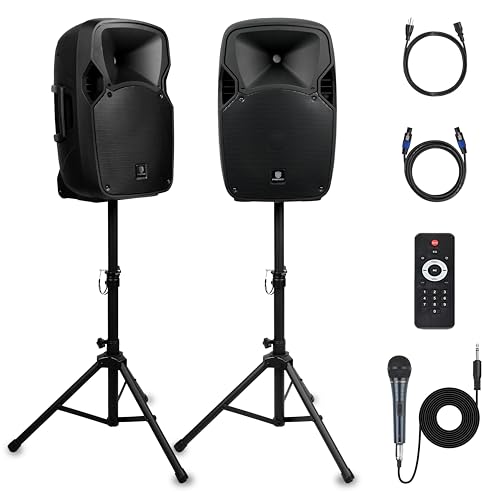


As an Amazon Associate we earn from qualifying purchases at no extra cost to you.
Quick answer: which DJ speaker fits which job
| Situation | Speaker class | Example models | Price tier |
|---|---|---|---|
| Bedroom or apartment practice | 5-inch powered monitors | JBL 305P MkII, KRK Rokit 5 G4, Pioneer DJ DM-50D | Entry |
| Home party, 20-40 guests | 8-inch or 10-inch powered tops | Yamaha DBR10, JBL EON710 | Mid |
| Parties, 50-150 guests | 12-inch tops plus 15-inch or 18-inch sub | Mackie Thump12A, QSC K12.2, JBL EON712 | Mid to premium |
| Mobile DJ, weddings | 12-inch tops with stands, 18-inch subs | QSC K12.2, Yamaha DXR12 MKII, JBL PRX900 series | Premium |
| Outdoor, no mains power | Battery-powered portable PA | Electro-Voice Everse 8, JBL PartyBox Stage 320 | Mid |
What makes a speaker a good DJ speaker
A DJ speaker has to do something a hi-fi speaker does not: play dance music at high level for hours without compressing, distorting or overheating. That comes down to a few measurable things.
- Maximum SPL. Rated peak SPL at one meter is the most honest loudness figure. A 10-inch powered top usually lists 125 to 129 dB; a 12-inch top lists 128 to 132 dB. Every 3 dB you add needs roughly double the amplifier power, so the jump from 126 to 129 dB is bigger than it looks.
- Low-frequency extension. Most 10-inch tops reach about 50 to 55 Hz at the -10 dB point and most 12-inch tops about 45 to 50 Hz. Kick drums and sub bass sit in the 40 to 80 Hz range, so a top without a sub will feel thin in a large room even if it is loud.
- Inputs. You want at least two combo XLR/TRS inputs, or one combo and one RCA pair, so a controller and a microphone can plug in at the same time. A stereo RCA or 3.5 mm input is useful for a phone or laptop.
- Weight and handles. A 12-inch plastic-cabinet top is usually in the mid-20s to low-30s of pounds. Anything heavier than that becomes tiring on stands, so check the published weight before you buy.
- Cabinet material. Molded polypropylene cabinets are lighter and survive bumps; wooden cabinets are heavier, often sound a little more controlled and can be refinished.
Best powered DJ speakers: the picks
Yamaha DBR10: best overall for home and small gigs
Spec line: 10-inch woofer, 1-inch compression driver, 700 W peak Class-D amplifier, up to 129 dB maximum SPL, about 55 Hz to 20 kHz (-10 dB), two XLR/TRS combo inputs plus a stereo RCA input.
Best for: people who want a clean, neutral sound that does not need much tuning, and who will use the speaker for DJing, live bands and presentations in the same week. Yamaha has long offered a long warranty on the DBR series in many regions, which matters for gear that gets moved around.
Skip if: you need a very bass-heavy sound from a single speaker or want a built-in mixer.
- Pro: even, uncolored voicing that works for music and speech.
- Pro: light enough for one person to carry and put on a stand.
- Pro: wide dispersion for a 10-inch speaker, so the sound is consistent across a room.
- Con: the 10-inch driver runs out of low-end below the mid-50 Hz range, so a sub is a worthwhile add-on for dance music.
- Con: no onboard mixer, so you need a controller or mixer for more than two sources.
JBL EON710: best for bass-forward parties on a mid budget
Spec line: 10-inch woofer, 1-inch compression driver, rated around 1,300 W peak, about 128 dB peak SPL, extension to roughly 52 Hz, Bluetooth control through the JBL Pro Connect app for EQ and presets on the current EON7 generation.
Best for: home parties, small clubs and mobile DJs who like a punchy low-mid and want app control without carrying a laptop.
Skip if: you want a flat studio-style response or you hate using apps for setup.
- Pro: strong low-mid weight for a 10-inch speaker.
- Pro: onboard DSP presets for music, speech and monitor use save setup time.
- Pro: the larger EON712 and EON715 share the same family if you outgrow it, so tonal matching is easy.
- Con: the wattage figure is a peak rating and should not be compared directly with other brands’ RMS numbers.
- Con: the app and Bluetooth features add one more thing that can go wrong at a gig; plan a manual fallback.
Mackie Thump12A: best value 12-inch for loud parties
Spec line: 12-inch woofer, 1.4-inch compression driver, about 1,300 W peak in the Thump A series, roughly 127 to 129 dB maximum SPL, lightweight molded cabinet, two combo inputs, selectable voicing modes.
Best for: DJs on a tight budget who need volume and low-end punch and will carry the gear often. Mackie Thump speakers are among the most commonly cited value picks for beginner mobile DJs and small bands.
Skip if: you need very precise high-end detail or plan to run the speakers hard for eight-hour events every weekend.
- Pro: strong output per unit of cost.
- Pro: light and easy to place on a pole mount.
- Pro: Bluetooth audio versions are available for background music between sets.
- Con: the highs can sound a little brighter and less refined than the Yamaha or QSC options.
- Con: expect more limiter activity near maximum volume than on the premium models.
QSC K12.2: best premium pick for working mobile DJs
Spec line: 12-inch woofer, 1.4-inch titanium compression driver, 2,000 W peak Class-D amplifier, about 132 dB maximum SPL, 45 to 50 Hz low-frequency extension, built-in DSP with selectable voicing, multiple mounting points.
Best for: wedding and event DJs who need consistent coverage and loud, clean output from a rugged cabinet with a long service life. The K.2 line has been a standard in rental fleets for years.
Skip if: you only play for yourself at home; this is more speaker, and more money, than a bedroom needs.
- Pro: very clean at high volume with strong limiter protection.
- Pro: wide, even dispersion and a controlled sound that carries into the back of a room.
- Pro: durable cabinet and a well-known resale market.
- Con: premium price tier compared with Mackie and Yamaha.
- Con: heavier than the polypropylene budget options, so a stand with a rated load is a must.
Electro-Voice Everse 8: best battery-powered DJ speaker
Spec line: 8-inch woofer, battery powered with roughly 12 hours of playtime on the maker’s rating, weather-resistant housing, built-in Bluetooth and a small mixer with a few inputs.
Best for: outdoor events without mains power, such as garden parties, small beach sets and pop-up sessions.
Skip if: you need to fill a large indoor room; an 8-inch driver on batteries has limits.
- Pro: true cord-free operation and a rugged build.
- Pro: onboard mixing means a microphone, a phone and a controller can all connect without extra gear.
- Pro: easy to carry as a single unit.
- Con: less output and bass than a 12-inch AC-powered top.
- Con: battery runtime drops noticeably at high volume.
Studio monitors for home DJs: JBL 305P MkII, KRK Rokit 5 G4 and Pioneer DJ DM-50D
For a desk-based setup, a pair of 5-inch powered monitors is the most sensible choice. These speakers are not built for loud parties but give accurate, detailed sound at bedroom volume, which is what matters when you are learning beatmatching or practicing mixes.
- JBL 305P MkII: 5-inch woofer, 1-inch soft-dome tweeter, roughly 41 W per side, wide sweet spot thanks to the waveguide, balanced XLR and TRS inputs. Best for neutral monitoring.
- KRK Rokit 5 G4: 5-inch woofer, DSP-driven EQ with an LCD for room correction, a more bass-forward voicing that many dance-music producers like.
- Pioneer DJ DM-50D family: designed specifically for DJ desks, with RCA inputs that match a mixer’s outputs and a more compact footprint. Bluetooth versions exist for streaming.
Skip if: you need to fill a room with sound for guests. Monitors in this class have a limited maximum level and little low-end below roughly 50 to 55 Hz.
Powered subwoofers: the missing piece
The most effective upgrade for a DJ rig is almost always a subwoofer. Popular powered subs in the 15-inch and 18-inch class include the JBL EON718S, Mackie Thump118S, Yamaha DXS15 MKII and QSC KS112. A single sub takes the lowest octave off the tops, so they run cleaner and louder, and the kick drum gets weight you can feel. A 12-inch sub is portable but only goes down to roughly 40 Hz; an 18-inch sub reaches 30 to 35 Hz, which is where deep house and bass music live.
Best DJ speakers by buying scenario
Best DJ speakers for home
For home use, start with a pair of 5-inch or 8-inch powered monitors. A 5-inch pair is fine for a small room under about 150 square feet; an 8-inch pair, such as the Kali LP-8 V2 or Yamaha HS8, gives more bass and headroom for a living room. If you want to throw occasional parties, a pair of 10-inch PA tops will be louder and more forgiving than monitors, though they look more like gear than furniture.
Best DJ speakers for parties
Wattage per person is not a useful rule, so use this one instead: aim for a maximum SPL that is at least 15 dB above the sound level you want at the back of the room. If you want 95 dB at the back of a room 30 feet deep, a speaker rated 125 dB at one meter loses about 30 dB over that distance, leaving about 95 dB. That is why 10-inch speakers with 125 dB ratings are right for a 30-foot room and why larger crowds need 12-inch tops or sub support.
Best portable DJ speakers
If you need to move your sound between locations without cables, look at battery-powered options. The Electro-Voice Everse 8 is built for professional use. For casual use, the JBL PartyBox Stage 320 is a popular party speaker with mic and guitar inputs, roughly 240 W of rated output and light effects. The Bose S1 Pro+ is a portable PA that works as a DJ monitor or small-room speaker, with a built-in mixer and a battery that lasts around 11 hours by the maker’s rating.
Best DJ speakers for beginners
A beginner should buy for the room they have, not for the gear they hope to grow into. Two good beginner paths exist. The first is a pair of desktop monitors such as the Pioneer DJ DM-50D plus an entry-level controller. The second is a single 10-inch powered top like the Yamaha DBR10 or JBL EON710 for a mono, club-style setup. Both leave room to add a sub later.
Best DJ speakers under 500
With a limit of 500 per purchase, the choices that fit are a single 10-inch or 12-inch powered top at the lower end of mid-price, a pair of 5-inch to 8-inch studio monitors, or a pair of Pioneer DJ desktop speakers. A single 12-inch Mackie Thump generally fits the budget in many markets, but a pair plus a sub does not. If you need stereo with a budget, buy two 8-inch monitors first and add a sub later.
Best DJ subwoofer speakers
For a small room, a 12-inch powered sub is plenty. For events up to 100 people, one 15-inch sub per pair of tops is a sound starting ratio. For 150 people or more, run an 18-inch sub per side. Check the crossover: you want a built-in high-pass output that feeds the tops so they do not waste power on frequencies below 80 to 100 Hz.
Specification comparison
| Model | Driver | Rated power | Max SPL | Low-end (-10 dB) | Best use |
|---|---|---|---|---|---|
| Yamaha DBR10 | 10 in | 700 W peak | 129 dB | ~55 Hz | Home, small gigs |
| JBL EON710 | 10 in | 1,300 W peak | ~128 dB | ~52 Hz | Parties with DSP presets |
| Mackie Thump12A | 12 in | 1,300 W peak | ~127-129 dB | ~48-50 Hz | Value pick, mobile DJ |
| QSC K12.2 | 12 in | 2,000 W peak | ~132 dB | ~45-50 Hz | Working mobile DJ |
| Electro-Voice Everse 8 | 8 in | Battery, ~12 h | Mid-120s dB | ~60 Hz | Outdoor, cord-free |
| JBL 305P MkII | 5 in | 41 W per side | ~108 dB | ~49 Hz (-10 dB) | Desk practice |
Figures are the manufacturers’ published ratings, rounded where noted. Maximum SPL is measured in the maker’s own test conditions, so compare within a brand cautiously and across brands only loosely.
How to choose: numbers that matter
Step 1: size the room and the crowd
A rough rule: a 10-inch top covers up to about 40 people, a 12-inch top up to about 100, and a pair of 12-inch tops with a sub up to about 200 in a typical indoor room. Outdoor events need roughly twice the capacity because there are no walls to reflect sound.
Step 2: decide whether you need a sub
If most of your music is hip-hop, EDM, house, reggaeton or anything with a heavy kick, a sub is worth it as soon as the room is bigger than a large living room. For jazz, acoustic or background music, you can skip it.
Step 3: count your inputs
Write down every source: one controller, one microphone, a phone for requests. If that is three or more, either choose a speaker with a built-in mixer, such as some Mackie Thump and Bose S1 Pro+ models, or plan a small external mixer.
Step 4: plan the stands and cables
Tripod stands rated for at least 120 lb are standard. Budget for two XLR cables of 15 to 25 feet and a power cable per speaker. These are often the first things that fail, so carry a spare.
Step 5: worked example
You throw parties for 60 people in a 25 by 40 foot room. A pair of 12-inch tops rated 128 dB at one meter will deliver about 98 to 100 dB at 30 feet, enough for dancing with room to talk. Add one 15-inch sub and the kick drum fills the room without pushing the tops. If you only buy tops, the same room will sound loud but thin.
Ownership realities: what wears first
- Cables and connectors fail before speakers do. Strain-relieved XLR cables are worth the small extra cost.
- Handles and corners of plastic cabinets crack when dropped; foam corner protectors and padded covers extend life.
- Heat shortens the life of amplifiers. Do not stack gear in direct sun, and leave the rear heat sink clear.
- Limiter lights are a warning, not a goal. If the limiter blinks constantly, turn the volume down or add speakers.
- Warranty and parts: premium brands tend to have longer warranties and spare parts availability, which matters if you gig regularly.
Common mistakes
- Comparing peak wattage figures from different brands as though they were equivalent.
- Using home hi-fi speakers for parties; they are not built for sustained high levels.
- Pointing speakers at the floor or against a wall, which muddies the bass.
- Skipping a stand and placing tops on tables, which couples bass into the surface and worsens the sound.
- Running a sub without setting the crossover, leading to a boomy mix.
Frequently Asked Questions
Are powered speakers better than passive ones for DJs?
For most DJs, yes. Powered speakers have the amplifier matched to the drivers in the same cabinet, so there is nothing else to buy and fewer cables to carry. Passive speakers make sense in fixed installations where one rack of amplifiers feeds many cabinets.
Can I use studio monitors for DJing at a party?
You can for a small gathering, but monitors are built for close listening and cannot match PA speakers for volume or low-end. If guests are standing or dancing more than a few feet away, PA tops are the better choice.
How many watts do I need for a DJ speaker?
Watts alone is a poor guide. Look at maximum SPL and the frequency range. A 700 W peak speaker with a 129 dB rating can be louder than a 1,300 W peak speaker with a 126 dB rating because driver efficiency differs.
Do I need a subwoofer for DJing?
If you play bass-heavy music for a crowd, yes. A sub takes the lowest frequencies off your tops, which lets them play louder with less distortion. For small rooms or acoustic styles, tops alone are usually enough.
Can I use Bluetooth speakers for DJing?
Casual use, yes. For performing, Bluetooth adds latency of roughly 100 to 200 milliseconds, which makes cueing and monitoring awkward. Use a wired connection from your controller or mixer whenever possible.
How long do DJ speakers last?
Well-built powered speakers commonly last a decade or more with normal care. Amplifier modules and handles are the usual failure points, and buying from brands with long warranties and repair support improves the odds.
Bottom line
For a single recommendation, choose a pair of Yamaha DBR10 or JBL EON710 speakers for home and small events, step up to Mackie Thump12A tops for value at larger gatherings, and choose QSC K12.2 tops with a powered sub if DJing is a paid job. Use studio monitors for desk practice, and a battery-powered unit for outdoor sets. Whichever route you take, size the system to the room using maximum SPL, plan for a sub if your music needs it, and treat cables and stands as part of the budget rather than an afterthought.
More from Amazon
Programs that pair well with the guide above. Offers and eligibility are set by Amazon and may change.
Free shipping on eligible items, Prime Video and more. Eligible new members can start with a free trial.
Start a Prime free trialAd-free music streaming. Eligible new subscribers can start with a free trial.
Try Music Unlimited freeA Prime membership for ages 18-24 with a trial period. Eligibility is set by Amazon.
See Prime for Young AdultsAudiobooks and podcasts to listen to on the go. Eligible new members can start with a free trial.
Try Audible freeAs an Amazon Associate we earn from qualifying purchases.



Write Your Review
No reviews yet. Be the first to share your experience!