

Key takeaways
- Compare the best tuner pedals by accuracy, display, bypass type and polyphonic tuning for guitar and bass pedalboards at home and on any stage.
A tuner pedal is the one pedal that has to work every single time you step on it: it must mute your signal silently, read pitch fast under stage lighting, and stay out of the way of everything after it in the chain. The real decision is how much accuracy you need, because listed figures run from plus or minus one cent on stage-standard models to a tenth of a cent on strobe pedals built for intonation work.
This guide is for gigging guitarists and bassists who tune between songs, home players building a first pedalboard, and anyone who sets intonation on a bench. Every pick below is a stompbox chromatic tuner sold on Amazon, chosen from the names and specifications on its listing: stated accuracy in cents, display type, bypass or buffer arrangement, tuning modes and range, and how the pedal is powered.
Quick Picks
As an Amazon Associate we earn from qualifying purchases
| Product | Best for | Key spec from title |
|---|---|---|
| BOSS TU-3 Chromatic Tuner Pedal | Gigging players who need a rugged, silent-muting stage tuner | 21-segment LED meter |
| Peterson StroboStomp HD | Intonation work, recording and sweetened tunings | True strobe display, ±0.1 cent accuracy |
| TC Electronic PolyTune 3 | Checking all six strings with a single strum | Polyphonic tuning with built-in BonaFide Buffer |
| TC Electronic PolyTune 3 Mini | Fully loaded boards with almost no free rail space | Tiny polyphonic tuner with BonaFide Buffer |
| Donner DT-1 Chromatic Tuner Pedal | First boards and backup boards on a budget | A0 to C8 range with ±1 cent strobe mode |
How to Choose
Accuracy in cents, and strobe versus needle
Cents are hundredths of a semitone, and every pedal here publishes its accuracy in them. A needle or LED-meter tuner rated at plus or minus one cent is entirely adequate for live playing, because few listeners can hear a one-cent error inside a full band mix. Strobe displays react to far smaller differences: a tenth of a cent on the Peterson, and two hundredths of a cent in the strobe modes of the TC Electronic pedals. That resolution matters when you set intonation, record doubled parts, or tune instruments that drift as you play them.
Display size, brightness and layout
On a dark stage you read a tuner with your foot on it and your eyes a body-length away, so display design is a practical feature, not decoration. Segment LED meters like the TU-3’s are coarse but instantly readable, and its High-Brightness mode exists for outdoor stages. LCD strobe displays show far more information, including note name and drift direction, but reward a steadier gaze. Mini pedals shrink the display with the enclosure; the PolyTune 3 Mini keeps 109 LEDs, yet its readouts are physically smaller, which matters if your eyesight or stage position is unforgiving.
True bypass, buffers and your signal chain
A tuner usually sits first in the chain, so its bypass type affects every pedal after it. True bypass removes the tuner from the circuit entirely when off, which vintage-style fuzz pedals prefer. A good buffer instead drives long cable runs and large boards without treble loss, which is why the TU-3 is buffered and both TC Electronic pedals let you switch between buffer and true bypass. Players with complex switching should also read our guide to loop switchers for keeping tuners and buffers under control.
Power options and pedalboard space
Every pedal here runs on 9V, but the details differ in ways that affect your board. The TU-3 and StroboStomp HD accept a 9V battery as well as a mains supply, which suits a small grab-and-go board. The PolyTune 3 Mini and Donner DT-1 have no battery compartment at all, so a spare slot on your power supply is mandatory. Check current draw against your supply’s per-output limit, and measure your free rail space before ordering a full-size pedal: the Peterson is noticeably longer than the mini pedals it competes with.
The 5 Best Options
BOSS TU-3 Chromatic Tuner Pedal

The TU-3 is the default choice when you want a tuner pedal that simply works for years: a die-cast BOSS enclosure, a 21-segment LED meter you can read from standing height, and tuning accurate to plus or minus one cent. Chromatic mode handles any instrument, while Guitar and Bass modes tune by string number and support seven-string guitars and six-string basses. Guitar Flat mode drops up to six semitones for down-tuned sets, the output mutes automatically while you tune, and the Accu-Pitch Sign function flashes a clear confirmation when a string lands in tune.
Specs
- Accuracy: ±1 cent, as listed
- Display: 21-segment LED meter with High-Brightness mode
- Modes: Chromatic, plus Guitar and Bass modes that tune by string number
- Instrument support: 7-string guitars and 6-string basses, as listed
- Flat tuning: Guitar Flat mode, up to six semitones below standard pitch
- Bypass: buffered bypass; output mutes while tuning, with a separate always-live Bypass output
- Power: DC 9V battery or BOSS PSA-series adaptor (sold separately)
- Weight: 390 g including battery
Best for: Gigging guitarists and bassists who want a durable, easy-to-read stage tuner that mutes silently.
Watch out for: There is no true-bypass option, so if a buffer-sensitive fuzz pedal sits later in your chain, test that pairing before committing the TU-3 to the board.
ASIN: B004D8KX7K
Peterson StroboStomp HD

Choose the StroboStomp HD when tuning accuracy is the whole point. Its true strobe display is rated at plus or minus 0.1 cent, ten times finer than a one-cent needle tuner, which makes it the pick for setting intonation, recording, and alternate or sweetened tunings. The high-definition LCD carries a variable-color backlight you can assign per preset, and more than 135 Sweetened Tunings cover guitar, bass, Buzz Feiten and steel guitar. Output options include pop-less true bypass, a Pure Buffer mode and a buffered monitor mode for always-on checking.
Specs
- Tuner type: true strobe pedal tuner
- Accuracy: ±0.1 cent
- Display: high-definition LCD with variable-color LED backlight and 10 preset colors
- Output modes: pop-less true bypass, Pure Buffer mode, buffered monitor mode
- Presets: over 135 Sweetened Tunings; custom presets load via Peterson Connect through the USB port
- Power: 9V battery (included) or 9V DC supply
- Dimensions: 5 x 2.6 x 2.1 inches
- Weight: 13.9 ounces
Best for: Players who set their own intonation, record, or work with alternate and sweetened tunings.
Watch out for: The strobe pattern reacts to very small pitch changes and takes practice to read quickly, and at 5 inches long this is the largest pedal in the guide.
ASIN: B07PW9KBBJ
TC Electronic PolyTune 3

The PolyTune 3 is built around one party trick that turns out to be genuinely useful: strum all six strings and the display shows the tuning of each string at once, so you only adjust the ones that drifted. It switches to single-string tuning automatically when you play one note, with chromatic accuracy of plus or minus 0.5 cent and a strobe mode rated at plus or minus 0.02 cent. A built-in BonaFide Buffer, switchable with true bypass, keeps long cable runs from dulling your top end.
Specs
- Tuning modes: polyphonic, chromatic and strobe
- Accuracy: ±0.5 cent in chromatic mode; ±0.02 cent in strobe mode, as listed
- Polyphonic mode: shows every string from one strum and auto-switches to single-string tuning
- Bypass: switchable true bypass or built-in BonaFide Buffer
- Display: 109-LED display with automatic brightness adjustment
- Extra modes: Drop D and capo tuning modes
- Power: 9V battery or 9V DC supply (supply not included)
- Weight: 9.5 ounces
Best for: Players who retune between songs and want a one-strum check of all six strings.
Watch out for: Polyphonic readings are rated at around one cent, so switch to chromatic or strobe mode for final adjustments and intonation work.
ASIN: B06Y4G7NQD
TC Electronic PolyTune 3 Mini

The PolyTune 3 Mini squeezes the same polyphonic idea into a pedal roughly two-thirds the width of a standard stompbox, which is why it suits boards where every inch is already spoken for. You still get polyphonic, chromatic and strobe modes, a 109-LED display, and the BonaFide Buffer, with side DIP switches choosing buffered or true bypass and an always-on mode that keeps tuning visible while you play. The trade-off is power: there is no battery compartment, so it runs from a 9V supply only.
Specs
- Tuning modes: polyphonic, chromatic and strobe
- Accuracy: ±0.5 cent in chromatic mode; ±0.02 cent in strobe mode, as listed
- Buffer: built-in BonaFide Buffer, switchable to true bypass via side DIP switches
- Display: 109 LEDs, with an always-on mode available
- Dimensions: 3.66 x 2.01 x 1.73 inches
- Weight: 100 grams (3.53 ounces)
- Power: 9V DC supply; no battery compartment
Best for: Crowded pedalboards that need full polyphonic tuning inside a mini footprint.
Watch out for: It cannot run on a battery, and some marketplace spec tables for this pedal carry garbled fields, so confirm the 1/4-inch jacks and 9V input rather than trusting every listed detail.
ASIN: B07QVPJDDL
Donner DT-1 Chromatic Tuner Pedal
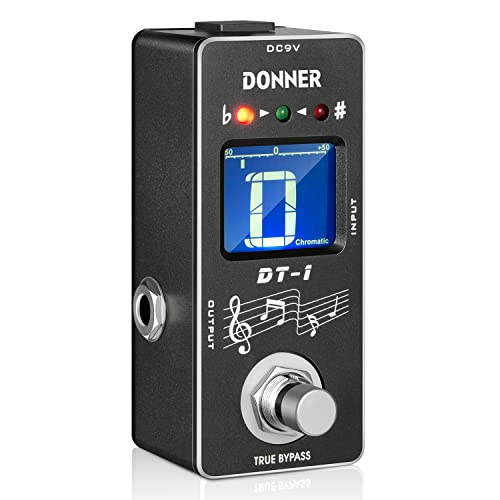
The DT-1 is the budget route onto a pedalboard: a compact chromatic tuner with a pitch-indicator display, true bypass switching and a stated range from A0 to C8, which covers standard and extended-range guitars plus five- and six-string basses. Its strobe mode is specified at plus or minus one cent, matching the headline accuracy of far costlier stage tuners, and the display pairs a small LCD with LED indicators so pitch direction is easy to follow. There is no battery compartment and no adapter in the box, so budget for a 9V supply.
Specs
- Tuning range: A0 (27.5 Hz) to C8 (4186 Hz)
- Accuracy: ±1 cent in strobe mode, as listed
- Modes: chromatic tuning with strobe mode and pitch indicator display
- Bypass: true bypass
- Power: 9V DC supply (not included); no battery compartment
- Dimensions: 12.19 x 5.99 x 6.6 cm
- Weight: 220 g
Best for: First pedalboards and backup boards that still need full-range chromatic tuning.
Watch out for: No power adapter is included and there is no battery option, so the pedal only works once you add a 9V supply to the board.
ASIN: B00MO6KKSK
Which One Fits Your Situation
Playing live sets where tuning has to be silent and fast
Pick the BOSS TU-3. Its output mutes the moment you engage it, the 21-segment meter reads clearly from standing height, and the High-Brightness mode covers outdoor stages. If you would rather check every string with one strum between songs, the PolyTune 3 does that instead, and its chromatic mode is still twice as fine as the TU-3’s one-cent figure for single-string touch-ups.
Setting intonation or recording in the studio
This is strobe territory. The Peterson StroboStomp HD resolves a tenth of a cent and offers more than 135 Sweetened Tunings, so it suits bench work, alternate tunings and instruments like pedal steel. The PolyTune 3’s strobe mode is rated even finer on paper, at two hundredths of a cent, and works well as a second option if you also want polyphonic checking on the same pedal.
A small board with no free space left
Choose the PolyTune 3 Mini. It keeps polyphonic tuning, the strobe mode and the switchable BonaFide Buffer while taking up roughly two-thirds of a standard pedal’s width, and its always-on mode lets you glance at tuning mid-song. Just confirm you have a spare 9V output on your supply, because there is no battery compartment to fall back on when a rail runs out of slots.
A first pedalboard on a tight budget
Start with the Donner DT-1. It covers the full A0 to C8 range, claims plus or minus one cent in its strobe mode, and switches with true bypass, so it will not hold a growing board back. The savings against the bigger names are better spent on the 9V supply this pedal needs anyway, since no adapter is included and there is no battery option.
Common Mistakes
- Placing the tuner after distortion or modulation pedals, where noise and pitch effects make the display jump around; a tuner tracks cleanest first in the chain.
- Assuming a mini tuner runs on batteries: several compact models are supply-only, so check for a battery compartment before relying on one at a gig.
- Ignoring bypass type: a buffered tuner in front of some vintage fuzz circuits can change their response, while true bypass at the head of a long cable run can dull the top end.
- Trusting polyphonic mode for final adjustments: the all-strings view is a quick status check, and fine tuning still belongs in single-string chromatic or strobe mode.
- Buying accuracy you cannot use: a two-hundredths-of-a-cent strobe figure does not help if your stage routine only leaves five seconds between songs.
Frequently Asked Questions
How accurate does a tuner pedal need to be for live playing?
For most live playing, plus or minus one cent is enough: that is the TU-3’s figure, and errors that small disappear inside a band mix. Finer accuracy helps when you set intonation, record, or play exposed parts where two instruments must agree closely. Below a tenth of a cent, you are chasing stability in the instrument itself as much as tuner resolution.
Is polyphonic tuning as accurate as tuning one string at a time?
No. Polyphonic mode is a fast status check: TC Electronic rates the all-strings view at about one cent, while the same pedals quote half a cent in chromatic mode and two hundredths of a cent in strobe mode. Use the strum to find which strings drifted, then finish those strings one at a time in chromatic or strobe mode for the number that matters.
Should a tuner pedal be true bypass or buffered?
Neither is automatically better; it depends on the rest of the chain. True bypass keeps the tuner completely out of your signal when off and suits buffer-sensitive fuzz pedals. A buffer at the front protects treble across long cables and big boards, which is why the TU-3 is buffered full-time and the TC Electronic pedals let you switch between the two.
Can one tuner pedal cover seven-string guitar and six-string bass?
Yes, if its modes and range are written for them. The TU-3’s Guitar and Bass modes tune by string number and explicitly support seven-string guitars and six-string basses, while its chromatic mode covers any pitch. Wide-range chromatic pedals like the Donner DT-1, rated from A0 to C8, also handle low bass strings that narrower guitar-only tuners can struggle to track.
More from Amazon
Programs that pair well with the guide above. Offers and eligibility are set by Amazon and may change.
Free shipping on eligible items, Prime Video and more. Eligible new members can start with a free trial.
Start a Prime free trialAd-free music streaming. Eligible new subscribers can start with a free trial.
Try Music Unlimited freeA Prime membership for ages 18-24 with a trial period. Eligibility is set by Amazon.
See Prime for Young AdultsAudiobooks and podcasts to listen to on the go. Eligible new members can start with a free trial.
Try Audible freeAs an Amazon Associate we earn from qualifying purchases.

Write Your Review
No reviews yet. Be the first to share your experience!