

Key takeaways
- Compare the best signal amplifiers for TV antennas by gain, noise figure, band coverage and powering for weak over-the-air reception in country homes.
When a channel pixelates every evening or drops out whenever the weather turns, the real decision is where your signal is being lost. An amplifier cannot invent a signal your antenna never captured, but the right one, installed at the right point, stops a long cable run or a splitter from throwing away channels the antenna already receives. Choosing the wrong type, or far more gain than your losses, can overload the tuner and make reception worse than no amplifier at all.
This guide is for rural households far from the broadcast towers, families splitting one antenna across several rooms, homes close to a cell tower, and viewers using a simple indoor antenna. The picks below were chosen from their Amazon product pages by amplifier type, gain, noise figure, filtering, band coverage and output count, so each one maps to a distinct installation.
Quick Picks
As an Amazon Associate we earn from qualifying purchases
| Product | Best for | Key spec from title |
|---|---|---|
| Channel Master TV Antenna PreAmp 1 (CM-7779HD) | Most outdoor antennas with long cable runs | Adjustable 17/30 dB gain |
| Winegard LNA-200 Boost XT HDTV Preamplifier | Weak rural signals at the mast | 18 dB maximum gain, 1 dB noise figure |
| GE 4-Way HD Digital TV Antenna Amplifier (34479) | Feeding up to four TVs from one antenna | 4 outputs |
| Televes 560383 TForce Mast Preamplifier | Homes near cell towers with mixed signal strengths | Automatic gain up to 31 dB UHF |
| GE Indoor HD Digital TV Antenna Amplifier (42178) | A single TV on an indoor antenna | Built-in 4G/5G LTE filter |
How to Choose
Decide Whether You Need a Preamplifier or a Distribution Amplifier
The two types solve different problems and are not interchangeable. A preamplifier mounts at the antenna, usually on the mast, and lifts a weak signal before the cable run can degrade it, so it suits distant towers and fringe reception. A distribution amplifier sits indoors where the feed splits, replacing a passive splitter so several TVs can share one antenna without each room losing strength. Weak-signal listeners face the same placement logic with the best shortwave radios, where the first stage of amplification matters most. Buying the wrong type is the most common reason an amplifier disappoints.
Match the Gain to Your Actual Losses
Gain is only useful when it roughly replaces what your installation loses. A long coaxial run, a four-way split and older cable can easily eat the equivalent of a modest amplifier’s output, while a short run in a strong-signal suburb needs little or none. Adjustable models, such as a preamplifier with switchable 17 dB and 30 dB settings, let you start low and step up only if channels still break up. Fixed high gain near powerful transmitters overloads the tuner, which shows up as channels vanishing rather than improving, so treat the biggest number on the box with suspicion.
Read the Noise Figure Before the Gain Figure
Every amplifier adds a little noise of its own, and the noise figure states how much, in decibels. A figure around 1 dB is excellent, figures under 3 dB are respectable, and anything much higher can bury the weakest channels in hiss the tuner cannot separate from the signal. This matters most exactly where amplifiers are bought most often: at the edge of reception, where the incoming signal is barely above the noise floor. Two amplifiers with identical gain can perform very differently on a marginal channel, and the one with the lower noise figure usually wins.
Check Filtering and Band Coverage
Modern reception problems often come from interference rather than weakness. Cell signals now sit directly above the television band, so a built-in LTE or 5G filter that rejects everything above the repacked UHF channels can fix pixelation that no amount of gain touches. FM filtering helps homes near radio transmitters. Confirm the amplifier covers both VHF and UHF, since many markets keep a few stations on high VHF after the repack, and check whether it is built for a passive antenna, because most of these models must not be paired with an already-amplified antenna.
The 5 Best Options
Channel Master TV Antenna PreAmp 1 (CM-7779HD)

The PreAmp 1 is the safest single recommendation for a non-amplified outdoor antenna because it avoids the usual either-or choice on gain: a switch on the indoor power inserter selects 17 dB or 30 dB, so the same unit covers a suburban rooftop and a fringe installation at the end of a long cable run. Its built-in filtering tackles the interference side as well, and the die-cast housing with mast, wall or indoor mounting options suits attic and rooftop installs alike. For most households with one antenna and one main viewing run, this is the amplifier to try first.
Specs
- Gain: adjustable 17 dB or 30 dB, switched at the power inserter
- Bands: VHF and UHF, for non-amplified TV antennas
- Filtering: built-in LTE filter, plus FM and LTE out-of-band filters
- Noise figure: under 2 dB
- Outputs: 1
- Powering: powered over the coaxial cable with the included power inserter and adapter
- Placement: indoor/outdoor; mast mount, wall mount or indoor
- Dimensions: 4.25 x 5.25 x 1 inches
- Weight: 9.5 ounces
- Included: preamplifier, 6 ft coaxial cable, power inserter, power adapter, mounting bracket
Best for: households with a passive outdoor antenna and a long or lossy cable run who want one adjustable preamplifier.
Watch out for: the listing states it is not designed for low-quality powered antennas with built-in rotators, so check your antenna type before ordering.
ASIN: B0C34KVK34
Winegard LNA-200 Boost XT HDTV Preamplifier
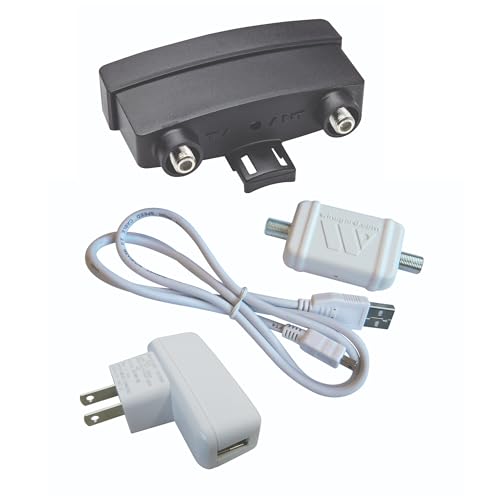
For a genuinely weak signal, what happens at the mast matters more than anything downstream, and the LNA-200 is built for exactly that spot. Its published noise figure of 1 dB typical is the lowest in this roundup, which is what a fringe household is really buying: the weakest channels get amplified before cable loss and before the amplifier’s own noise can compete with them. TwinAmp circuitry amplifies the VHF and UHF bands separately, which helps markets where one strong VHF station sits alongside faint UHF signals, and power travels up the coax from an indoor USB inserter.
Specs
- Gain: 18 dB maximum (typical)
- Noise figure: 1 dB (typical)
- Bands: VHF and UHF, amplified separately with TwinAmp Technology
- Powering: +5V at 130 mA through the included USB power inserter; USB cable and 110V adapter included
- Placement: outdoor, mast-mounted at the antenna
- Outputs: 1
- Dimensions: 4.38 x 1.5 x 2.75 inches
- Weight: 8 ounces
- Compatibility: non-amplified (passive) outdoor antennas
Best for: rural and fringe-area homes where distant towers leave channels hovering at the edge of reception.
Watch out for: the Amazon page prints the impedance as 140 ohms, which conflicts with the 75-ohm coax system this amplifier connects to, so treat that field as a listing error and confirm details on the Winegard documentation.
ASIN: B00DQN3R9O
GE 4-Way HD Digital TV Antenna Amplifier (34479)

When the signal at the antenna is already decent and the problem is sharing it, this GE unit replaces the passive four-way splitter that quietly costs every room signal. It feeds up to four televisions or converter boxes from one antenna, covers the full 50 to 1006 MHz band used by digital VHF and UHF broadcasts, and connects with standard F-type fittings, so it drops into most existing home wiring. The included AC adapter powers it at the wiring point, and the limited-lifetime warranty is unusually strong backing for a distribution amplifier in this class of product.
Specs
- Outputs: 4, for hook-up of up to four devices
- Frequency range: 50-1006 MHz
- Bands: HD digital VHF and UHF
- Connectors: F-type
- Powering: AC power adapter included
- Noise: low-noise amplification design
- Placement: indoor, at the distribution point
- Warranty: limited-lifetime warranty
Best for: homes splitting one antenna feed across three or four rooms where reception is already fair at the antenna.
Watch out for: GE does not publish a gain figure for this model in the listing, so compare it on output count and placement rather than on boost numbers, and do not expect it to rescue a signal that is weak before the split.
ASIN: B005AUH1SE
Televes 560383 TForce Mast Preamplifier

The TForce removes the guesswork that makes people buy two amplifiers: its automatic gain control watches the VHF and UHF bands independently and continuously rebalances them, raising faint stations while holding back strong ones that would otherwise overload the tuner. That behaviour, plus steep built-in filtering that rejects FM and 5G signals above 608 MHz, makes it the natural pick for homes near a cell tower, where interference and one overpowering local station are the real enemies. A DC pass switch can also power an active antenna, and the screened cast-metal chassis is made for permanent mast mounting outdoors.
Specs
- Gain: automatic, up to 31 dB UHF and 22 dB VHF, adjusted independently per band
- Bands: Low VHF, High VHF and UHF (RF channels 2-36), single input
- Filtering: built-in 5G and FM filtering; rejects signals above 608 MHz
- Noise figure: not published in the listing; described as very low noise
- Powering: 12 V power supply unit included; DC pass switch for powering an active antenna
- Placement: mast-mounted, outdoor; cast metal chassis with ABS case
- Outputs: 1
Best for: homes near cell towers or with a difficult mix of one strong local station and several weak distant ones.
Watch out for: there is nothing to adjust by hand, so if you specifically want a manual gain control for fine-tuning, the switchable Channel Master above suits you better.
ASIN: B08R44YZH6
GE Indoor HD Digital TV Antenna Amplifier (42178)
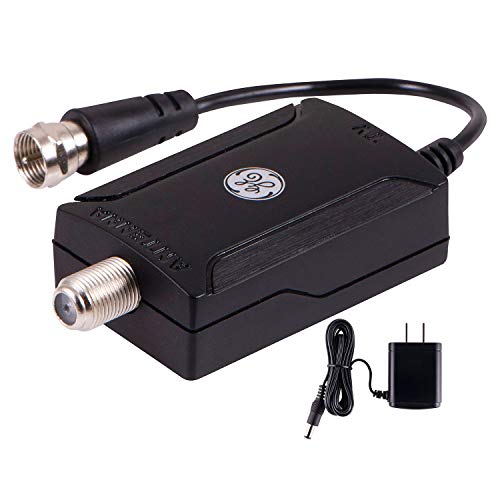
Not every weak-signal problem involves a roof. This compact GE amplifier sits between a passive indoor antenna and a single television, adding modest low-noise boost and, just as usefully, a built-in 4G/5G LTE filter through its PureAmp circuitry, which addresses the phone-interference pixelation common in apartments and dense neighbourhoods. It supports the current broadcast standards listed on its page, including ATSC 3.0 NextGen TV, and installation is a short coax connection each side plus the included AC adapter. It is the lowest-commitment way to find out whether amplification helps an indoor setup at all.
Specs
- Gain: 12 dB
- Filtering: built-in 4G/5G LTE filter (PureAmp Technology)
- Bands: VHF and UHF; supports 1080p, 4K Ultra HD and ATSC 3.0 NextGen TV
- Powering: AC adapter included
- Placement: indoor use only, with passive indoor antennas
- Outputs: 1
- Impedance: 75 Ohms
- Dimensions: 2.75 x 1.8 x 0.75 inches
- Weight: 3.84 ounces
Best for: apartment and indoor-antenna viewers whose in-range channels break up and who want a simple single-TV fix.
Watch out for: it is an indoor-only device for passive indoor antennas, and its modest boost cannot recover a channel the antenna itself barely receives.
ASIN: B07NF6JYJV
Which One Fits Your Situation
Your Farmhouse Sits Far From Every Tower
Distance is a noise problem before it is a strength problem, so start at the mast. The Winegard LNA-200 Boost XT, with its 1 dB typical noise figure, preserves the faintest channels before the long run into the house can degrade them. If your cable run is exceptionally long or you want headroom to experiment, the Channel Master PreAmp 1 on its 30 dB setting is the alternative.
One Antenna Has to Feed the Whole House
Splitting is a distribution problem, and no mast preamplifier is required if reception at the antenna is already sound. The GE 4-Way amplifier replaces your passive splitter and feeds up to four rooms from the wiring closet or attic. Cap any unused outputs, keep the runs as short as the house allows, and only add a preamplifier later if individual channels still sit below the reception threshold.
A Cell Tower Looms Over Your Neighbourhood
Interference, not weakness, is your enemy, and gain alone will amplify the problem. The Televes 560383 combines steep 5G filtering above 608 MHz with automatic per-band gain, so it rejects the cell signals while keeping strong locals under control. The Channel Master PreAmp 1 is the manual alternative, pairing its own built-in LTE filter with a switchable gain you can back down to 17 dB.
You Watch on One TV With an Indoor Antenna
Keep the fix small and reversible. The GE 42178 connects between the antenna and the television in minutes, adds a gentle boost, and filters the phone interference that plagues indoor reception. If it does not stabilise your weakest in-range channel, the honest conclusion is that the antenna needs a better position, not a stronger amplifier.
Common Mistakes
- Adding an amplifier to an antenna that already has one built in, which overloads the signal; most preamplifiers in this guide are specified for passive antennas only.
- Buying the highest gain available instead of matching gain to cable and splitter losses, then losing strong channels to tuner overload.
- Installing a distribution amplifier at the mast or a preamplifier at the splitter, when each type belongs at the opposite end of the run.
- Blaming weak signal for pixelation that is actually LTE or FM interference, which a filter fixes and extra gain worsens.
- Leaving unused distribution outputs unterminated and forgetting the amplifier needs power, whether from an inserter, a USB port or an AC adapter.
Frequently Asked Questions
Will an amplifier give me channels my antenna cannot receive at all?
No. An amplifier strengthens and preserves a signal the antenna already captures; it cannot create one below the reception threshold. If a channel never appears on a scan with the antenna in its best position, the fixes are antenna height, placement or a more directional antenna. Amplification helps channels that appear but break up, pixelate or vanish in poor weather.
What is the difference between a preamplifier and a distribution amplifier?
A preamplifier mounts at the antenna and boosts a weak signal before cable losses damage it, serving one main feed. A distribution amplifier sits where the signal splits and compensates for splitter loss across several televisions. Fringe homes may use both, in that order. Suburban homes with a healthy signal usually need only the distribution type, if anything.
Can too much gain make my reception worse?
Yes. A tuner overloaded by excessive gain or one very strong local station can lose channels entirely, sometimes more than it gained. Symptoms include strong stations breaking up while weaker ones improve. Switchable models let you drop from a high setting to a low one, and automatic-gain models such as the Televes rebalance continuously, which is why matching gain to your losses matters.
Do I really need an LTE or 5G filter?
If a cell tower is nearby, quite possibly. Repacked television channels now end where mobile signals begin, and a strong phone signal can desensitise a tuner or amplifier even though it is not a TV channel. A built-in filter, as fitted to the Channel Master, Televes and GE indoor models here, rejects those frequencies before amplification. Rural homes far from towers benefit least.
More from Amazon
Programs that pair well with the guide above. Offers and eligibility are set by Amazon and may change.
Free shipping on eligible items, Prime Video and more. Eligible new members can start with a free trial.
Start a Prime free trialAd-free music streaming. Eligible new subscribers can start with a free trial.
Try Music Unlimited freeA Prime membership for ages 18-24 with a trial period. Eligibility is set by Amazon.
See Prime for Young AdultsAudiobooks and podcasts to listen to on the go. Eligible new members can start with a free trial.
Try Audible freeAs an Amazon Associate we earn from qualifying purchases.
Write Your Review
No reviews yet. Be the first to share your experience!