

The best desktop microphone arm for podcasting in 2026 is the Rode PSA1+ if you use a heavy XLR mic and want silent, damped movement, the Elgato Wave Mic Arm Pro if you want gas-spring smoothness and a 3 kg load rating, and the FIFINE BM88 if you want a low-profile arm that holds a Shure SM7B-class mic without costing much. The deciding number is not the price but the match between your microphone’s weight and the arm’s rated load range, because an arm that is too weak sags and one that is too strong will not hold a light mic in place. This guide compares seven real arms by load, reach, clamp size and noise, then shows how to size one to your mic and desk.
Our top picks


As an Amazon Associate we earn from qualifying purchases at no extra cost to you.
Quick comparison of the seven picks
| Pick | Best for | Rated load | Reach | Desk clamp opening | Price tier |
|---|---|---|---|---|---|
| Rode PSA1+ | Heavy XLR mics, quiet recording | 94 g to 1.2 kg | 940 mm horizontal, 860 mm vertical | Up to 70 mm (or 55 mm insert) | Premium |
| Elgato Wave Mic Arm Pro | Heaviest mics, smooth one-hand moves | Up to 3 kg | About 750 mm total length | Up to 60 mm | Premium |
| Elgato Wave Mic Arm MK.2 | Mid-weight USB and XLR mics | 200 g to 1.2 kg | 950 mm horizontal, 850 mm vertical | Up to 60 mm | Mid-range to premium |
| Elgato Wave Mic Arm LP | Low-profile desks, on-camera setups | Up to 2 kg | About 740 mm | Up to 60 mm | Mid-range |
| Blue (Logitech G) Compass | Clean look, internal springs | Up to 1.1 kg (2.4 lb) | About 32 in (810 mm) | C-clamp | Mid-range |
| FIFINE BM88 | Low-profile on a budget | Up to 1.5 kg | About 27.8 in (706 mm) | 20 to 60 mm | Budget |
| Neewer NW-35 | Cheapest scissor arm for light mics | Up to about 1.5 kg | About 800 mm extended | Varies by version | Budget |
Specs come from the manufacturers’ datasheets and help pages where available (Rode, Elgato, Logitech and FIFINE), supplemented by retailer listings and reviews. Where listings disagree, the manufacturer figure is used and the difference is noted.
How to choose a mic arm: the numbers that matter
Match the load range to your microphone
Every arm has a rated load range, and the spring tension is tuned for that range. Weigh your microphone, shock mount and any pop filter together and compare the total with the rating. Reference weights for common podcast microphones, from manufacturer and review data, are:
- Shure SM7B: about 765 g, plus a few tens of grams for a pop filter or foam cover.
- Rode PodMic: about 937 g, which is heavy for its size because of the brass body.
- Shure MV7 USB/XLR: about 550 g (the MV7+ should be similar, but confirm on Shure’s spec sheet).
- Large USB condenser mics such as the Blue Yeti: well over 1 kg with the base, which is beyond what most arms rate and often requires a mic-only mounting solution.
A practical rule: stay between 30 and 90 percent of the rated maximum. A 765 g SM7B plus a 100 g shock mount is 865 g, or 72 percent of the Rode PSA1+ maximum of 1.2 kg, which is a comfortable fit. The same microphone on a 3 kg Elgato Wave Mic Arm Pro uses only 29 percent of that rating, which is fine because that arm’s gas spring is built to hold a range of loads.
Reach and clamp clearance
Reach decides whether the microphone can sit at mouth height without you leaning toward it. Measure from the edge of the desk to the place where your mouth will be, then add 100 to 150 mm of margin. A typical seated mouth position is 500 to 700 mm from the desk edge when a monitor sits in between, so arms with 740 to 950 mm of reach cover most setups. Vertical reach matters when your desk is low or you stand while recording.
Clamp opening is the second hard limit. A thick desktop, a monitor shelf or a lip underneath can stop a clamp from fitting. Rode lists the PSA1+ clamp at up to 70 mm, with a threaded insert option for tops up to 55 mm. Elgato’s arms and the FIFINE BM88 handle roughly 60 mm. FIFINE’s manual also asks for at least 55 mm of free space below the desk edge for the clamp body.
Spring type: scissor, parallelogram or gas spring
Scissor arms such as the Neewer NW-35 use external coil springs. They are cheap and work, but the springs can creak and a sensitive condenser microphone will pick that up. Parallelogram arms such as the Rode PSA1+ and Blue Compass use enclosed or internal springs with damping, which are quieter. Gas spring arms such as the Elgato Wave Mic Arm Pro use a pneumatic cylinder for smooth, silent travel and handle a broader range of loads.
Cable routing and noise
Internal cable channels keep cables from tapping the arm. Loose cables hanging off an arm are a common source of thumps in recordings, so prefer built-in routing or a few cable clips. An XLR cable is thicker than USB and does not fit every channel, so check that the arm advertises XLR-width routing.
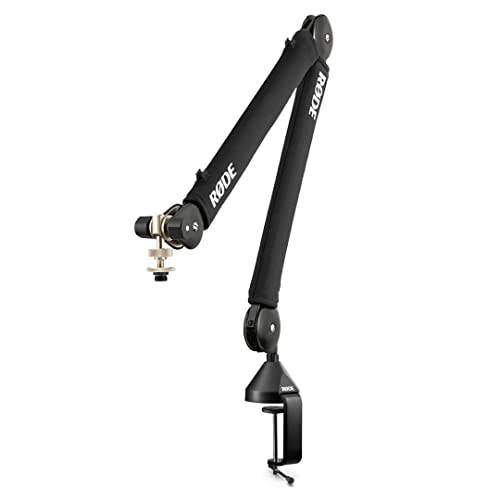
Best overall for XLR mics: Rode PSA1+
The Rode PSA1+ is a parallelogram spring arm with a horizontal reach of 940 mm and a vertical reach of 860 mm, per Rode’s datasheet. It supports loads from 94 g to 1.2 kg, rotates 360 degrees, weighs about 1.52 kg itself, and comes with a desk clamp for tops up to 70 mm and a threaded insert for tops up to 55 mm. It has a 3/8 in mic thread with a 5/8 in adapter included, and integrated channels that carry both USB and XLR cables.
- Who it suits: podcasters using an SM7B, PodMic or similar heavy dynamic microphone, and anyone recording in a quiet room where arm noise would be audible.
- Pros: damped springs that reviewers describe as silent when the arm is moved mid-recording, a reach long enough for large desks, and strong build quality.
- Cons: it sits at the top of the consumer price range, it is heavy, and the 1.2 kg ceiling is lower than the Elgato Pro’s. Some retailers still list the older PSA1 figures (shorter reach, smaller range), so check that you are reading PSA1+ data.
Best for heavy mics and smooth moves: Elgato Wave Mic Arm Pro
The Elgato Wave Mic Arm Pro replaces coil springs with a gas spring and is rated for up to 3 kg, according to Elgato. It has two 300 mm arm segments for about 750 mm of total length, a clamp that opens to 60 mm, and about 60 mm of surface clearance (100 mm with the riser). Elgato positions it for more advanced studio setups, with motion that is adjustable with one hand and no knobs to tighten.
- Who it suits: podcasters and streamers who change mic position often, use heavy broadcast mics with a large shock mount, or add a camera or light to the same arm.
- Pros: the highest load rating in this group, smooth and quiet motion, and a clean look.
- Cons: shorter reach than the PSA1+ or MK.2, a heavier arm at roughly 2 kg per Elgato’s comparison table, and a premium price tier. For a light mic the extra capacity is wasted.
Best mid-weight all-rounder: Elgato Wave Mic Arm MK.2
The Elgato Wave Mic Arm MK.2 is rated for 200 g to 1.2 kg per Elgato’s specification page, with 950 mm of horizontal reach and 850 mm of vertical reach, a 150 mm riser included in the box, and 360 degree rotation at the arm and head. The clamp opens to 60 mm (Elgato’s quick start guide says up to 63 mm, so the two documents differ slightly). It uses a 1/4 in mount with 3/8 in and 5/8 in adapters and silent springs with built-in cable channels.
- Who it suits: people with a USB microphone or a mid-weight dynamic mic who want a long reach and a clean desk.
- Pros: long reach, easy adjustment without knobs, and an all-metal build.
- Cons: the 1.2 kg limit leaves less headroom than the Pro for heavy rigs, and its price tier overlaps with the Rode PSA1+, which has comparable reach and a longer track record.
Best low-profile arm: Elgato Wave Mic Arm LP
The Elgato Wave Mic Arm LP is a low-profile arm rated for up to 2 kg including the microphone and accessories, per Elgato’s materials. Independent reviews put its reach near 740 mm, so treat that figure as approximate. It has a clamp that expands to 60 mm, tension-adjustable joints with manual knobs, and 1/4, 3/8 and 5/8 in thread adapters.
- Who it suits: streamers and video-call users who want the microphone to sit below the camera line, and anyone who wants the arm out of the shot.
- Pros: a sleek profile, a 2 kg rating that handles most podcast mics, and easy cable routing.
- Cons: a recurring complaint in reviews is that the magnetic cable channel lids can pop open when a USB cable is under tension, and the shorter reach limits placement on deep desks. Reports on its weight and rating also differ across sellers, so confirm the load before pairing it with a heavy mic.
Best for a clean look: Blue (Logitech G) Compass
The Compass is an extruded aluminum arm with internal springs, a hidden cable channel wide enough for XLR according to reviewers, and a 360 degree rotation. It holds up to 2.4 lb (about 1.1 kg) including the microphone and shock mount, reaches about 32 in (810 mm), and clamps to the desk with a C-clamp. It has 5/8 in threading with a 3/8 in adapter, and friction hinges that tighten by hand.
- Who it suits: podcasters who want a polished tube-style arm without the premium price tier, and owners of Blue microphones.
- Pros: quiet operation, enclosed cabling, and a sturdy aluminum build.
- Cons: available only in black, coverage by reviewers is older, and the 1.1 kg rating leaves less margin than the PSA1+ for the heaviest dynamic microphones.
Best budget low-profile arm: FIFINE BM88
The FIFINE BM88 is a low-profile all-metal arm with a 1.5 kg load limit, a maximum length of about 27.8 in (706 mm) in the manual, and a clamp for desks 20 to 60 mm thick. Its lower arm sits about 72 mm above the desk and the upper arm about 157 mm. It ships with 1/4, 3/8 and 5/8 in thread adapters, hidden cable channels and a spring-loaded ratchet clamp. Joint tension is set with an Allen key.
- Who it suits: podcasters on a budget, small-desk setups, and anyone who wants a streamlined arm that holds an SM7B-weight microphone.
- Pros: the lowest cost for a low-profile design, a capacity high enough for most dynamic mics, and a compact reach that suits small desks.
- Cons: reviews describe movement that is less smooth than spring-damped arms, joints that need occasional tightening, and lower long-term durability than the Rode.
Best cheapest option: Neewer NW-35
The Neewer NW-35 is a scissor-style arm with external coil springs, rated for about 1.5 kg (3.3 lb) according to Neewer, with 360 degree horizontal rotation and a clamp whose opening varies by version, from about 45 mm on old listings to 70 mm on the current white version. It extends to about 800 mm and comes with a 3/8 to 5/8 in adapter and cable straps; some bundles also include a shock mount or pop filter.
- Who it suits: first-time podcasters, light condenser or dynamic mics, and anyone who needs a working arm now and will upgrade later.
- Pros: by far the lowest cost in this group and an easy setup.
- Cons: exposed springs can creak and may be picked up by sensitive condenser microphones, the cable stays outside the arm, and it is not suited to heavy rigs or large USB mics like the Blue Yeti. Specifications differ between versions, so verify the exact listing.
Decision matrix: pick by mic and desk
| Your situation | Best match | Reason |
|---|---|---|
| Shure SM7B or Rode PodMic on a deep desk | Rode PSA1+ | 940 mm reach, 1.2 kg range, damped springs |
| Heavy mic plus camera or light on the arm | Elgato Wave Mic Arm Pro | 3 kg gas spring |
| Shure MV7-class mic, long reach | Elgato Wave Mic Arm MK.2 | 950 mm reach, 200 g minimum load |
| Streaming setup where the mic must stay below the camera | Elgato Wave Mic Arm LP | Low-profile design, 2 kg rating |
| Small desk, light budget, SM7B | FIFINE BM88 | Compact, 1.5 kg capacity |
| Minimal spend, light mic | Neewer NW-35 | Cheapest working arm |
| Preference for tube-style aluminum look | Blue (Logitech G) Compass | Internal springs, hidden cable path |
Worked example: sizing an arm to a PodMic setup
Say you record with a Rode PodMic (about 937 g) in a shock mount (about 150 g) and a pop filter (about 50 g). The load is roughly 1,137 g, or 1.14 kg. On the Rode PSA1+ (maximum 1.2 kg) that is about 95 percent of the limit, which is too close for comfort. Springs sag over months, and any addition would push you over. On the Elgato Wave Mic Arm MK.2 (1.2 kg) the margin is the same. On the FIFINE BM88 (1.5 kg) the load is 76 percent, which works. On the Elgato Pro (3 kg) it is 38 percent, which gives plenty of headroom. This is why heavy brass-bodied mics often pair better with arms rated above 1.5 kg, even though the SM7B at 765 g fits the 1.2 kg arms comfortably.
Now check reach. If your monitor sits 350 mm from the desk edge and your mouth is 600 mm from the edge, a 740 mm arm needs to fold only partly, which leaves room for adjustment. If you stand and your mouth is 900 mm from the edge, you need a 950 mm arm or a standing-desk mounting position.
How to install and set up a mic arm
- Weigh the full microphone assembly. Include shock mount, pop filter and cable weight. Use a kitchen scale for accuracy.
- Measure the desk edge. Confirm the desktop thickness and the free space under the edge match the clamp opening.
- Clamp the arm at the rear or side of the desk. Keep it away from the keyboard so keystrokes are not transferred through the desk into the mic.
- Attach the mic and set the spring tension. Tighten the joint knobs until the arm holds position without drooping, then back off slightly so you can still move it.
- Route the cable along the arm. Leave a loop of slack at each joint so the cable does not pull the arm out of position, and tape or clip it at the base.
- Position the microphone. For dynamic mics, put it 5 to 10 cm from your mouth, slightly off axis to cut plosives. Record 30 seconds, listen for thumps and adjust.
Durability and ownership realities
- Springs relax over time. Coil springs lose tension, so an arm that holds a mic today may droop after a year. Choose a rating with headroom.
- Clamps scratch desks. Metal clamps can mark wood or glass. Add a thin rubber pad under the clamp pad.
- Knobs and joints loosen. Budget arms like the BM88 and NW-35 need periodic tightening with an Allen key or knob.
- Cable lids can open. Magnetic or snap-in cable covers, like those on the Elgato LP, may release if the cable is stiff. Use a more flexible cable or add a clip.
- Warranty and spares. Check whether the manufacturer sells replacement springs, clamps or adapters before choosing a model.
Common mistakes to avoid
- Choosing by price alone and ignoring the rated load.
- Buying an arm that is too heavy-duty for a light USB mic, which then never stays in position.
- Clamping to a desk thicker than the clamp opening.
- Letting the cable hang free, which can transmit bumps into the recording.
- Reading specs for the original PSA1 or other older revisions instead of the current model.
Frequently Asked Questions
How much weight should a podcast mic arm hold?
Choose an arm whose rated range comfortably includes your microphone, shock mount and pop filter, ideally using 30 to 90 percent of the maximum. A Shure SM7B at roughly 765 g fits most arms rated for 1.2 kg or more, while a Rode PodMic at about 937 g is better on an arm rated for 1.5 kg or more.
Are low-profile mic arms good for podcasting?
Yes, if the reach suits your desk. Low-profile arms such as the Elgato Wave Mic Arm LP and FIFINE BM88 keep the mic below your line of sight and out of camera shots, but their shorter reach can limit placement on deep desks.
Will a mic arm pick up keyboard noise?
It can, because vibrations travel from the desk through the clamp into the arm. Mount the arm away from your typing area, use a shock mount for the microphone, and choose an arm with damped springs or a gas spring for lower mechanical noise.
Can I use a mic arm with a standing desk?
Yes, as long as the clamp fits the desktop thickness and the arm’s vertical reach covers your standing height. Arms with a vertical reach of about 850 mm or more, such as the Rode PSA1+ and Elgato MK.2, give the most flexibility.
What thread size do microphones use?
Most professional microphones and shock mounts use a 5/8 in thread, and many consumer and USB mics use 3/8 in or 1/4 in. Arms usually include adapters, but check that the arm you choose lists the thread your microphone or shock mount needs.
Is a gas spring arm better than a coil spring arm?
Gas spring arms such as the Elgato Wave Mic Arm Pro move smoothly and handle a wide range of loads, but they cost more and weigh more. Well-damped coil spring arms like the Rode PSA1+ are very quiet and are often enough for a single dynamic microphone.






Write Your Review
No reviews yet. Be the first to share your experience!