

Key takeaways
- Shine: ABS develops a glossy patch on frequently used keys over time. PBT resists this but can wear more slowly with a matte look.
- Cleaning: Pull the caps with a puller, wash them in warm water with mild soap, and air-dry completely before refitting. Avoid solvents on printed legends.
- Stem fit: Tight stems can make caps hard to remove. Use a wire puller and pull straight up to prevent bending a switch stem.
- Row height: A tall profile like ASA or MT3 raises wrist angle. A wrist rest helps.
- Backlight: Shine-through legends only work with sets designed for it. Opaque caps block backlight bleed.
- Return policy: Group-buy and themed sets often have limited returns. Check before opening.
The best custom keycap set for most mechanical keyboards in 2026 is a thick Cherry-profile double-shot PBT set from a maker such as ePBT or Akko, because it delivers a deep sound, lasting legends and a standard fit for far less than a group-buy set. If you want the enthusiast reference, GMK’s Cherry-profile double-shot ABS sets remain the benchmark for colour and sharp legends, and sculpted profiles such as MT3 and ASA suit people who want a distinctive typing feel. This guide compares seven keycap families by material, thickness, profile and compatibility so you can match a set to your board.
Our top picks


As an Amazon Associate we earn from qualifying purchases at no extra cost to you.
Quick comparison of keycap sets
| Pick | Best for | Material and method | Profile | Typical thickness | Price tier |
|---|---|---|---|---|---|
| GMK Cherry-profile sets | Premium reference | Double-shot ABS | Cherry | 1.5mm | Premium |
| ePBT Cherry sets | Best overall PBT | Dye-sublimated PBT | Cherry | About 1.5mm | Mid-range |
| Akko Cherry Profile PBT | Best value double-shot | Double-shot PBT | Cherry | About 1.5mm | Budget |
| Akko ASA | Best sculpted budget | Dye-sublimated PBT | ASA | 1.5mm to 1.6mm | Budget to mid-range |
| Keychron Double Shot Cherry PBT | Best Keychron match | Double-shot PBT | Cherry | About 1.2mm to 1.5mm | Budget |
| Drop MT3 sets | Best deep sculpted profile | Double-shot ABS or PBT | MT3 | 1.2mm/1.8mm ABS, 1.5mm PBT | Premium |
| XVX MOA sets | Best themed budget | Dye-sublimated PBT | MOA | Varies | Budget |
Thickness figures come from manufacturer pages and community databases, and several sources disagree by a few tenths of a millimetre. Use them to compare families rather than as exact specifications for every set.
How to choose keycaps: the four decisions that matter
Keycaps look like a purely visual upgrade, but four technical choices determine how they type and sound. The first is material. ABS plastic takes colour well and gives sharp, bright legends. PBT is denser, resists shine and usually sounds deeper. The second is how the legends are made: double-shot caps are moulded from two plastics so the legend is part of the cap, while dye-sublimation bonds ink into the plastic, which is only possible with PBT. The third is profile, the shape and height of each row. The fourth is the layout the set supports, which decides whether every key on your board gets a cap.
Thickness is the shortcut for sound. A cap of 1.5mm or more usually produces a lower, rounder tone than a 1.2mm cap, because the extra wall mass damps the high-frequency ring of the plastic. Compatibility is the shortcut for frustration. Almost every modern hot-swap keyboard uses MX-style stems, but layouts differ, and a set that lacks a 2.25u left shift, a split backspace or an ISO enter will leave gaps.
Best premium reference: GMK Cherry-profile sets
GMK’s Cherry-profile sets are the original reference for the genre. GMK says its keycaps are 1.5mm thick ABS with double-shot legends that never fade. The company’s CYL range is where the Cherry profile began. Compared with typical PBT, ABS has a fuller sound, more vibrant colours and sharper legends, but it is less resistant to shine over years of use.
The appeal is the design quality. GMK sets are released through community designs and often through group buys, with long waits and strict limited runs. Retail stock of past designs does appear, and for many buyers that is the practical way to buy. Expect a large, well-organised kit covering many layouts, but also expect to pay the highest price in this guide.
Who it suits: enthusiasts who want the best colour accuracy, crisp legends and strong resale value. Main trade-off: price, waiting times, and ABS shine on frequently used keys.
Best overall PBT: ePBT Cherry sets
ePBT, short for EnjoyPBT, is a brand specialising in thick Cherry-profile PBT. Its sets are usually dye-sublimated with a matte finish and about 1.5mm walls, based on published descriptions. They tend to sound deeper and softer than ABS and avoid the oily shine that develops on ABS over time.
Dye-sublimated legends are not as sharp as double-shot legends at fine sizes, and some very dark colours can show slightly fuzzy edges on small characters. In practice, most users find the legends clear, and the texture feels pleasant to the touch. Colourways range from muted to bold, and base kits usually cover popular layouts, with novelty and numpad extras sold separately.
Who it suits: typists and gamers who want a long-lasting, deep-sounding set without waiting for a group buy. Main trade-off: legends are less crisp than double-shot sets.
Best value double-shot: Akko Cherry Profile PBT
Akko’s Cherry-profile PBT sets are genuine double-shot caps, which is unusual at a budget level. A double-shot PBT cap has a legend moulded through the thickness, so it cannot rub away, and it keeps the benefits of PBT. They typically come in common layouts with extra keys for 60 percent, TKL and full-size boards.
The weak points are consistency and fit. Some users report that stabilised keys such as the spacebar can be a little tight on certain stabilisers, and that colour batches can differ slightly. Test-fit a few keys on your board before pressing everything on. For the price, it is one of the easiest ways off stock ABS keycaps.
Who it suits: first-time upgraders and budget builds. Main trade-off: less refined colour matching and occasional fit issues.
Best sculpted budget: Akko ASA
Akko’s ASA keycaps are a dye-sublimated PBT set with a sculpted profile that sits taller than Cherry and shorter than the extra-tall SA family. Listings show around 158 keys at 1.5mm, though another source lists 1.6mm, so thickness depends on the specific set. The profile has a spherical top that suits people who like a slightly more cushioned feel.
ASA works best on boards with a low case or a lower typing angle, because the taller caps raise your hands. It is also less friendly to compact keyboards with tight rows. The set’s strength is that it adds a distinctive feel without the group-buy waits associated with SA-style sets.
Who it suits: people who want a different feel from Cherry at a moderate cost. Main trade-off: height and a less standard shape, so test with your wrist rest.
Best match for Keychron boards: Keychron Double Shot Cherry PBT
Keychron sells a Double Shot Cherry PBT set that covers a wide range of layouts, with 219 keys listed to fit 60 percent through full-size layouts, including HHKB, ISO and Windows-key-less variants. All Keychron boards use MX-compatible stems, so any standard set fits. However, Keychron’s K-series boards use north-facing switches, and Cherry-profile caps can interfere on some rows. Q-series and V-series boards use south-facing switches and work well.
One reviewer noted that the caps can scratch during installation and that some keys show shine over time, so handle the set carefully and use a keycap puller rather than prying with your fingers. As a bundled upgrade for a Keychron board, the layout coverage is the main selling point.
Who it suits: Keychron owners who want a ready-made upgrade. Main trade-off: not the thickest set, and possible clearance issues on K-series boards.
Best deep sculpted profile: Drop MT3 sets
MT3 is a deeply sculpted profile with a dish that cradles the fingertip. Drop’s MT3 sets are available in double-shot ABS at 1.2mm for most walls and 1.8mm in places, according to community specifications, and in a PBT version at 1.5mm with a rougher typing surface. Many typists love the feel because the tall, dished rows give strong tactile guidance.
The profile is taller than Cherry and the rows are much more varied, so you need a full set to avoid a mismatched surface. MT3 is tied to specific sets and layouts, so check that the kit includes the modifiers your board needs.
Who it suits: typists who prefer a dished, sculpted feel. Main trade-off: taller profile and less compatibility with unusual layouts.
Best themed budget: XVX MOA sets
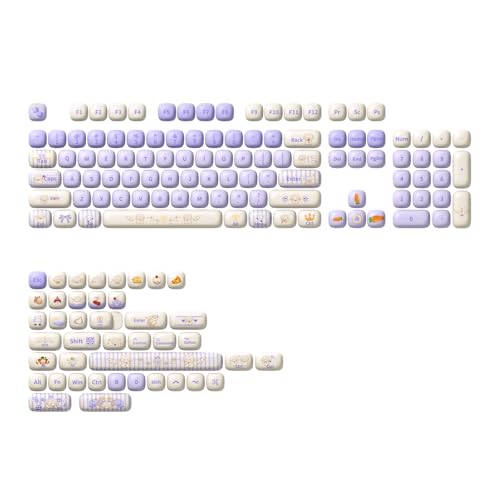
MOA is a tall, uniform profile with a rounded top, and XVX sells MOA-profile PBT sets in themed designs such as Sakura and Fuji Mountain. Listings show sets of 142 keys. MOA’s uniform row heights make a layout simpler to swap, since most rows share the same height. That also means row-specific ergonomics are less pronounced than on Cherry.
These themed kits are best treated as a way to personalise a board for a low outlay. Check which modifiers and extras are included, because themed sets sometimes skimp on rarely used keys.
Who it suits: buyers who care about design and want PBT at a low cost. Main trade-off: mixed legend quality and limited layout coverage.
Decision matrix: match the set to your situation
| Your situation | Choose | Reason |
|---|---|---|
| Want the sharpest legends and richest colour | GMK ABS double-shot | Best colour accuracy and legend detail |
| Want a deep sound that lasts years | Thick PBT (ePBT) | Resists shine and sounds muted |
| Tight budget | Akko Cherry PBT or XVX MOA | Low cost with PBT durability |
| Own a Keychron Q or V board | Keychron Cherry PBT | Layout coverage and fit |
| Prefer a taller, cushioned profile | Akko ASA | Sculpted feel without a group buy |
| Heavy typist who likes a dish | MT3 | Deep sculpt guides the fingertip |
| Low-profile or compact board | Cherry or similar low profile | Keeps hand height reasonable |
Worked example: counting the keys you actually need
Before buying, count your layout. A 60 percent ANSI board needs 61 keycaps, a 75 percent board around 82 to 84, a tenkeyless board 87 and a full-size board 104. Now add the special sizes. A standard ANSI set needs a 1.75u caps lock, a 2.25u left shift, a 2.75u right shift, a 6.25u spacebar and a 2u backspace. If your set offers an ISO enter or split shift, you may not need those kits. A base kit of about 120 to 150 keys usually covers all common layouts, while a 219-key set such as Keychron’s covers HHKB, ISO and Windows-key-less cases as well.
If your board has a unique layout, such as a split spacebar or a 65 percent with a 1u right shift, check the set’s layout diagram on the product page. A missing 1u key can mean a mismatched cap on an otherwise perfect set.
Ownership realities: cleaning, wear and compatibility
- Shine: ABS develops a glossy patch on frequently used keys over time. PBT resists this but can wear more slowly with a matte look.
- Cleaning: Pull the caps with a puller, wash them in warm water with mild soap, and air-dry completely before refitting. Avoid solvents on printed legends.
- Stem fit: Tight stems can make caps hard to remove. Use a wire puller and pull straight up to prevent bending a switch stem.
- Row height: A tall profile like ASA or MT3 raises wrist angle. A wrist rest helps.
- Backlight: Shine-through legends only work with sets designed for it. Opaque caps block backlight bleed.
- Return policy: Group-buy and themed sets often have limited returns. Check before opening.
Common mistakes
The most frequent error is buying a set that does not cover your layout. The second is choosing a profile that clashes with the board: a tall set on a high-case board can leave your wrists at an uncomfortable angle. The third is paying group-buy prices for a set when a retail PBT alternative would meet your needs. Finally, do not judge sound by the keycap alone, as plate material, foam and switch type shape the sound at least as much.
Keycap profiles explained
Profile describes the height and curvature of each row. Cherry profile is a low, sculpted shape with a gentle dish, and it is widely regarded as the best all-round choice because the height difference between rows is moderate and your fingers stay close to the switches. OEM is similar but taller and found on most stock keyboards. SA and its relatives, including Akko’s ASA, are tall and spherical, which gives a distinctive cushioned feel but changes wrist angle. MT3 has a deep dish and a high profile that rewards touch typists. MOA has a uniform row height, which makes it easy to rearrange rows but takes away the ergonomic stepping of a sculpted profile.
Low-profile switches use a separate family of keycaps, so a standard set will not fit a board such as the NuPhy Air75 HE. Always confirm whether your board takes full-height MX-stem caps or a low-profile design before browsing any set.
Step by step: swapping a keycap set safely
- Photograph the layout. Take a photo of the current keys so you can restore unusual positions like split shifts later.
- Remove the old caps with a wire puller. A wire puller grips under the cap evenly. Pulling with fingernails or a flat tool can crack stems and scratch the plate.
- Check the switch stems. Look for bent or cracked stems before fitting new caps. A damaged stem is easier to replace now than after a new set is on.
- Sort the new set by row. Cherry-style rows are labelled R1 to R4, and sorting avoids placing a key on the wrong row.
- Fit the modifiers first. Test the large keys, such as shift, enter and spacebar, to check stabiliser clearance before pressing the rest.
- Press straight down. Push each cap with even pressure until it seats. Angled pressure can bend a stem.
- Test every key. Use a key tester web page to confirm all keys register and none stick.
What really shapes the sound
People often buy a keycap set expecting a different sound, then discover the result depends on the whole board. Keycaps change the high-frequency character, so thick PBT usually sounds deeper and ABS slightly brighter. The plate and case change the low-frequency body of the sound. Switches determine the click or thock at the point of bottom-out. Foam inside the case and a layer under the PCB remove echo. If you want a deeper sound, a thick set helps, but it works best alongside a case that is not hollow.
Typing feel follows the same logic. A smooth dished profile makes fast typing easier, while a flat or uniform profile can feel less guided. Texture also matters. Dye-sublimated PBT tends to have a fine grain that gives grip, while double-shot ABS is smoother and can feel slick when your fingers are warm. Many players keep a small set of replacement caps for the keys they use most, such as WASD, so a worn key can be replaced without buying a complete set.
Frequently Asked Questions
Are PBT keycaps better than ABS?
PBT is denser and resists shine, and it usually sounds deeper. ABS takes colour and crisp legends better. Neither is universally better, and a thick well-made ABS set can outperform a thin PBT set.
What is the difference between double-shot and dye-sublimated keycaps?
Double-shot caps have the legend moulded into the cap from a second plastic, so it cannot wear off. Dye-sublimated caps have ink bonded into the surface, which is only possible with PBT and can fade after years of heavy use.
What keycap profile should I choose?
Cherry is the standard choice and suits most people. Sculpted profiles like MT3 and ASA feel different, and low profiles suit compact setups. Pick the one that matches your preferred hand height.
Will any keycap set fit my keyboard?
Most hot-swap and mechanical boards use MX-style stems, so physical fit is rarely an issue. Layout is the real check, along with clearance on boards with north-facing switches.
How thick should keycaps be?
Around 1.5mm is a good target for a deep, muted sound. Thinner 1.2mm caps tend to sound brighter. Thickness is a guide, not a guarantee, so compare with reviews of the specific set.
How do I clean keycaps without damaging the legends?
Remove them with a puller, wash with warm water and mild soap, and dry fully. Avoid alcohol or strong solvents on printed legends. Double-shot caps tolerate cleaning best.



Write Your Review
No reviews yet. Be the first to share your experience!