
Our Short List of 3
All 3 Picks at a Glance
| Product | Specs | Action |
|---|---|---|
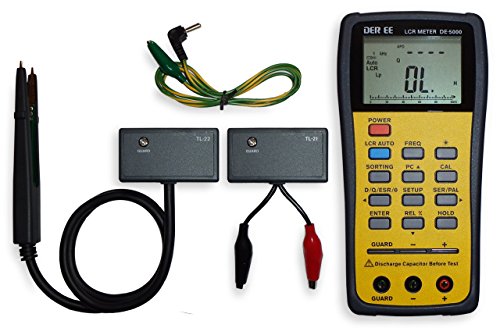 DER EE DE-5000 | Check price on Amazon | |
 FNIRSI LC1020E | Check price on Amazon | |
 UNI-T UT612 | Check price on Amazon |
Key takeaways
- Compare the 3 best LCR meters for electronics component testing, with real Amazon picks, test frequencies, and what to check before you buy one.
A multimeter tells you whether a resistor is roughly right, but it cannot measure inductance or capacitance with any precision, and that gap shows up the moment you sort parts, check a batch of capacitors, or chase a fault in a filter circuit. An LCR meter measures inductance, capacitance, and resistance directly, and a good handheld one reads all three at several test frequencies, so you can see how a part behaves rather than guessing from a single number. For bench work and repair, that is the difference between knowing a part is good and merely hoping it is.
This guide compares three precision handheld LCR meters in the 100 kHz class: a reference-grade meter with Kelvin leads and sorting, a value pick with a modern color display, and a mid-range UNI-T meter with a wide measurement range. Each one measures at the same five test frequencies, and each one suits a different kind of electronics work.
As an Amazon Associate, we earn from qualifying purchases.
Quick Answer
For most electronics work, the DER EE DE-5000 is the meter to buy first: five test frequencies, 4-wire Kelvin measurement, and a sorting mode that speeds up batch checking. The FNIRSI LC1020E is the value pick, with a color display and USB-C at a lower tier. The UNI-T UT612 covers the widest measurement range of the three and suits anyone who needs large inductance and capacitance values.
DER EE DE-5000
The DER EE DE-5000 is the reference-grade pick of this guide, and its strength is measurement you can trust across a whole bench session. It tests at five frequencies, 100 Hz, 120 Hz, 1 kHz, 10 kHz, and 100 kHz, so a capacitor or inductor can be checked at the frequency it will actually work at rather than at one fixed tone. The dual display shows 19,999 counts on the primary reading and 1,999 counts on the secondary, which keeps both the main value and a secondary parameter like D, Q, or ESR visible at once.
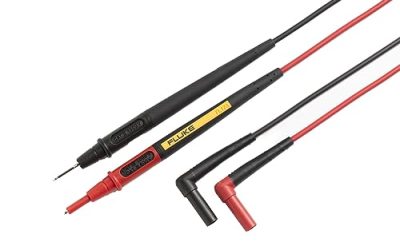
The part that makes this meter stand out for sorting work is its 4-wire Kelvin connection, which separates the current and sense leads so lead resistance does not pollute small resistance readings. Combined with the sorting mode, which bins parts against set limits, it turns a tedious afternoon of checking components into a fast pass-or-fail routine. The TL-21 alligator clips and TL-22 SMD tweezers come as a bundle with the meter, which matters because multiple listings of this meter exist with different bundles, and this is the TL-21 plus TL-22 bundle exactly. AUTO-LCR mode picks the right measurement type on its own, and an optional IR-USB link moves readings to a computer. A 9 V battery powers the unit.
FNIRSI LC1020E
The FNIRSI LC1020E is the value pick of this guide, and it earns that place by covering the same five test frequencies as the reference meter while adding the kind of modern touches a daily-use tool should have. It measures at 100 Hz, 120 Hz, 1 kHz, 10 kHz, and 100 kHz, with 19,999 counts of resolution, and it shows ESR, Q, D, theta, and reactance on a dual display so a capacitor’s losses are visible alongside its value. Three test levels, 0.1, 0.3, and 0.6 V, let the meter probe sensitive parts gently, and DC bias support opens up measurements on parts that behave differently under a steady voltage.
The hardware is built for the bench. Kelvin jacks and a component socket give a solid connection for leaded parts, and open and short calibration keeps readings honest before a measurement session starts. The 2.8-inch TFT display is easy to read at arm’s length, USB-C handles charging and data, and the sorting mode bins parts the same way the reference meter does. This is the pick for someone who wants full-frequency LCR measurement without paying the reference-grade tier, and who values a readable screen and a modern connector over the extra refinement of the DE-5000.
UNI-T UT612
The UNI-T UT612 is the mid-range pick of this guide, and its case is range. It measures inductance from 20 microhenries all the way to 2000 henries, capacitance from 200 picofarads to 20 millifarads, and resistance from 20 ohms to 200 megaohms, which covers everything from tiny SMD inductors to large power capacitors and high-value resistors. Accuracy is stated as plus or minus 0.5 percent plus 5 counts for inductance and capacitance, and plus or minus 0.3 percent plus 5 counts for resistance. All five test frequencies are covered, 100 Hz, 120 Hz, 1 kHz, 10 kHz, and 100 kHz, at a 0.6 Vrms test level.
The display reads 20,000 counts on the primary value and 2,000 counts on the D and Q secondary values, and the meter covers inductance, capacitance, resistance, DCR, Q, D, theta, and ESR in one unit. Auto LCR check picks the measurement type, the LCD has a backlight for dim benches, and a USB interface moves data to a computer. Output impedance is 120 ohms. This is the meter for a bench that sees the full spread of part sizes, from small signal parts to large power components, and for anyone who wants one handheld meter that does not run out of range halfway through a job.
How to Choose
Start with test frequency, because it decides whether the meter measures parts the way they will actually be used. A capacitor that looks fine at 1 kHz can show very different losses at 100 kHz, and an inductor’s value shifts with frequency too. All three picks in this guide cover the same five frequencies from 100 Hz to 100 kHz, which is the right span for general electronics work. Any meter that tops out at 10 kHz or a single frequency is a different class of tool, and it will not answer questions about high-frequency behavior.
Next, look at the connection method. Four-wire Kelvin measurement separates the current and sense paths, which matters most when measuring low resistances or small inductances, where the resistance of the test leads themselves would otherwise swamp the reading. If the work is mostly sorting small parts or checking low-value resistors and inductors, Kelvin leads or jacks are worth having. For larger parts and general checking, a standard two-wire connection with a component socket is often enough, and the socket makes swapping parts faster.
Then weigh the display and the secondary parameters. A meter that shows only the primary value forces you to switch modes to see dissipation factor, quality factor, or ESR, while a dual display shows both at once. ESR matters most when checking electrolytic capacitors, since a capacitor can read the right capacitance and still be failing through high series resistance. Sorting mode is the other feature that saves real time: it bins parts against limits, so a batch of components can be checked in minutes instead of one slow reading at a time.
Finally, check the measurement range against the parts you actually handle. A meter with a narrow inductance range is fine for signal work but useless for power inductors, and a meter that stops at a few millifarads cannot check large filter capacitors. The UNI-T pick in this guide covers the widest range of the three, while the other two cover the standard spread for general electronics. Match the range to the bench, not to the spec sheet, and make sure the meter’s test level suits sensitive parts if low-voltage components are part of the work.
Who Should Skip
Skip this guide entirely if the work is only checking whether a resistor is open or a capacitor is shorted, because a basic multimeter already answers those questions and an LCR meter adds nothing. Skip the DE-5000 if the budget is tight and the work is occasional, since its Kelvin leads and sorting mode earn their keep only with regular use. Skip the UT612 if the bench never sees large inductors or high-value resistors, because its wide range is wasted on small signal parts. Skip the LC1020E if a plain monochrome display and a simpler interface are preferred, since its color screen and extra modes are conveniences rather than necessities. And skip any handheld LCR meter as a substitute for a bench instrument when the work demands laboratory-grade accuracy, because handheld meters trade a little precision for portability.
FAQ
What does an LCR meter measure that a multimeter cannot?
An LCR meter measures inductance and capacitance directly, with accuracy and test-frequency control a multimeter does not offer. A multimeter can check resistance and continuity, and some can estimate capacitance, but they cannot measure an inductor’s value or a capacitor’s losses at a chosen frequency. For sorting parts, checking filter components, or verifying a batch of capacitors, an LCR meter is the right tool.
Why do LCR meters test at several frequencies?
A part’s behavior changes with frequency: a capacitor’s losses rise, an inductor’s effective value shifts, and the equivalent series resistance becomes more visible at higher frequencies. Testing at 100 Hz, 1 kHz, and 100 kHz shows how the part performs across its working range. A single-frequency reading can hide problems that only appear at the frequency the circuit actually uses.
What is a Kelvin connection and why does it matter?
A Kelvin connection, also called four-wire measurement, uses separate pairs of leads for current and voltage sensing, so the resistance of the test leads does not add to the reading. It matters most for low resistances and small inductances, where lead resistance would otherwise dominate the result. For larger parts the effect is small, but for precision sorting of small components it is the difference between a trustworthy reading and a misleading one.
What is ESR and why should I check it?
ESR, or equivalent series resistance, is the resistance inside a capacitor that turns some of the signal into heat. A capacitor can read the correct capacitance and still be failing because its ESR has risen, which is the classic failure mode of aging electrolytic capacitors. An LCR meter that displays ESR alongside capacitance catches that failure directly, which is why the dual display on all three picks in this guide matters.
Final Verdict
For most electronics work, the DER EE DE-5000 is the meter to buy first: five test frequencies, 4-wire Kelvin measurement, and a sorting mode that makes batch checking fast. Add the FNIRSI LC1020E when the budget is tighter and a color display with USB-C is wanted, or the UNI-T UT612 when the bench needs the widest measurement range of the three. Whichever is chosen, check parts at the frequency they will work at, calibrate before a session, and let ESR tell you what capacitance alone cannot.
Product and ASIN Reference
| Product | ASIN |
|---|---|
| DER EE DE-5000 | B00S298KJO |
| FNIRSI LC1020E | B0FL7QG7MX |
| UNI-T UT612 | B0C96ZWKTS |
More from Amazon
Programs that pair well with the guide above. Offers and eligibility are set by Amazon and may change.
Free shipping on eligible items, Prime Video and more. Eligible new members can start with a free trial.
Start a Prime free trialAd-free music streaming. Eligible new subscribers can start with a free trial.
Try Music Unlimited freeA Prime membership for ages 18-24 with a trial period. Eligibility is set by Amazon.
See Prime for Young AdultsAudiobooks and podcasts to listen to on the go. Eligible new members can start with a free trial.
Try Audible freeAs an Amazon Associate we earn from qualifying purchases.

Write Your Review
No reviews yet. Be the first to share your experience!