
Our Short List of 3
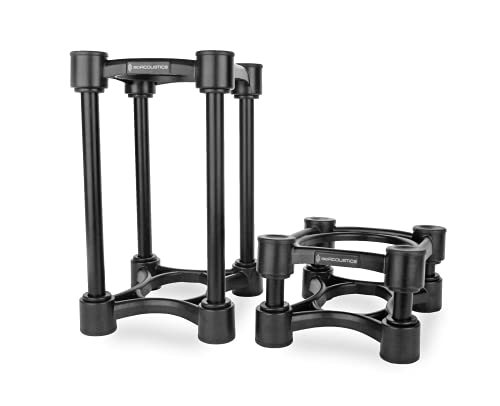
- Best for: Small monitors on a desk that need isolation.
- Isolation stands for small studio monitors
- Sold as a pair
- Height settings 2.8 or 8.25 inches
- Tilt up to 6.5 degrees

- Best for: Medium monitors that outgrow the smaller ISO-130.
- Isolation stands for medium studio monitors
- Sold as a pair
- Height settings 3 or 8.25 inches
- Tilt up to 6.5 degrees

- Best for: Producers who want monitors off the desk at ear height.
- Floor stands for near-field studio monitors
- Sold as a pair
- Height adjustable 36.5 to 54 inches
- Platform 9.5 x 9.5 inches
All 4 Picks at a Glance
| Product | Specs | Action |
|---|---|---|
| IsoAcoustics ISO-130 |
| Check price on Amazon |
| IsoAcoustics ISO-155 |
| Check price on Amazon |
| On-Stage SMS6000-P |
| Check price on Amazon |
 Kanto SP26PLW |
| Check price on Amazon |
Key takeaways
- Find the best studio monitors stands: four floor and desktop stands compared on height, weight capacity, isolation and fit for studio speakers of every size.
A studio monitor sounds only as good as the surface it sits on, because a speaker on a desk passes vibration into the furniture and loses low-end clarity. The right stand lifts the tweeter to ear height, decouples the cabinet from the desk or floor, and holds the speaker steady at the listening position. Picking one means matching the stand height to your seat, the weight capacity to your speakers, and the footprint to the room, since a stand that wobbles or sits too low wastes the money spent on the monitors.
This guide is for home-studio owners setting up a first mixing desk, for producers moving monitors off the desk and onto floor stands, and for anyone whose speakers sit too low or too close to a wall. Each stand below was chosen from the names and specs on its Amazon page, with height range, weight capacity, platform size and isolation checked against the listing before it earned a place.
Quick Picks
As an Amazon Associate we earn from qualifying purchases
| Product | Best for | Key spec from title |
|---|---|---|
| IsoAcoustics ISO-130 | Small monitors on a desk | Height to 8.25 inches, 20 lb capacity |
| IsoAcoustics ISO-155 | Medium monitors on a desk | Height to 8.25 inches, 40 lb capacity |
| On-Stage SMS6000-P | Monitors off the desk | Height 36.5 to 54 inches, 90 lb capacity |
| Kanto SP26PLW | A tidy fixed-height setup | 26 inches tall, hidden cable routing |
How to Choose
Height and listening position
The tweeter should sit at ear height when you are seated at the desk, because a monitor aimed at your chest sounds dull and a monitor aimed above your head sounds thin. Floor stands place the speaker beside the desk at roughly 26 to 36 inches, which suits most seated listening positions, while desktop stands raise a small monitor by a few inches and tilt it toward your ears. Measure your seated ear height from the floor, then pick a stand whose range covers that number. A stand with a few inches of adjustment forgives a chair change later.
Weight capacity and stability
Weight capacity decides whether a stand holds the speaker safely, so check the rated limit against the speaker’s weight before you buy. A stand rated for 20 pounds suits a small 5-inch monitor, while a floor stand rated for 75 pounds or more suits heavy 8-inch monitors and leaves room for a larger upgrade. Stability matters as much as capacity: a wide base and a low centre of gravity keep the stand upright when a cable is tugged. Fillable columns add weight and calm resonance, and levelling feet steady the stand on uneven floors. Never trust a stand rated below the speaker it must carry.
Isolation and sound clarity
Isolation keeps the speaker’s vibration out of the desk and floor, so the low end stays tight instead of booming through the furniture. Desktop stands use isolators in the top and bottom frames, which let the speaker float on soft mounts rather than sitting hard on the desk. Floor stands decouple with rubber pads on the top plate and spikes or rubber feet below, and a fillable column damps resonance further. A stand that isolates well makes a modest monitor sound cleaner, while a rigid stand passes every thump into the room. Listen for tighter bass after the stand is fitted.
Platform size and cable routing
The platform must fit the speaker’s base with a little room to spare, because a platform smaller than the cabinet leaves the speaker overhanging and unstable. Check the platform dimensions against the speaker’s footprint, and remember that a rotating top plate helps angle the monitor toward the listening position. Cable routing keeps the setup tidy: hollow columns and channels hide power and audio cables, while clips on the back of a desktop stand keep short cables off the desk. A stand with hidden routing also makes it easier to move the speaker without unplugging everything.
The 4 Best Options
IsoAcoustics ISO-130
- Best for: Small monitors on a desk that need isolation.
- Isolation stands for small studio monitors
- Sold as a pair
- Height settings 2.8 or 8.25 inches
- Tilt up to 6.5 degrees
Small monitors on a desk that need isolation.
Measure the speaker base, since the platform is only 5.1 by 6 inches.
The ISO-130 is the desktop pick for small studio monitors that need isolation without a floor stand. Its patented isolators sit in the top and bottom frames, so the speaker floats on soft mounts instead of passing vibration into the desk, and the low end tightens noticeably once the monitor is fitted. Two height settings raise the speaker to 2.8 or 8.25 inches, and the tilt adjusts up to 6.5 degrees so the tweeter points at your ears. Each stand carries up to 20 pounds, which suits compact 5-inch monitors and desktop speakers.
IsoAcoustics ISO-155
- Best for: Medium monitors that outgrow the smaller ISO-130.
- Isolation stands for medium studio monitors
- Sold as a pair
- Height settings 3 or 8.25 inches
- Tilt up to 6.5 degrees
Medium monitors that outgrow the smaller ISO-130.
Check the speaker weight, since the 40-pound limit is per stand.
The ISO-155 is the step up for medium monitors that are too wide or too heavy for the ISO-130. Its larger platform measures 6.1 by 7.5 inches and carries up to 40 pounds per stand, which suits 6-inch and 7-inch studio monitors with room to spare. The same isolator design floats the speaker on soft mounts, and the height settings of 3 or 8.25 inches plus up to 6.5 degrees of tilt aim the tweeter at the listening position. The pair format means one box covers a stereo setup, and the stands suit desks and console tops alike.
On-Stage SMS6000-P
- Best for: Producers who want monitors off the desk at ear height.
- Floor stands for near-field studio monitors
- Sold as a pair
- Height adjustable 36.5 to 54 inches
- Platform 9.5 x 9.5 inches
Producers who want monitors off the desk at ear height.
The tall height suits standing positions too, so measure the seated ear height before setting the pin.
The SMS6000-P is the floor pick for producers who want the monitors off the desk and at ear height beside the mixing position. Its height adjusts from 36.5 to 54 inches with a security pin, so it suits seated and standing listening alike, and the 9.5-inch square platform carries speakers up to 90 pounds per stand. An 18-inch triangular base with levelling spikes keeps the stand steady on carpet, and foam padding on the platform grips the speaker without scratching the cabinet. The pair format covers a stereo setup in one box.
Kanto SP26PLW
- Best for: Rooms where a fixed 26-inch stand with hidden cables suits the layout.
- Floor stands for bookshelf speakers and studio monitors
- Sold as a pair
- 26 inches tall
- Rotating top plate with foam padding
Rooms where a fixed 26-inch stand with hidden cables suits the layout.
The height is fixed, so check 26 inches matches the seated ear height first.
The SP26PLW is the tidy pick for bookshelf and studio monitors that need a fixed 26-inch height with clean cable routing. Its steel column hides cables inside, the rotating top plate angles the speaker toward the listening position, and foam padding on the plate grips the cabinet without marking it. Carpet spikes and hardwood feet come in the box, so the stand suits either floor type, and the white finish blends with light-coloured rooms. A quarter-inch mounting hole on the top plate secures speakers that accept a threaded insert.
Which One Fits Your Situation
Small monitors on a desk
Pick the IsoAcoustics ISO-130 when the monitors sit on a desk and need isolation. Its soft mounts float the speaker off the desk, the two height settings and tilt aim the tweeter at your ears, and the 20-pound capacity covers compact 5-inch monitors. It is the simplest upgrade for a bedroom studio with a small desk.
Monitors off the desk
Pick the On-Stage SMS6000-P when the monitors must leave the desk entirely. Its adjustable height from 36.5 to 54 inches suits seated and standing positions, the 90-pound capacity holds heavy monitors, and the spiked base stays steady on carpet. The pair format covers a stereo setup in one box.
A tidy living-room setup
Pick the Kanto SP26PLW when the stands must look as good as they sound. Its white finish suits light rooms, the steel column hides cables, and the rotating top plate angles the speaker toward the sofa. The fixed 26-inch height suits seated listening, and the included feet cover carpet and hardwood floors.
Medium monitors that need room
Pick the IsoAcoustics ISO-155 when the monitors are too wide for the smaller ISO-130. Its larger platform and 40-pound capacity suit 6-inch and 7-inch monitors, the isolators keep the low end tight on the desk, and the height and tilt settings aim the tweeter at the listening position.
Common Mistakes
- Buying a stand rated below the speaker’s weight.
- Setting the tweeter above or below ear height and blaming the speaker.
- Placing the platform smaller than the speaker’s base and leaving it overhanging.
- Skipping isolation and letting the desk colour the low end.
- Forgetting to check the platform size before ordering a pair.
Frequently Asked Questions
How high should a studio monitor stand be?
The tweeter should sit at ear height when you are seated at the desk, which usually means a stand of 26 to 36 inches or a desktop stand that raises the speaker a few inches. Measure your seated ear height from the floor, then pick a stand whose range covers that number. A stand with height adjustment forgives a chair change later.
Do studio monitor stands improve sound?
Yes, a good stand improves what you hear by lifting the tweeter to ear height and keeping vibration out of the desk and floor. Isolation tightens the low end and clears the stereo image, while a stand at the wrong height can make a monitor sound dull. The stand does not change the speaker itself, but it lets the speaker work as designed.
Can I use speaker stands for studio monitors?
Yes, most speaker stands suit studio monitors as long as the platform fits the speaker base and the weight capacity covers the monitor. Check the platform dimensions and the rated limit before buying, since a bookshelf stand built for light speakers may not hold a heavy 8-inch monitor. Floor stands with wide bases suit the heaviest models best.
Should I fill my monitor stands with sand?
Filling a hollow column with dry sand adds weight and damps resonance, which steadies the stand and tightens the low end. Only fill stands designed for it, and use dry sand or shot so moisture cannot rust the column from inside. Seal the fill hole after pouring, and check the stand stays level once the extra weight is in.
More from Amazon
Programs that pair well with the guide above. Offers and eligibility are set by Amazon and may change.
Free shipping on eligible items, Prime Video and more. Eligible new members can start with a free trial.
Start a Prime free trialAd-free music streaming. Eligible new subscribers can start with a free trial.
Try Music Unlimited freeA Prime membership for ages 18-24 with a trial period. Eligibility is set by Amazon.
See Prime for Young AdultsAudiobooks and podcasts to listen to on the go. Eligible new members can start with a free trial.
Try Audible freeAs an Amazon Associate we earn from qualifying purchases.
Write Your Review
No reviews yet. Be the first to share your experience!