

Key takeaways
- Five 55-inch TVs below their makers' flagship tiers, compared on listing specs: Mini-LED and QLED panels, refresh rates, HDR formats and gaming features.
Every television in this guide is a 55-inch set that sits below its maker’s flagship tier, and that positioning is the whole band argument: TCL’s QM7K sits a rung under its QM8K line, Hisense’s U7 below the U8, Samsung’s Q60D is its entry QLED and the DU7200 its entry Crystal UHD, and LG’s UT75 is its entry UHD LED line. The listings state the feature sets; the step-down placement is what puts these five in the same conversation.
The five sets serve living rooms that split time between films and consoles. Every pick was chosen from the names and specifications on its Amazon product page: panel technology, refresh rate, HDR formats, ports and audio, with each listing’s gaps and conflicts handled openly in its section.
Quick Picks
As an Amazon Associate we earn from qualifying purchases.
| Product | Best for | Key spec from title |
|---|---|---|
| TCL QM7K 55-Inch Mini LED QLED 4K TV | Gamers and film watchers who want the deepest stated specification here: Mini-LED dimming, 144Hz and full HDR format support. | Mini LED QLED 4K, 144Hz refresh rate, Google TV |
| Hisense U7 55-Inch Mini-LED ULED 4K TV | Console and PC gamers who want the highest stated refresh and VRR figures, plus strong HDR format support for films. | Mini-LED ULED 4K, native 165Hz, VRR up to 288 |
| Samsung QLED Q60D 55-Inch 4K TV | Samsung households that want the QLED colour story and Gaming Hub in the brand’s entry QLED line. | QLED 4K, Quantum HDR, Gaming Hub, Alexa built-in |
| Samsung Crystal UHD DU7200 55-Inch 4K TV | Everyday viewing households that want Samsung’s entry 4K set with a stated platform, upscaling and Q-Symphony soundbar pairing. | Crystal UHD 4K, PurColor, Motion Xcelerator, Tizen |
| LG UT75 55-Inch LED 4K TV | Streaming-first households that want webOS, free channels and AirPlay 2 in an entry 4K set. | LED 4K, webOS, AI-powered with Alexa built-in |
How to Choose
Panel technology is the first fork
Two of these sets use Mini-LED backlights with full-array local dimming, which is where deep blacks and controlled highlights come from in this group. The Samsung Q60D argues colour instead, through Quantum Dot volume and Dual LED tone mapping, while the DU7200 and LG UT75 are Direct LED sets whose listings compete on processing and platforms. Decide whether your room and content reward contrast control or colour volume, because the listings separate cleanly along that line.
Refresh rate splits gamers from streamers
The stated figures run from 60 Hz on the two entry sets to 144 Hz on the TCL and a native 165 Hz with VRR up to 288 on the Hisense. A 60 Hz panel serves broadcast, film and casual play well; high-refresh consoles and PCs need the higher panels to show what they output. One pick, the Q60D, has no refresh figure in its captured fields at all, which this guide states rather than fills in: check it live if gaming matters.
HDR format support is a checklist, not a badge
Between them the listings name Dolby Vision, Dolby Vision IQ, HDR10+, HDR10 and HLG, and no two sets carry the same combination. Dolby Vision and HDR10+ are rival dynamic formats carried by different streaming libraries, so the right checklist is the services you actually watch. The TCL and Hisense cover the widest spread here; the entry Samsung and LG sets cover HDR10 and HLG, which serves broadcast and basic streaming without the dynamic formats.
Platform and ports decide the daily friction
Google TV appears on the TCL and Hisense, Tizen is stated on the DU7200, webOS on the LG, and the Q60D’s platform goes unnamed in its captured fields. Mirroring differs too: AirPlay 2 on the TCL and LG, Smart View on the Samsung entry set. Port counts run from three HDMI to the TCL’s four with a USB 3.0 socket. Count your consoles, sticks and soundbars first; a missing port is a daily annoyance no panel figure offsets.
The 5 Best Options
TCL QM7K 55-Inch Mini LED QLED 4K TV
The QM7K is the specification leader of this set. Its listing describes a Mini LED QLED panel with full-array local dimming (one backlight field says otherwise; two fields agree on Mini-LED, which governs), LD2500 precise dimming, a 144Hz refresh rate and Game Accelerator 240 VRR for the 55-inch size. Google TV runs the platform, with AirPlay 2 and Google Cast mirroring, four HDMI ports and Dolby Vision, HDR10+ and HLG support. Audio needs care: the title names one brand, but two spec fields name Bang & Olufsen 2.2, and the fields govern here.
Specs
- Screen: 55 inches, 4K resolution, Mini LED QLED per listing fields
- Backlight: Mini-LED with full-array local dimming per two agreeing fields
- Dimming: LD2500 Precise Dimming per listing description
- Refresh rate: 144 Hz per listing; Motion Rate 480 per fields
- Gaming: Game Accelerator 240 VRR for this size per fields
- HDR: Dolby Vision, HDR10+, HLG per fields
- Platform: Google TV; AirPlay 2 and Google Cast mirroring per fields
- Ports: 4 HDMI; 2 USB (1x USB 2.0, 1x USB 3.0) per fields
- Audio: Bang & Olufsen 2.2 per spec fields (the title names a different brand; fields govern)
- Processor: AIPQ Processor PRO per description
- Mount: VESA 300 x 300 mm per fields; viewing angle 178 degrees per fields
Best for: Gamers and film watchers who want the deepest stated specification here: Mini-LED dimming, 144Hz and full HDR format support.
Watch out for: Peak brightness is omitted from this guide because the listing’s description and spec table contradict each other with no third figure to settle it; check the live fields if brightness is your deciding factor.
Hisense U7 55-Inch Mini-LED ULED 4K TV
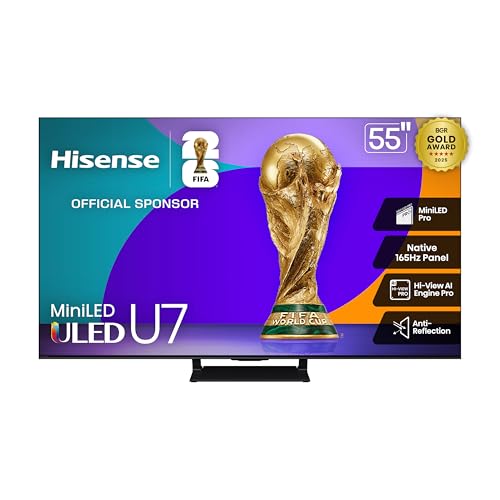
The U7 is the refresh-rate pick: its title states a native 165Hz panel with VRR up to 288, the highest motion figures in this guide. The bullets describe Mini-LED Pro with up to 3000 nits of peak brightness and up to 3000 local dimming zones, and those up-to figures are series maxima in the maker’s wording, kept as up-to claims here rather than measurements of this set. Full Array Local Dimming Pro, Dolby Vision IQ with Atmos, HDR10+, IMAX Enhanced and a 2.1.2-channel surround system complete a specification aimed squarely at fast content.
Specs
- Screen: 55-inch class (54.6 inches stated), 4K, Mini-LED ULED QLED per fields
- Refresh rate: native 165 Hz per title and fields
- VRR: up to 288; VRR range 48Hz-165Hz per bullets
- Brightness: up to 3000 nits peak per bullets (series maximum wording)
- Dimming zones: up to 3000 per bullets (series maximum wording)
- Dimming: Full Array Local Dimming Pro per fields
- HDR: Dolby Vision IQ, HDR10+ per title and fields
- Audio: 2.1.2-channel surround; Dolby Atmos per title
- Platform: Google TV per title
- Engine: Hi-View AI Engine Pro per listing
- Dimensions: 3 x 48.3 x 28.1 inches per fields
- Model: 55U75QG, 2025 per listing
Best for: Console and PC gamers who want the highest stated refresh and VRR figures, plus strong HDR format support for films.
Watch out for: The brightness and dimming-zone numbers are the maker’s up-to series figures, not measured values for the 55-inch set, and the listing’s weight fields conflict, so neither is treated as settled here.
Samsung QLED Q60D 55-Inch 4K TV
The Q60D is Samsung’s entry QLED line, and its captured spec table lists the brand’s colour story: Dual LED, 100% Color Volume with Quantum Dot, Quantum HDR and a Quantum Processor Lite 4K, with Motion Xcelerator for smoother action and Object Tracking Sound Lite from a 2-channel speaker system. The title adds a slim design, the Samsung Gaming Hub and Alexa built in. Two facts are deliberately absent from this entry: the captured fields never name the smart platform’s operating system, and no refresh rate was captured, so neither is asserted here.
Specs
- Screen: 55 inches, 4K, QLED per title and fields
- Colour: 100% Color Volume with Quantum Dot per fields
- Backlight tone: Dual LED per fields
- HDR: Quantum HDR per fields
- Processor: Quantum Processor Lite 4K per fields
- Motion: Motion Xcelerator per fields
- Audio: Object Tracking Sound Lite; 2-channel speakers per title and fields
- Features: Gaming Hub and Alexa built-in per title; slim design per title
- Dimensions: 8.8 x 48.5 x 29.4 inches per fields
- Model: QN55Q60DAFXZA, 2024 per listing
Best for: Samsung households that want the QLED colour story and Gaming Hub in the brand’s entry QLED line.
Watch out for: Confirm the refresh rate and the smart platform field on the live listing before buying, since neither was present in the captured fields used for this guide.
Samsung Crystal UHD DU7200 55-Inch 4K TV
The DU7200 is Samsung’s entry Crystal UHD line, a Direct LED set whose listing states a 60 Hz refresh rate, HDR10 and Hybrid Log Gamma support and the Crystal Processor 4K with 4K upscaling. PurColor, Mega Contrast and a Contrast Enhancer handle the picture story, while Object Tracking Sound Lite and Q-Symphony cover audio from a 2-channel system (one field claims more channels; the speaker description governs). The operating system is stated here, unlike its Q60D sibling: Tizen, with Smart View mirroring, three HDMI ports and one USB port.
Specs
- Screen: 55-inch class (54.6 inches stated), 4K, LED with Direct LED backlight per fields
- Refresh rate: 60 Hz per fields
- HDR: HDR10 and Hybrid Log Gamma per fields
- Processor: Crystal Processor 4K with 4K upscaling per fields
- Colour: PurColor per fields
- Motion: Motion Xcelerator per fields
- Audio: Object Tracking Sound Lite, Q-Symphony; 2-channel per speaker description
- Platform: Tizen per fields; Smart View mirroring per fields
- Ports: 3 HDMI; 1 USB per fields
- Mount: VESA 200 x 200 mm per fields
- Model: UN55DU7200FXZA, 2024 per listing
Best for: Everyday viewing households that want Samsung’s entry 4K set with a stated platform, upscaling and Q-Symphony soundbar pairing.
Watch out for: One field lists 5.1 audio channels against the speaker description’s 2-channel figure; the description governs, so plan sound on a 2-channel base or a Q-Symphony soundbar.
LG UT75 55-Inch LED 4K TV
The UT75 is LG’s entry UHD LED line: a Direct LED 4K panel at 60 Hz with HDR10 and HLG support, driven by the alpha 5 AI Processor 4K Gen7. The description specifies webOS 24 with more than 300 free LG Channels, a Game Optimizer and GeForce NOW included, with the footnotes that a subscription and controller are required for the gaming service. Connectivity runs to three HDMI and two USB ports with AirPlay 2 mirroring, and audio is a down-firing 2.0-channel AI Sound system at 20 watts. Alexa is built in per the title.
Specs
- Screen: 55 inches, 4K, LED with Direct LED backlight per fields
- Refresh rate: 60 Hz per fields
- HDR: HDR10, HLG per fields
- Processor: alpha 5 AI Processor 4K Gen7 per fields
- Platform: webOS (webOS 24 per description); 300+ free LG Channels per description
- Gaming: Game Optimizer; GeForce NOW included per description (subscription and controller required)
- Ports: 3 HDMI; 2 USB per fields
- Mirroring: AirPlay 2 per fields
- Audio: AI Sound, down firing, 2.0 channel, 20 watts per fields
- Mount: VESA 200 x 300 mm per fields
- Model: 55UT7570PUB, 2024 per listing
Best for: Streaming-first households that want webOS, free channels and AirPlay 2 in an entry 4K set.
Watch out for: The listing’s brightness and contrast fields are corrupted or vague, so both are omitted here; one field also muddles the USB version split, and the port count of two is the figure the fields support.
Which One Fits Your Situation
A gamer with a high-refresh console or PC
Take the Hisense U7 for its stated native 165Hz panel and VRR up to 288, or the TCL QM7K at 144Hz with Game Accelerator 240 VRR and four HDMI ports. Both listings support the fast panels modern consoles and graphics cards can feed, and the TCL’s extra HDMI socket matters in a setup where a console, a PC and a streaming box all compete for inputs.
A film watcher who streams across many services
Take the TCL QM7K: Dolby Vision, HDR10+ and HLG together cover the widest format spread here, with Mini-LED local dimming behind dark scenes. Rival dynamic formats live in different streaming libraries, so carrying both means the set rarely falls back to a lesser version of a film, and the Google TV platform keeps the apps for those libraries in one place.
A Samsung household adding a second room set
Take the Q60D for the QLED colour story and Gaming Hub, or the DU7200 if you want the platform stated plainly as Tizen with Q-Symphony for a Samsung soundbar. Both sit in Samsung’s entry tiers, so expectations should be set by their listings rather than by the flagship sets in the same showroom, and both state 55-inch class panels for the same wall or stand.
A streaming-first living room with Apple devices
Take the LG UT75 for webOS 24, its free channel line-up and AirPlay 2 mirroring, in the entry tier of LG’s range. The 300-plus free channels stated in its description cover casual viewing without another subscription, and AirPlay 2 lets iPhones and iPads put photos and video on the big screen without extra hardware in the cabinet.
Common Mistakes
- Treating a maker’s up-to brightness or zone figure as a measured value for the 55-inch set, when the listing’s own bullets frame them as series maxima.
- Assuming every Samsung set’s platform and refresh rate from the brand’s reputation, when one listing here states Tizen and 60 Hz and the other states neither in its captured fields.
- Quoting the TCL QM7K’s title audio brand over its spec fields, when two fields name a different audio partner and the fields govern.
- Counting ports from a range overview instead of the model’s own fields, since HDMI and USB counts differ between these five listings.
- Comparing these sets against flagship lines on panel figures alone, when their listings position them as the step-down tiers where the value argument lives.
Frequently Asked Questions
Are all five televisions the same size?
Yes. Every pick is a 55-inch-class set, and two listings state the measured diagonal as 54.6 inches, which is the standard pairing for the class. Keeping one size across the guide makes the panel, refresh and platform differences the whole comparison.
Which TV is best for gaming?
On stated figures, the Hisense U7: a native 165Hz panel and VRR up to 288 lead this group. The TCL QM7K follows with 144Hz, Game Accelerator 240 VRR and four HDMI ports for multiple consoles. The two entry sets state 60 Hz, and the Q60D’s captured fields state no refresh figure at all, so check that one live before gaming on it.
Which sets support Dolby Vision?
The TCL QM7K lists Dolby Vision among its HDR formats, and the Hisense U7 lists Dolby Vision IQ. The Samsung and LG sets here list HDR10 and HLG families instead, per their captured fields. Which set serves you depends on the streaming libraries you use, since the dynamic formats are carried by different services and rarely by the same film.
Why is no price comparison given for an under-800 guide?
The band is argued from line positioning: each set is its maker’s step-down tier below a flagship line, as the listings’ own model ladders show. Prices move; the tier a model occupies in its range is the stable fact, and the specifications carry the comparison.
More from Amazon
Programs that pair well with the guide above. Offers and eligibility are set by Amazon and may change.
Free shipping on eligible items, Prime Video and more. Eligible new members can start with a free trial.
Start a Prime free trialAd-free music streaming. Eligible new subscribers can start with a free trial.
Try Music Unlimited freeA Prime membership for ages 18-24 with a trial period. Eligibility is set by Amazon.
See Prime for Young AdultsAudiobooks and podcasts to listen to on the go. Eligible new members can start with a free trial.
Try Audible freeAs an Amazon Associate we earn from qualifying purchases.
Write Your Review
No reviews yet. Be the first to share your experience!