

Key takeaways
- Frequency range. A 3-inch built-in driver typically starts to roll off at roughly 100 to 150 Hz. A pair of 4-inch to 5-inch powered bookshelf speakers reaches down to about 55 to 60 Hz.
- Stylus and cartridge quality. Many budget all-in-ones use basic ceramic cartridges with a heavier tracking force. That increases record wear. Better turntables use a magnetic cartridge, such as the Audio-Technica AT3600L class or the AT-VM95 family, with replaceable styluses and lower tracking force.
- Upgradeability. A turntable plus speakers lets you replace one part at a time. An all-in-one is replaced as a whole.
The best record player with speakers depends on what you value. For convenience, an all-in-one suitcase or cabinet player from Victrola or Crosley works out of the box. For better sound, a belt-drive turntable without speakers, such as the Audio-Technica AT-LP60X family, paired with a small powered speaker pair beats every built-in speaker design. This guide sorts the options by how you will actually use the player, and it covers the one detail that surprises most buyers: built-in speakers are the weakest part of an all-in-one.
The analysis below is based on manufacturers’ published specifications and published professional reviews, not on personal bench work. Where a model’s details vary by version or region, it is described by type.
Our top picks



As an Amazon Associate we earn from qualifying purchases at no extra cost to you.
Choose your path first
| You want | Best type | Examples | Price tier |
|---|---|---|---|
| Plug in and play, gift for a beginner | All-in-one with built-in speakers | Victrola Journey and Eastwood, Crosley Cruiser | Entry |
| Furniture-style player with CD, radio, cassette | Multimedia cabinet player | Victrola Nostalgic 6-in-1 class | Mid |
| Best sound without a hi-fi system | Turntable plus powered speakers | Audio-Technica AT-LP60X plus Edifier R1280T/DB | Mid |
| Bluetooth to wireless speaker | Bluetooth turntable | Audio-Technica AT-LP60XBT, AT-LP60XSPBT bundle | Entry to mid |
| Long-term upgrade path | Hi-fi belt-drive turntable | Fluance RT81 and RT85 families | Mid to premium |
The honest trade-off: built-in speakers versus separate speakers
Built-in speakers are small, typically 2 to 3 inches and driven by a few watts per channel, and they sit in the same box as a spinning platter. Sound from those speakers travels through the cabinet and plinth and into the tonearm, which causes a muddy, boomy sound and sometimes skipping at higher volume. Separate speakers solve both problems because they sit on a different surface from the record.
Three differences are worth knowing:
- Frequency range. A 3-inch built-in driver typically starts to roll off at roughly 100 to 150 Hz. A pair of 4-inch to 5-inch powered bookshelf speakers reaches down to about 55 to 60 Hz.
- Stylus and cartridge quality. Many budget all-in-ones use basic ceramic cartridges with a heavier tracking force. That increases record wear. Better turntables use a magnetic cartridge, such as the Audio-Technica AT3600L class or the AT-VM95 family, with replaceable styluses and lower tracking force.
- Upgradeability. A turntable plus speakers lets you replace one part at a time. An all-in-one is replaced as a whole.
If you only have a handful of records and want something that looks nice and works immediately, an all-in-one is a reasonable choice. If you plan to build a collection, spending the same budget on a turntable and speakers pays off.
Best record players with speakers: the picks
Victrola Journey: best portable suitcase player
Spec line: suitcase-style record player with built-in stereo speakers, 3-speed platter (33 1/3, 45 and 78 RPM), Bluetooth input, headphone jack, and a carry handle.
Best for: students, small apartments and first-time buyers who want a self-contained and good-looking player.
Skip if: you care about record care or sound quality.
- Pro: simple, portable and available in many colors.
- Pro: Bluetooth input lets the case play streaming audio.
- Pro: 78 RPM support for older shellac records, though those need a special stylus for best results.
- Con: small speakers and light tonearm limit bass and accuracy.
- Con: the stylus and cartridge are basic, and replacements are limited.
Victrola Eastwood and similar Bluetooth suitcase models: best value for casual listening
Spec line: suitcase-style 3-speed player with built-in speakers, Bluetooth, and an auxiliary input. Models vary by year, so check the current listing for details.
Best for: kids’ rooms and casual listening where records are secondary to the experience.
Skip if: you own valuable or rare records.
- Pro: low cost and easy setup.
- Pro: includes an auxiliary input for phones and tablets.
- Pro: compact and light.
- Con: tracking force is often high, so records wear faster.
- Con: speaker bass is thin.
Victrola Nostalgic 6-in-1 style cabinet players: best multimedia furniture piece
Spec line: wood-effect cabinet with a turntable on top, Bluetooth, CD player, cassette player, FM radio, aux input and built-in speakers.
Best for: people who own a mix of formats (vinyl, CDs, cassettes) and want one piece of furniture to play all of them.
Skip if: you want a single great format; the cassette and CD mechanisms are mid-grade.
- Pro: plays many formats from one unit.
- Pro: larger cabinet gives somewhat fuller sound than a suitcase.
- Pro: looks like furniture rather than gear.
- Con: takes up space.
- Con: more parts means more that can fail over time.
Crosley Cruiser and Voyager families: best style-first portable players
Spec line: portable suitcase players with built-in speakers, 3-speed operation and Bluetooth on newer versions. Crosley has long been among the best-known names in entry-level turntables.
Best for: first-time buyers and gifts, with color and style choices.
Skip if: you plan to build a large record collection.
- Pro: wide range of finishes and an established brand.
- Pro: simple to use and widely available.
- Pro: Bluetooth versions let you stream music.
- Con: the same limits as other suitcase players on stylus quality and tracking.
- Con: audio quality varies between models.
Audio-Technica AT-LP60XSPBT: best Bluetooth bundle with a matching speaker
Spec line: fully automatic belt-drive turntable with a replaceable stylus, 33 1/3 and 45 RPM, built-in phono preamp, Bluetooth output, bundled with a matching wireless speaker. The turntable has no built-in speakers; sound comes from the bundled one.
Best for: beginners who want a real turntable with a stylus they can replace, and who like a wireless speaker they can move around.
Skip if: you want one single box or need 78 RPM playback.
- Pro: a proper turntable with a built-in preamp and an upgrade path.
- Pro: fully automatic operation protects the record from mistakes with the tonearm.
- Pro: the Bluetooth connection allows many speakers, not just the bundled one.
- Con: the bundled speaker is small, so sound is still modest.
- Con: no 78 RPM support.
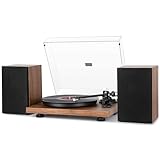
Audio-Technica AT-LP60X plus Edifier R1280T or R1280DB: best sound for the money
Spec line: the AT-LP60X is a fully automatic belt-drive turntable with a built-in preamp. The Edifier R1280T and R1280DB are 4-inch, two-way powered bookshelf speakers with analog RCA inputs, and the DB adds Bluetooth.
Best for: anyone who wants noticeably better sound than any built-in speaker without learning hi-fi terms.
Skip if: you want a single unit with no extra cables.
- Pro: much wider frequency range and cleaner bass than any all-in-one.
- Pro: the turntable uses a standard replaceable stylus.
- Pro: both parts are standard and easily swapped or upgraded.
- Con: two boxes to place and wire, with a power cable for each speaker.
- Con: needs desk or shelf space.
Fluance RT81 or RT85 with powered speakers: best upgrade path
Spec line: belt-drive, wooden-plinth turntables with magnetic cartridges, with the RT85 at the premium end and the RT81 in the mid tier. Neither has built-in speakers.
Best for: people who expect to build a collection and want a turntable that will outlast the first speaker pair.
Skip if: you want a cheap gift or something that works with no extra purchases.
- Pro: better cartridges and platter give clearer, steadier sound.
- Pro: fully manual operation and a quality tonearm suit careful listeners.
- Pro: easy to upgrade the cartridge later.
- Con: needs separate speakers and sometimes a phono preamp.
- Con: higher cost.
Best by search need
Best Bluetooth record player with speakers
For built-in speakers plus Bluetooth input, Victrola and Crosley suitcase players are the simple options. For Bluetooth output to your own speaker, the AT-LP60XBT and the AT-LP60XSPBT bundle give a proper turntable with wireless connection. Note the difference: input lets a phone play through the player’s speakers, while output sends the record’s sound to a wireless speaker.
Best portable record player with speakers
Suitcase players, such as the Victrola Journey or Crosley Cruiser, are made for carrying. Check the weight and battery claim: many need mains power, and battery models tend to have shorter runtimes. Do not move the player while a record is playing, and lock the tonearm first.
Best record player under 200
With a 200 limit, you can buy any suitcase player or a turntable such as the Audio-Technica AT-LP60X, and in some markets a basic powered speaker pair at the lower end. The best use of 200 is usually the turntable plus the cheapest decent powered speaker pair you can find, because it gives better sound than any all-in-one at the same limit. If you need everything in one box, a suitcase or cabinet player fits comfortably.
How to choose: the numbers that matter
| Spec | Entry all-in-one | Turntable plus speakers | Why it matters |
|---|---|---|---|
| Speaker size | 2-3 in | 4-5 in | Larger drivers give more bass |
| Low-frequency roll-off | ~100-150 Hz | ~55-60 Hz | Kick drum and bass guitar live here |
| Cartridge | Ceramic or basic magnetic | Magnetic, replaceable | Affects record wear and detail |
| Tracking force | Often 3-5 g | Often 1.5-2.5 g | Lower force is easier on grooves |
| Speeds | 33, 45, 78 | 33, 45 on most | Only needed for 78 RPM shellac |
| Upgrade path | Replace whole unit | Replace parts | Lower long-term cost |
These are typical ranges for each class, not guarantees for a specific model.
Phono preamp and connections
A turntable with a magnetic cartridge needs a phono preamp, either built in or in the speaker or receiver. If your turntable has a built-in preamp, it can connect to any powered speaker with an RCA or aux input. If it does not, you need a phono input on the amplifier or a small separate preamp.
Belt-drive versus direct-drive
Most affordable turntables are belt-drive, where a rubber belt isolates motor vibration. That is a good choice for listening. Direct-drive models are typically used by DJs.
Worked example
You have a 150 square foot bedroom and about 40 records. An all-in-one suitcase player will be fine for the first few months. If you buy a turntable and a pair of 4-inch powered speakers, you spend roughly the same overall at the 200 mark, gain about an octave of bass, and have a turntable you can keep when your collection grows.
Care and ownership
- Replace the stylus roughly every 500 to 1,000 hours of play, or when records start to sound harsh.
- Keep the dust cover closed while playing; it reduces both dust and feedback.
- Put the turntable on a solid surface that does not vibrate with speaker bass.
- Use an anti-static brush or a carbon fiber brush before each play.
- Store records upright, not stacked, to avoid warping.
Common buying mistakes
- Buying on looks alone. A player that looks like vintage furniture can hide a ceramic cartridge and a tonearm with no counterweight adjustment. Look for a listed cartridge model and a replaceable stylus.
- Ignoring the stylus supply. If the maker does not sell a replacement stylus, the player becomes disposable once the original wears out. Audio-Technica and Fluance sell replacements for their cartridges; many generic suitcase players do not.
- Placing speakers on the same shelf as the turntable. Bass vibration travels through the shelf into the stylus and causes a low rumble or feedback. Put the turntable on a stable surface and the speakers at least a foot away, ideally on stands or a separate shelf.
- Skipping the 45 RPM check. Some second-hand and novelty players only offer one or two speeds. Make sure 33 1/3 and 45 are both listed.
- Forgetting the phono switch. If a turntable has a preamp switch, leave it on PHONO when connecting to a plain powered speaker and on LINE only when the receiver already has a phono input. A wrong setting sounds either very quiet and thin or loud and distorted.
Pairing guide: speaker size by room
| Room size | Speaker class | What to expect |
|---|---|---|
| Up to 120 sq ft (dorm, desk) | Built-in speakers or 3-inch powered desktop pair | Fine for background play, thin bass |
| 120-250 sq ft (bedroom) | 4-inch powered bookshelf pair | Balanced sound, bass down to about 55-60 Hz |
| 250-400 sq ft (living room) | 5-inch to 6.5-inch powered pair | Fuller bass, more volume headroom |
Frequently Asked Questions
Are record players with built-in speakers bad for records?
Many entry-level models use a heavier tonearm and a basic stylus, which wears records faster than a quality turntable. They are fine for new or inexpensive records, but not ideal for rare or valuable ones.
Can I add external speakers to a record player with built-in speakers?
Often yes. Many all-in-one players have an RCA or headphone output that can feed powered speakers. Check the back panel for a line output; if there is only an aux input, the player cannot send sound out.
Does a turntable need a preamp?
If it has a magnetic cartridge, the signal is too weak for a normal speaker input and needs a phono preamp. Many modern turntables, including the Audio-Technica AT-LP60X, have one built in with a switch to turn it on or off.
What speed should I use for my records?
Most albums play at 33 1/3 RPM and most singles at 45 RPM. 78 RPM is for older shellac records and needs a stylus designed for it.
Is a Bluetooth turntable worse than a wired one?
Wired connections are generally cleaner and have no delay. Bluetooth is convenient and sounds fine for casual listening, but it compresses the audio. If you have good speakers, use the wired option.
How long do record players last?
A belt-drive turntable can run for decades if the belt is replaced when it stretches and the stylus is changed on time. All-in-one players depend more on the quality of their speakers and amplifier boards, and typically last a few years of regular use.
Bottom line
If you want one box and a simple gift, pick a Victrola or Crosley suitcase player and accept the limits on sound and record wear. If you care how your records sound, buy a turntable like the Audio-Technica AT-LP60X or the AT-LP60XSPBT bundle and add a pair of powered bookshelf speakers; step up to the Fluance RT81 or RT85 if you plan to keep growing the collection. Decide on speaker size, cartridge type and upgrade path first, and the model choice becomes straightforward.
More from Amazon
Programs that pair well with the guide above. Offers and eligibility are set by Amazon and may change.
Free shipping on eligible items, Prime Video and more. Eligible new members can start with a free trial.
Start a Prime free trialAd-free music streaming. Eligible new subscribers can start with a free trial.
Try Music Unlimited freeA Prime membership for ages 18-24 with a trial period. Eligibility is set by Amazon.
See Prime for Young AdultsAudiobooks and podcasts to listen to on the go. Eligible new members can start with a free trial.
Try Audible freeAs an Amazon Associate we earn from qualifying purchases.



Write Your Review
No reviews yet. Be the first to share your experience!